


9 Quality Control Mistakes Importers Make and How to Avoid Them
Sourcing products from China can be one of the most profitable business decisions you make or one of the most expensive mistakes. The difference often comes down to one thing: quality control. Yet despite its importance, quality control (QC) remains one of the most misunderstood and underinvested areas in global sourcing.
Whether you're importing electrical accessories, construction materials, hardware or industrial components, the same patterns of failure appear again and again. Defective shipments. Rejected containers. Emergency reorders. Angry customers. Brand damage. And at the root of most of these disasters? A preventable QC mistake made early in the process.
This guide breaks down the nine most common quality control mistakes importers make and more importantly, exactly how to fix them.
Mistake #1: Are You Relying Only on Final Inspection?
This is the single most widespread mistake in importer quality programs and arguably the costliest. Many buyers believe that ordering a final random inspection (FRI) before shipment is enough to protect them. It isn't.
By the time a final inspection takes place, the entire production run is already complete. If a critical defect exists; wrong material, incorrect dimensions, a systematic safety failure, it exists across thousands of units. Your options at that point are grim: reject the shipment and delay your delivery, negotiate a partial rework at extra cost or accept the risk and ship anyway.
The fix is to adopt a layered QC approach. This means inspecting at multiple stages: before production begins (supplier audit and golden sample approval), during production at around 20-30% completion (known as a DUPRO or During Production Inspection) and at the final stage. Each layer catches different types of problems and dramatically reduces the cost of fixing them. A defect caught during production costs a fraction of what it costs to manage post-shipment.
Read more: Caught in the Middle: How During Production Inspection Safeguards Your Supply Chain
Mistake #2: Are You Choosing Suppliers Based on Price Alone?
Price pressure is real and every importer feels it. But consistently choosing the cheapest factory without evaluating quality capability is a strategy that almost always backfires. Low-price factories frequently compensate for their thin margins by cutting corners substituting cheaper raw materials, skipping quality checks, outsourcing to unauthorized subcontractors or rushing production timelines.
The result? You save 8% on unit cost and lose 30% of the shipment to defects.
Supplier selection should include a formal qualification process: a factory audit that assesses production capacity, quality management systems, equipment condition, workforce stability and compliance history. Some importers even request trial orders with enhanced inspection before committing to a full production run. The goal is not to find the cheapest supplier but the most reliable one at a fair price.
Read more: 5 Signs Your Factory Audit Process Needs Improvement
Mistake #3: Are You Using Generic, One-Size-Fits-All Checklists?
A quality checklist is only as useful as its specificity. Many importers or the QC companies they hire use generic checklists that cover broad categories of inspection criteria without drilling into the product-specific details that actually matter.
For example, a generic checklist might flag "dimensional conformance" without specifying the critical tolerance thresholds for a particular electrical fitting. It might check "packaging integrity" without knowing that your specific product requires double-wall cartons with corner protectors. It might confirm "product appearance" without knowing that a hairline crack on a load-bearing component is a safety-critical defect, not a cosmetic one.
Product-specific checklists, built in collaboration between the importer and the QC team, are far more effective. They should define clear accept/reject criteria for every checkable attribute, list any applicable safety or certification requirements, specify AQL levels by defect category and flag any known recurring issues with that factory or product type.
Mistake #4: Are Your Technical Specifications Vague or Incomplete?
A factory can only produce to the level of detail you provide. If your technical specifications leave gaps, undefined tolerances, missing material grades, unspecified surface finish standards, absent performance requirements, the factory will fill those gaps in their own way. And their way is almost never your way.
Vague specs are one of the leading causes of disputes between importers and suppliers. The factory believes they delivered what was asked for. The importer believes they received something completely wrong. Both may be technically correct, because the specification never made the requirement clear.
The fix requires investing time upfront. Before production begins, prepare a detailed technical file that includes: engineering drawings with tolerances, approved material specifications, surface finish and appearance standards, functional performance requirements, applicable safety certifications and a golden sample that represents the accepted standard. This document becomes the contract between you and your factory and the basis for every inspection that follows.
Read more: Inspection First, Regret Never: Smart Brands’ Playbook to Avoid Quality Surprises
Mistake #5: Are You Ignoring During Production Inspections?
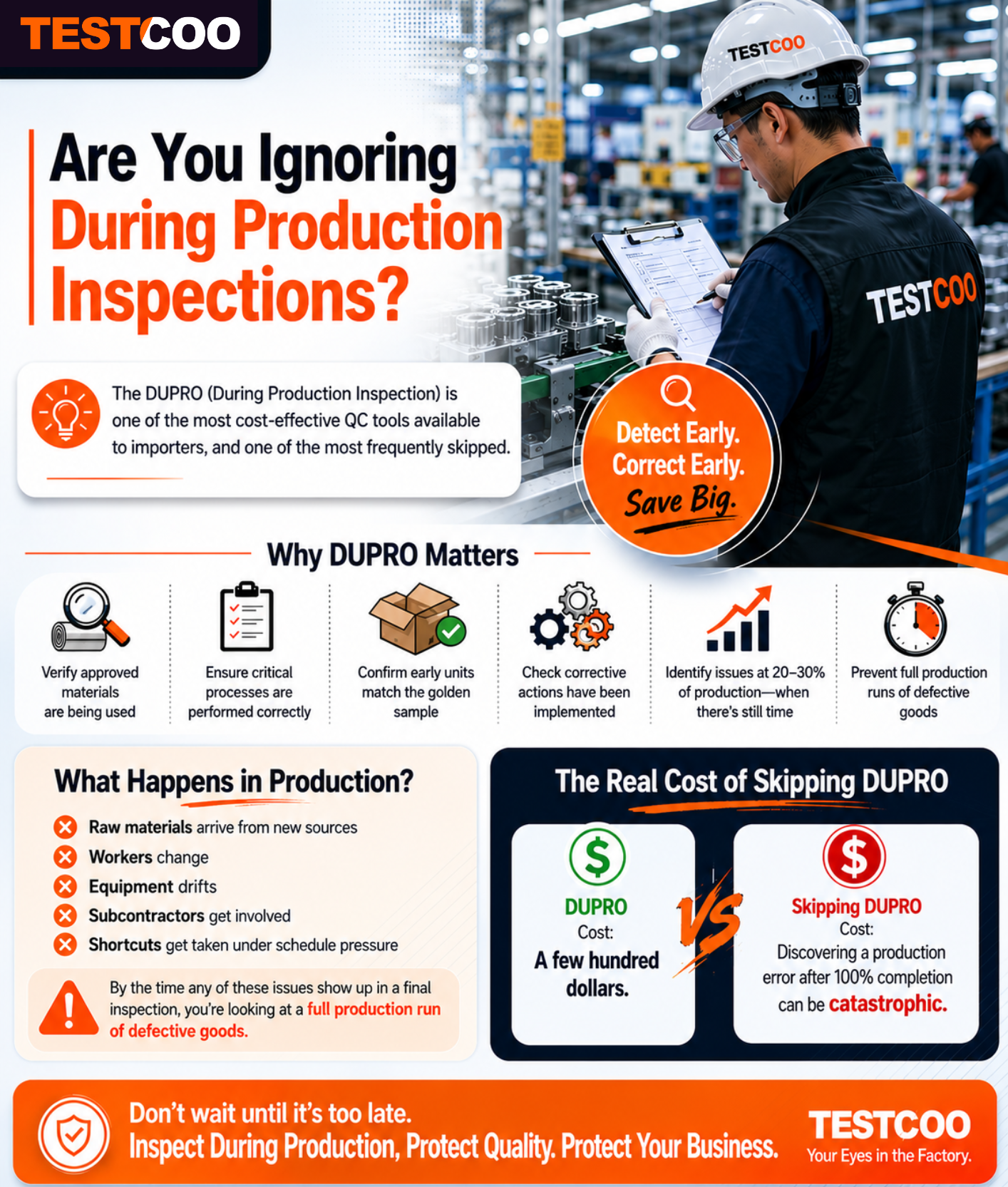
The DUPRO (During Production Inspection) is one of the most cost-effective QC tools available to importers and one of the most frequently skipped. Most importers assume that if the pre-production sample was approved, production will follow accordingly. Factories know better.
Production is a dynamic environment. Raw materials arrive from new sources. Workers change. Equipment drifts. Subcontractors get involved. Shortcuts get taken under schedule pressure. By the time any of these issues show up in a final inspection, you're looking at a full production run of defective goods.
A DUPRO conducted at 20-30% of production completion lets you verify that the process is being followed correctly while there is still time to correct it. You can check that approved materials are being used, that critical processes are being performed correctly, that early units match the golden sample and that any previous corrective actions have been implemented. The cost of a DUPRO is typically a few hundred dollars. The cost of discovering a production error after 100% completion can be catastrophic.
Read more: During Production Inspection: A Complete Guide to Smarter Quality Control
Mistake #6: Are You Failing to Follow Up on Root Causes After a Defect?
Defects get found. Shipments get reworked or rejected. And then nothing changes. The importer moves on, the factory moves on and the same defects appear three months later in the next shipment. This cycle of repeated failures is one of the clearest signs that a QC program lacks a corrective action process.
When a defect is identified, the response should not end with counting the number of failed units. It should trigger a structured root cause analysis: Why did this defect occur? At what stage in production? Due to what input - material, process, operator error? What specific change will prevent recurrence? By when and verified how?
This process is known as CAPA (Corrective and Preventive Action) and it is the mechanism by which a QC program actually improves over time rather than simply documenting the same failures repeatedly. Importers who implement CAPA tracking with their suppliers see measurable reductions in defect rates across consecutive shipments.
Read more: How to Prevent Garment Defects in Apparel and Textile Industry
Mistake #7: Do You Have No Vendor Performance Scoring System?
If you're managing multiple suppliers which most importers are and you have no way of comparing their quality performance, you're flying blind. You may be giving equal business to a consistently excellent factory and a chronically problematic one, simply because you have no structured data to tell the difference.
Vendor scorecards solve this problem. By tracking key performance indicators across every shipment - defect rate, pass/fail ratio at final inspection, DUPRO findings, on-time delivery, CAPA compliance, you build a factual picture of each supplier's reliability over time. This data enables smarter sourcing decisions: rewarding high-performing suppliers with more volume, placing higher-risk suppliers under enhanced QC scrutiny and making evidence-based decisions to replace underperforming factories.
Scorecards also change supplier behavior. When factories know their performance is being tracked and measured, quality accountability becomes real rather than aspirational.
Read more: 7 Types of Factory Audits that Help to Evaluate Your Supplier
Mistake #8: Are You Applying the Same QC Standards Across All Suppliers?
Not all suppliers carry the same level of risk and applying identical QC intensity to every factory regardless of their track record is both inefficient and ineffective. A factory with three years of clean inspection history and consistent quality output does not need the same level of intervention as a new supplier on their first order or a factory that failed two inspections in the last twelve months.
Risk-based inspection allocation where QC resources are concentrated on higher-risk suppliers, new vendors and complex or safety-critical products allows importers to maximize the value of their QC budget. Lower-risk suppliers can be maintained on a lighter inspection schedule (such as periodic audits and reduced AQL sampling) while higher-risk situations receive full DUPRO plus FRI coverage.
This approach also scales more sustainably as your supplier base grows. Rather than linearly increasing QC costs as you add vendors, you're deploying resources strategically based on where the actual risk lies.
Read more: ASTM vs. ISO: Key Differences in Global Standards for Quality & Compliance
Mistake #9: Are You Overlooking Loading Supervision?
Many importers conduct thorough pre-shipment inspections and then pay no attention to what actually goes into the container. Loading supervision is the final checkpoint in the QC chain and skipping it leaves a significant gap open.
Loading supervision verifies that the container is in acceptable condition before loading begins, that the correct products and quantities are loaded, that cartons are not damaged or wet, that the loading method protects product integrity and that the container seal number is accurately recorded. Without this step, a clean final inspection result can be undermined by a rushed or careless loading process and by the time the container arrives at destination, the damage is already done.
This is particularly relevant for construction products, which are often bulky, heavy and sensitive to moisture or physical impact during transit. An investment in loading supervision is a small insurance premium against a very avoidable type of loss.
Read more: Container Loading Inspection for Safer Shipments
Frequently Asked Questions
Q1: What is the most important quality control step when importing from China?
There is no single most important step effective quality control requires a layered approach covering pre-production, during production, final inspection and loading. That said, if importers had to prioritize one often-overlooked step, it would be the During Production Inspection (DUPRO). This is where defects are most cost-effectively caught and corrected, before they become locked into an entire production run. Most importers over-invest in final inspection and under-invest in production-stage oversight, which is precisely where the biggest quality risks actually develop.
Q2: How do I know if my supplier in China is reliable before placing a large order?
The best way to assess supplier reliability before committing to a large order is through a formal factory audit conducted by a qualified third-party inspection company. A good audit evaluates production capacity, quality management systems, equipment condition, raw material controls, workforce stability and compliance with relevant certifications. Beyond the audit, requesting a trial order with enhanced inspection including a DUPRO and final inspection gives you real production data rather than just a sample prepared under ideal conditions.
Q3: What is AQL and how should importers use it?
AQL stands for Acceptable Quality Level. It is an internationally recognized statistical sampling methodology that defines the maximum number of defective units considered acceptable in a sample, based on the total order quantity. Importers use AQL tables to determine how many units to inspect from a shipment and how many defects classified as critical, major or minor are acceptable before a shipment is rejected. Common AQL levels are 0 for critical defects (zero tolerance), 2.5 for major defects and 4.0 for minor defects, though these should be calibrated based on the specific product and its end-use risk.
Q4: Is it worth hiring a third-party QC company or should I manage inspections directly?
For most importers, third-party QC companies offer a significant advantage: an established inspector network across China, standardized inspection methodologies, local language capability and neutrality in the supplier relationship. Managing inspections directly is possible but requires having trusted, qualified personnel on the ground which is a significant operational and cost overhead. Third-party QC is particularly cost-effective for importers without a permanent China presence and it provides documented, photographic evidence of product condition that is invaluable in supplier dispute resolution.
Q5: How can I reduce defect rates across multiple suppliers without dramatically increasing my QC budget?
The most efficient approach is risk-based inspection allocation combined with vendor scorecards. By scoring each supplier on their historical quality performance - defect rates, inspection pass/fail ratios, CAPA compliance, you can identify which factories need intensive QC coverage and which have earned a lighter-touch approach. Concentrating inspection resources on higher-risk vendors and new suppliers, while maintaining periodic audits for proven ones, allows you to improve overall quality outcomes without proportionally increasing costs. Technology also helps: real-time reporting platforms and trend analysis across your supplier base make it easier to spot quality deterioration early, before it becomes a shipment-level problem.
The Bottom Line
Quality control is not a single event. It is a system and like any system, it works best when every component is in place. Fixing one mistake in isolation helps, but the importers who consistently receive excellent products from China are the ones who have built a comprehensive, multi-stage QC program grounded in clear specifications, structured inspections, supplier accountability and data-driven decision making.
The cost of getting quality control right is modest. The cost of getting it wrong in returns, delays, damaged relationships and lost business is anything but.
Testcoo is a leading 3rd party inspection company in China, which is fully accredited by ISO9001, ISO 27001, CNAS17020 and AQSIQ. We provide a comprehensive QC service such as product inspection service (IPC, DUPRO and FRI), loading supervision, sample picking, supplier audit, certification and testing.

Free Sample Report Performance Quality Control
Download a sample report to keep control of your supply chain!

Featured Articles
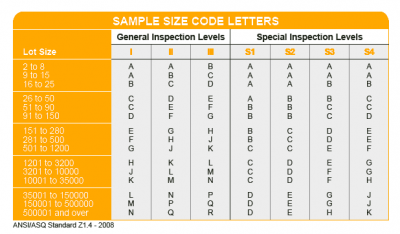 AQL Table | How to Read It
 TOP 10 Common Defects in Garments Quality Inspection
 Product Packaging and Shipment Label requirements for Amazon FBA
 What Is ASTM-F2413-18? Protective Footwear Standard
 How to Conduct Third-Party Quality Control Inspections for Electric Scooters
 SMETA Audit-What is SMETA Audit?
 TESTCOO Supplier Verification/Certification Service SLCP, Higg FEM, GRS, GOTS
 Quality Control Inspection Company in China
 What is Quality Inspection? A Complete Guide
 Guidelines for Product Inspection in India
Category
- Production Inspection Service
- Factory Audit
- Softline Inspection
- Hardline Inspection
- Electrics Inspection
- Certification
- Checklist
- Manufacturers
- Quality Assurance Basics
- Products Recall
- AQL
- Guidence and Standard
- News
- Supplier Management
- Amazon
- Protective Equipment
- e-commerce quality control
- Indian Manufacturing
- Soft Goods Quality Control
- Supply Chain Management
- Supply Chain Resilience
- E-Commerce Quality Control
- ISO 2859
- Supply Chain Optimization
- Garment Industry
- Higg Index