


During Production Inspection in the Philippines: Mitigating 2026 Production Risks
The Philippines remains a strategic manufacturing hub for global brands in apparel, electronics, furniture and automotive components, driven by its skilled workforce and ASEAN market access. However, 2026 brings heightened production risks including updated chemical regulations, tariff policy shifts and evolving quality standards that can disrupt supply chains and lead to non-compliance. During Production Inspection (DUPRO), conducted when 20-50% of manufacturing is complete, acts as a proactive safeguard to identify defects, process deviations and compliance gaps early before they escalate into costly rejections or shipment delays.
This article addresses critical questions about DUPRO in the Philippine context, covering its core value, key risk mitigation strategies, 2026 regulatory updates, implementation standards and how third-party inspection services enhance quality control for exporters and manufacturers.
What Is DUPRO in the Philippines and Why Is It Essential for 2026?
DUPRO in the Philippines is a targeted quality control process that evaluates production progress, material compliance and process adherence during active manufacturing. It is uniquely essential in 2026 due to the country’s recent regulatory changes, including stricter chemical control measures and industrial policy updates that raise compliance stakes for exporters. Unlike pre-shipment inspections that occur too late to address systemic issues, DUPRO enables real-time corrections to material defects, process inefficiencies or regulatory non-compliance.
This proactive approach directly aligns with the needs of manufacturers navigating the Philippines’ diverse production landscape, from small workshops to large industrial facilities and helps mitigate the amplified risks of 2026’s regulatory environment. By integrating DUPRO into quality management systems, businesses protect their brand reputation and ensure seamless market access.
Read More:Southeast Asia’s Booming Industries and the Growing Need
What Are the Core Objectives of Philippines DUPRO in 2026?
The core objectives of DUPRO in the Philippines for 2026 reflect both global quality control best practices and local regulatory priorities. These objectives include verifying that raw materials comply with updated chemical restrictions such as the DENR-EMB’s benzene ban, ensuring production processes align with ASEAN industrial standards and Executive Order 156’s manufacturing guidelines, identifying early-stage defects to reduce rework costs and providing transparent production visibility to stakeholders.
Each objective directly addresses 2026’s key risk areas, such as non-compliance with chemical control orders or deviations from automotive sector regulations. By focusing on these goals, DUPRO helps manufacturers maintain consistent quality while adhering to the Philippines’ evolving regulatory framework, supporting both local market success and international export compliance.
When Should Manufacturers Conduct DUPRO in the Philippines?
Manufacturers in the Philippines should conduct DUPRO when 20-50% of production is complete, a timeframe that balances meaningful sample assessment with sufficient correction time—especially critical in 2026’s regulatory environment. For high-volume orders like apparel or electronic components, inspecting at 30% completion provides a representative sample size while allowing adjustments for compliance issues such as restricted chemical use. For complex products subject to Executive Order 156’s automotive regulations, earlier inspections at 20% completion help address technical deviations before they impact large production runs.
Low-volume or custom items may benefit from two-phase DUPRO: initial inspection at production startup to verify material compliance and mid-cycle inspection to ensure process consistency. This timing strategy ensures that DUPRO effectively mitigates 2026’s unique risks, from chemical non-compliance to process inefficiencies.
What Does the 2026 DUPRO Process Entail in the Philippines?
The 2026 DUPRO process in the Philippines follows a structured, regulatory-aligned framework to deliver actionable insights. It begins with pre-inspection preparation, where inspectors align with manufacturers on product specifications, 2026 regulatory requirements (including benzene restrictions and EO 156 guidelines) and quality standards such as AQL 2.5. On-site production assessment follows, with inspectors verifying progress, workflow efficiency and adherence to standard operating procedures.
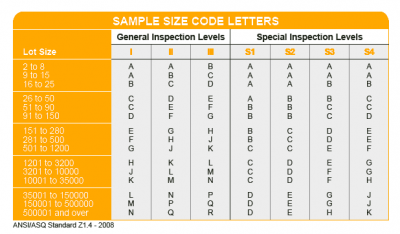
Sample selection adheres to ANSI/ASQ Z1.4 statistical methods, ensuring representative evaluation based on lot size. Physical and functional testing includes chemical compliance checks for restricted substances, dimensional accuracy verification and performance testing per relevant standards.
Defects are classified as Critical (safety or regulatory violations), Major (usability issues) or Minor (cosmetic flaws) before a detailed report is delivered within 24 hours. This process integrates 2026’s regulatory updates into every stage, ensuring comprehensive risk mitigation.
Read More: During Production Inspection (DUPRO): A Complete Guide

What Key 2026 Production Risks Does Philippines DUPRO Address?
Philippine DUPRO directly mitigates the most pressing 2026 production risks, which stem from updated regulations, supply chain volatility and process variability. These risks are particularly impactful for manufacturers targeting ASEAN and global markets where compliance with local regulations is mandatory. By addressing these specific challenges, DUPRO helps businesses avoid costly penalties, shipment delays and brand damage in 2026’s competitive landscape.
How Does DUPRO Mitigate Chemical Compliance Risks in 2026?
DUPRO effectively mitigates 2026’s chemical compliance risks, primarily driven by the DENR-EMB’s chemical control order banning benzene and benzene-containing mixtures (over 1% by volume) in applications like paints, adhesives and textiles. Inspectors verify that raw materials and production processes comply with this ban by checking material safety data sheets, conducting on-site tests for restricted substances and confirming supplier compliance with Republic Act 6969. For example, in textile manufacturing, DUPRO inspectors may test fabrics for benzene residues to ensure alignment with the chemical control order.
By catching non-compliant materials or processes early, DUPRO prevents production of banned products, avoiding fines and shipment seizures that could result from violating 2026’s chemical regulations.
Can DUPRO Address Process Deviation Risks Under 2026 Policies?
Yes, DUPRO is highly effective at addressing process deviation risks under 2026 policies such as Executive Order 156’s automotive manufacturing guidelines and ASEAN industrial standards. Process deviations—often caused by labor turnover or inadequate training—can lead to non-compliance with technical requirements, especially for regulated sectors like motor vehicle production.
DUPRO inspectors observe production lines to ensure adherence to approved processes, such as proper component assembly for automotive parts or chemical handling procedures to avoid benzene contamination. In practice, this means identifying issues like uncalibrated equipment or incorrect material mixing that could violate EO 156’s quality requirements. By correcting these deviations early, DUPRO helps manufacturers maintain compliance with 2026’s policy updates while reducing defect rates and production waste.
How Does DUPRO Manage Supply Chain Volatility Risks in 2026?
2026 supply chain volatility in the Philippines—including material shortages and inconsistent supplier quality—poses significant production risks that DUPRO effectively manages. Inspectors verify that incoming materials meet both specification requirements and 2026 regulatory standards, such as benzene-free formulations and EO 156-compliant components. For example, DUPRO checks that automotive parts suppliers adhere to the motor vehicle development program’s quality guidelines, preventing delays caused by non-compliant components.
Inspectors also assess supplier documentation to confirm material traceability and compliance with restricted substances lists. By validating material quality and regulatory compliance at the production stage, DUPRO mitigates the impact of supply chain disruptions, ensuring that manufacturers can maintain production schedules and avoid costly material replacements in 2026.
Does DUPRO Mitigate Regulatory Penalty Risks in 2026?
DUPRO significantly mitigates 2026 regulatory penalty risks in the Philippines by embedding compliance verification into active production, addressing the strict penalties associated with updated regulations. Non-compliance with 2026’s key rules—including the DENR-EMB benzene ban, BPS certification requirements and Executive Order 156—can result in fines, product seizures, imprisonment or market bans, making proactive risk mitigation critical for manufacturers. DUPRO’s structured approach directly targets these risks through four core mechanisms:
1. Chemical Compliance Validation for Benzene Ban Adherence
DUPRO inspectors verify compliance with the DENR-EMB’s 2026 chemical control order, which bans benzene and benzene-containing mixtures (over 1% by volume) under Republic Act 6969. This includes reviewing material safety data sheets, conducting on-site tests for restricted substances and confirming supplier adherence to chemical restrictions.
Violations of this ban carry penalties ranging from administrative fines (₱10,000–₱50,000) to imprisonment (6 months to 20 years) for severe offenses, with corporate officers held personally liable and foreign offenders facing deportation. By catching non-compliant materials or processes early, DUPRO prevents manufacturers from incurring these costly penalties.
2. BPS Certification and Product Compliance Verification
The Bureau of Product Standards (BPS) enforces mandatory certification for high-risk products like electronics and construction materials, with strict penalties for non-compliance. DUPRO inspects products against BPS standards, verifying label accuracy, safety performance and ongoing conformity to certified specifications.
Penalties for BPS violations include fines (₱50,000–₱1,000,000), product recalls, market blacklisting and even criminal charges for forged certifications (6 months to 3 years imprisonment). DUPRO’s mid-production checks ensure that products maintain BPS compliance throughout manufacturing, avoiding post-shipment penalties or certification revocation.
3. EO 156 Compliance for Automotive and Imported Goods
Executive Order 156 imposes strict regulations on motor vehicle manufacturing and used vehicle imports, with violations leading to registration denial, product seizures and legal liability for involved officials. For automotive manufacturers, DUPRO includes specialized checks to verify that production processes and components meet the order’s technical guidelines.
This covers assembly standards, component quality and export readiness requirements, reducing the risk of non-compliance during customs clearance or market surveillance. LTO and Customs actively enforce EO 156, with illegal registrations becoming permanently non-renewable and officials facing criminal charges for improper approvals.
4. Documentation and Process Audits for Regulatory Alignment
DUPRO includes thorough review of production documentation, ensuring alignment with all 2026 regulatory requirements. This includes verifying pre-manufacture/importation notices (required under RA 6969), BPS certification validity and compliance with labeling regulations from the Department of Trade and Industry. Failure to submit required documentation or permit inspections can result in imprisonment (6 months to 6 years) and fines (₱600–₱4,000) under RA 6969. DUPRO’s documentation audits ensure manufacturers maintain complete, up-to-date records, reducing the risk of penalties for administrative non-compliance.
By integrating these compliance checks into the production cycle, DUPRO transforms regulatory risk management from a reactive post-production task to a proactive process. This not only avoids the financial and reputational damage of penalties but also ensures seamless market access for Philippine exports in 2026’s strict regulatory environment.
What Standards and Regulations Govern 2026 Philippines DUPRO?
2026 Philippine DUPRO is governed by a combination of updated local regulations and international quality standards, reflecting the country’s commitment to both regulatory compliance and global market alignment. This dual framework ensures that inspections meet both domestic requirements and international export standards, critical for manufacturers operating in 2026’s competitive landscape.
What International Standards Apply to 2026 Philippines DUPRO?
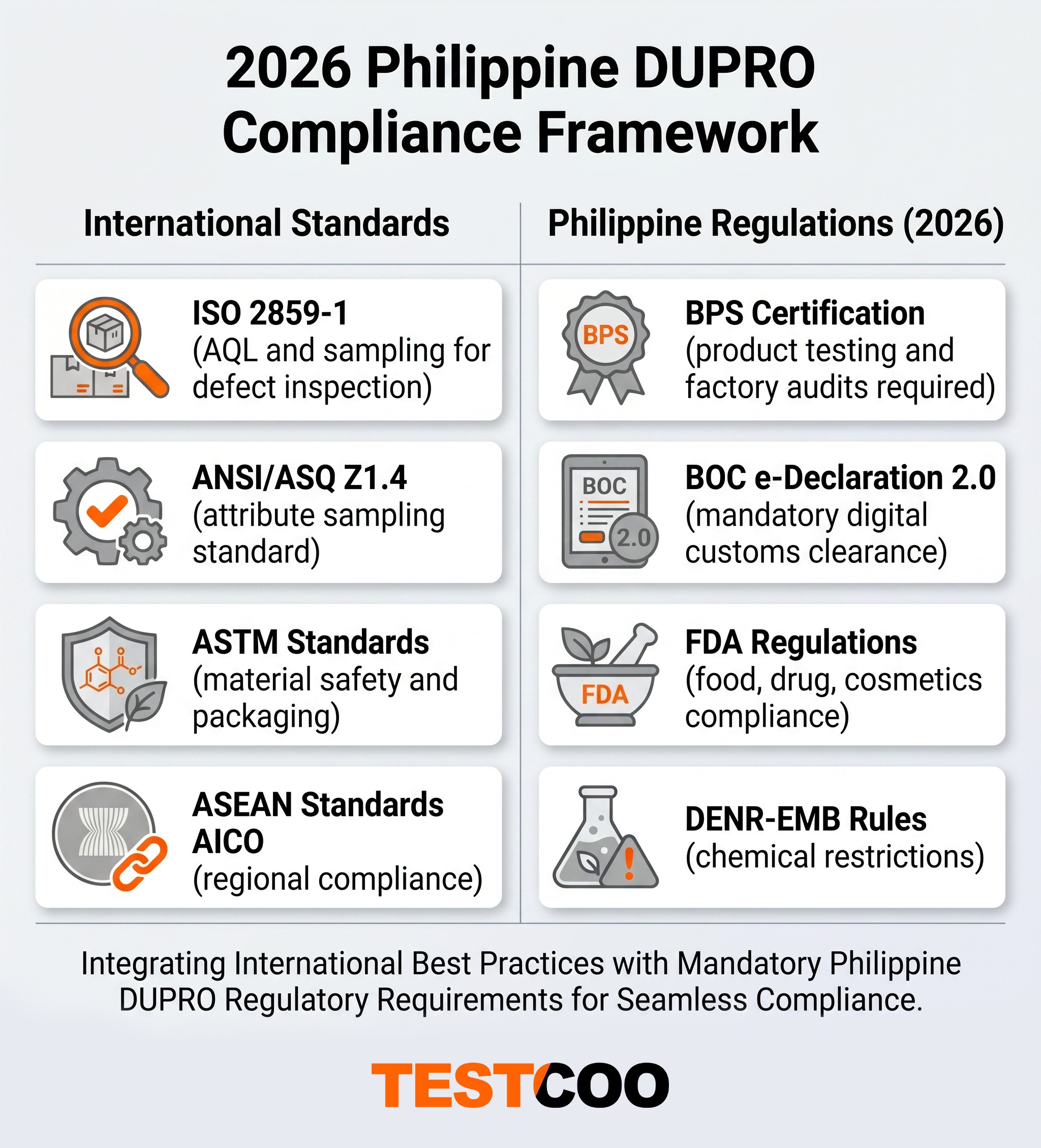
Key international standards governing 2026 Philippine DUPRO include AQL (Acceptable Quality Limit) per ANSI/ASQ Z1.4, the global benchmark for sampling and defect acceptance. ISO 9001 remains foundational for quality management systems, ensuring consistent process adherence and continuous improvement.
ASTM International standards provide specific testing protocols, such as ASTM D4169 for packaging durability and ASTM F963 for toy safety—relevant for compliance with both local and export requirements. For ASEAN-bound products, AICO (ASEAN Industrial Cooperation Agreement) standards ensure regional market access by harmonizing quality requirements across member states.
These international standards provide a consistent framework for DUPRO implementation, ensuring that Philippine manufacturers meet global quality expectations while adhering to local regulations.
What 2026 Philippines Regulations Impact DUPRO Implementation?
Several 2026 Philippine regulations directly impact DUPRO implementation, starting with the DENR-EMB’s chemical control order restricting benzene and benzene-containing mixtures under Republic Act 6969.
Executive Order 156 shapes DUPRO for the automotive sector by establishing manufacturing guidelines for motor vehicles and components. The Bureau of Product Standards (BPS) continues to mandate certification for regulated products, including electronics and construction materials, with inspection criteria integrated into DUPRO processes. The Department of Trade and Industry (DTI) regulates product labeling, requiring clear disclosure of material composition and compliance with restricted substances lists.
These regulations require DUPRO inspectors to verify chemical compliance, process adherence and documentation completeness, ensuring that inspections address both quality and regulatory requirements specific to 2026.
How Can Third-Party DUPRO Services Enhance 2026 Risk Management?
Third-party DUPRO services provide unique advantages for 2026 risk management in the Philippines, offering regulatory expertise, impartiality and local market knowledge that internal teams may lack. These services are particularly valuable for navigating 2026’s updated regulations and ensuring compliance across complex supply chains.
What Unique Value Do Third-Party DUPRO Inspectors Offer in 2026?
Third-party DUPRO inspectors deliver distinct value in 2026 through their deep understanding of updated Philippine regulations, including the benzene ban and EO 156. Their impartiality ensures objective evaluations without internal biases, critical for identifying regulatory non-compliance that internal teams might overlook. Local expertise allows inspectors to navigate regional manufacturing practices and supply chain dynamics, while specialized skills in chemical testing and regulatory verification address 2026’s unique compliance challenges.
Third-party services also provide standardized reporting aligned with international standards, ensuring that stakeholders receive clear, actionable insights. By combining regulatory expertise with quality control best practices, third-party DUPRO inspectors help manufacturers mitigate 2026’s amplified risks efficiently and effectively.
How Does Testcoo’s 2026 DUPRO Service Address Philippines Risks?
Testcoo’s 2026 DUPRO service in the Philippines is specifically designed to address this year’s unique regulatory and operational risks through tailored solutions. The service integrates 2026’s key regulatory updates—including benzene restrictions and EO 156 guidelines—into every inspection stage, with inspectors trained on the latest compliance requirements. Customized inspection plans align with product type, from automotive components to textiles, ensuring relevant testing for restricted substances and process adherence.
Testcoo’s local inspectors conduct on-site chemical compliance checks, verify material safety data sheets and assess process alignment with both local regulations and international standards. Real-time reporting delivers actionable insights within 24 hours, including corrective action recommendations for non-compliance issues. By combining regulatory expertise with global quality control best practices, Testcoo’s DUPRO service helps manufacturers navigate 2026’s challenges while maintaining product quality and compliance.
Frequently Asked Questions (FAQs)
1. Does 2026’s benzene ban require additional DUPRO testing?
Yes, DUPRO now includes benzene and restricted chemical testing for applicable products, aligning with DENR-EMB’s 2025 chemical control order implemented in 2026.
2. How does EO 156 affect DUPRO for automotive manufacturers?
EO 156 adds technical compliance checks to DUPRO, verifying component quality and production processes meet the motor vehicle development program’s 2026 guidelines.
3. What is the typical turnaround time for 2026 Philippine DUPRO reports?
Testcoo delivers comprehensive DUPRO reports within 24 hours of inspection, including regulatory compliance verification and corrective action recommendations.
4. Are third-party DUPRO services mandatory for 2026 Philippine exports?
While not mandatory, third-party DUPRO is highly recommended for 2026 exports to ensure compliance with updated regulations and avoid shipment delays.
5. What standards and regulations apply to DUPRO inspections in the Philippines in 2026?
DUPRO inspections in the Philippines in 2026 follow international standards like ISO 2859-1 and ANSI/ASQ Z1.4, along with local regulations such as BPS certification, BOC e-declaration, FDA requirements and DENR-EMB rules.
How Can 2026 DUPRO Transform Philippines Production Risk Management?
2026 DUPRO transforms Philippine production risk management by integrating regulatory compliance into proactive quality control, addressing this year’s unique challenges from benzene restrictions to EO 156 requirements. By identifying issues early, manufacturers reduce rework costs, avoid regulatory penalties and maintain consistent product quality across domestic and export markets.
Testcoo’s 2026 DUPRO service enhances this transformation through specialized regulatory expertise, local market knowledge and tailored inspection solutions that align with the Philippines’ evolving requirements.
Our certified inspectors combine deep understanding of 2026’s regulatory landscape with global quality control best practices, providing actionable insights that drive continuous improvement. Whether manufacturing automotive components, textiles or electronics, Testcoo’s DUPRO service delivers the compliance assurance and quality verification needed to navigate 2026’s risks with confidence.


Free Sample Report Performance Quality Control
Download a sample report to keep control of your supply chain!

Featured Articles
 AQL Table | How to Read It
 TOP 10 Common Defects in Garments Quality Inspection
 Product Packaging and Shipment Label requirements for Amazon FBA
 What Is ASTM-F2413-18? Protective Footwear Standard
 How to Conduct Third-Party Quality Control Inspections for Electric Scooters
 SMETA Audit-What is SMETA Audit?
 TESTCOO Supplier Verification/Certification Service SLCP, Higg FEM, GRS, GOTS
 Quality Control Inspection Company in China
 What is Quality Inspection? A Complete Guide
 Guidelines for Product Inspection in India
Category
- Production Inspection Service
- Factory Audit
- Softline Inspection
- Hardline Inspection
- Electrics Inspection
- Certification
- Checklist
- Manufacturers
- Quality Assurance Basics
- Products Recall
- AQL
- Guidence and Standard
- News
- Supplier Management
- Amazon
- Protective Equipment
- e-commerce quality control
- Indian Manufacturing
- Soft Goods Quality Control
- Supply Chain Management
- Supply Chain Resilience
- E-Commerce Quality Control
- ISO 2859
- Supply Chain Optimization
- Garment Industry
- Higg Index