


Previo en Origen (PEO) vs. Final Random Inspection (FRI): What Is the Difference
Prevailing market conditions and stringent customs laws have created a situation where procurement managers frequently confuse a standard Final Random Inspection (FRI) with a specialized Previo en Origen (PEO) inspection. While it is true that both occur at the supplier's plant before the container is loaded, their legal scope, their core operational tasks and their ultimate destinations differ entirely. Our experience managing intricate cross-border supplier audit projects confirms that understanding these exact boundaries is no longer just a quality concern; it is a critical strategic imperative that prevents costly customs delays, unexpected compliance fines and crippling supply chain bottlenecks.
What Is a Final Random Inspection (FRI) and What Does It Cover?
A Final Random Inspection (FRI), sometimes referred to in the industry as a Pre-Shipment Inspections (PSI), acts as the bedrock of standard manufacturing quality control. It is a vital risk management tool utilized by buyers to verify that their finished products meet their specific quality requirements before the goods are finalized and payment is released to the manufacturer.
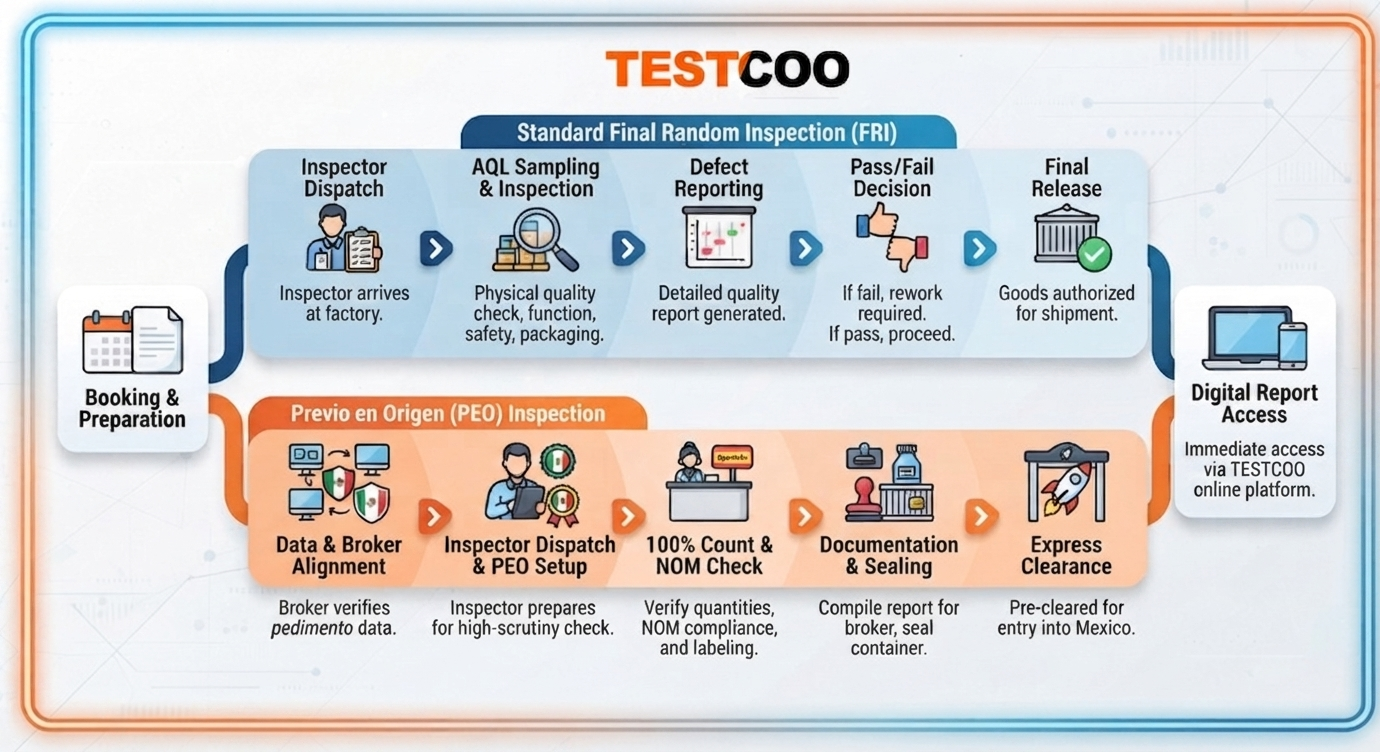
Typically, a FRI is executed when 80% to 100% of an entire production run is finished, packed and ready for shipment. At this stage, the batch is statistically representative of the total order volume. The core objective of a FRI is to answer the fundamental question: Are the goods that were produced identical in quality, quantity and function to the approved golden sample or the specifications outlined in the purchase order?
To achieve this, inspectors utilize internationally recognized statistical sampling procedures, most commonly the ISO 2859-1 standards based on AQL (Acceptable Quality Limit) tables. This method allows them to inspect a randomly selected portion of the shipment rather than every single unit, providing an accurate assessment of the overall quality without incurring the enormous cost of a 100% inspection.
Key elements of a standard FRI include:
- Defect Classification: Inspectors meticulously sort physical flaws found on the production line into minor, major and critical categories based on pre-defined criteria.
- Function & Performance Testing: Depending on the product category, inspectors perform on-site tests. This ensures that electronics power on and operate safely, textiles adhere to colorfastness and stretch requirements, or hard goods withstand designated stress and drop tests.
- Dimension & Barcode Check: Physical dimensions are verified against technical drawings and retail barcodes are scanned to ensure they are readable and accurate for point-of-sale systems.
- Packaging & Assortment Check: Inspectors verify that the correct assortment of sizes or colors is present and that master cartons are packed securely with appropriate shipping marks for international transit.
While a FRI provides an essential shield against receiving defective, broken, or non-conforming merchandise, it is fundamentally designed around general product quality assurance. It does not encompass the complex, legally binding customs statutes or the specific statutory import mandates required by the destination country's government agencies.
Read more: Final Random Inspection: Your Last Line of Defense Before Shipping | Testcoo
What Is a Previo en Origen (PEO) Inspection and How Does It Differ?
While a FRI looks at the product through the eyes of a consumer or a brand manager to ensure it looks and works correctly, a Previo en Origen (PEO) inspection shifts the focus entirely from standard product quality to strict legal and customs compliance. This specialized service is particularly critical for cross-border trade into Mexico, where it is governed by Article 42 of Mexico's Customs Law (Ley Aduanera).
The strategic shift that a PEO represents is profound. While a FRI asks, "Is this product well-made and defect-free?" a PEO inspection asks, "Does this specific cargo physically match the official import paperwork and does it satisfy every single regulatory mandate required by the destination country's customs authority?"
The ultimate goal of a PEO is not just to prevent defects, but to achieve pre-clearance status, ensuring the goods pass through the border without getting flagged for intensive, port-side examinations.
Key elements unique to a PEO inspection include:
- 100% Piece Counts & SKU Verification: Unlike the statistical sampling of a FRI, a PEO often requires a rigorous 100% physical count of every unit within the shipment, broken down precisely by SKU. This eliminates discrepancies between the physical manifest and the official import declarations (pedimento).
- Regulatory Compliance & Labeling: Inspectors conduct a deep dive into mandatory destination-specific requirements. For Mexico, this means verifying strict adherence to Official Mexican Standards (NOM), ensuring proper Spanish labeling, safety warnings and importer data are present before the goods depart.
- Customs Broker Alignment: The data gathered during a PEO is not just for the buyer; it is often fed directly to the importer's designated Mexican customs broker (agente aduanal). This real-time data verification allows the broker to pre-file the customs paperwork accurately, securing rapid clearance upon arrival at the border.
PEO vs. Final Random Inspection (FRI): Core Differences at a Glance
To make the right decision for your supply chain, it is crucial to view these two services side-by-side.
↵ ↵
↵ ↵
Feature | Final Random Inspection (FRI) | Previo en Origen (PEO) |
Primary Objective | Verify product quality, workmanship and function. | Verify legal compliance, accurate piece count and customs documentation alignment. |
Regulatory Framework | Based on the buyer's purchase order, commercial specifications and approved reference samples. | Based on the destination country's specific customs law (e.g., Mexico's Ley Aduanera, Article 42) and broker requirements. |
Sampling & Scope | Utilizes AQL statistical sampling tables to check for physical, aesthetic and functional defects. | Often involves high-scrutiny verification, sometimes up to 100%, tailored to statutory import rules. |
Labeling Focus | Checks for correct brand logos, retail barcodes and basic shipping marks. | Verifies mandatory regulatory compliance labels (e.g., NOM), Spanish language warnings and importer data. |
Operational Goal | To prevent defective, broken, or non-conforming goods from shipping from the factory. | To secure expedited customs clearance upon arrival and prevent port congestion, customs fines and cargo seizures. |
Typical Timing | Performed when 80-100% of goods are packed. | Performed when goods are packed and ready for shipment, timed to align with the preparation of the commercial invoice and import manifest. |
Why Traditional FRI Fails to Prevent Customs Bottlenecks
In our years of experience managing global cross-border inspection projects, we frequently encounter well-established brands that make a costly error: they rely solely on a standard FRI for their Mexico-bound manufacturing lines, only to watch their shipments get flagged and detained at the port of entry.
Why does this happen? Because a standard FRI inspector is not trained to look for the subtle variations in Mexican NOM labeling, nor are they tasked with cross-verifying the physical materials against the highly specific technical descriptions required on a Mexican pedimento.
Consider this high-stakes scenario: A container arrives at the busy port of Manzanillo carrying goods that hold a perfectly clean FRI certificate verifying top-tier quality. However, because the importer's tax ID (RFC) was missing from the Spanish warning label, or because the physical carton count was off by two units compared to the official manifest, Mexican customs authorities (Aduana) will immediately trigger a physical inspection (reconocimiento aduanero).
This mandatory port-side review forces the cargo into a bonded warehouse, where daily storage fees (almacenaje) and demurrage charges accumulate rapidly, quickly surpassing the cost of the initial production run. Distribution is delayed by weeks and brand reputation suffers. A PEO inspection neutralizes this entire chain of catastrophic events by completing the legal and documentary pre-clearance phase while the goods are still securely at the overseas factory.
Frequently Asked Questions (FAQ)
Q1: Can a Previo en Origen (PEO) and a Final Random Inspection (FRI) be combined into one visit?
Yes. Professional third-party quality control inspection companies like TESTCOO recognize the need for both quality assurance and legal compliance. Our expert teams can integrate both protocols into a single, comprehensive factory visit. Inspectors can perform standard AQL defect sampling to check for workmanship while simultaneously executing the rigorous 100% piece-count and regulatory compliance checks required for a PEO. This combined approach saves time and reduces inspection costs compared to two separate visits.
Q2: When should a PEO be booked compared to a standard FRI?
Both inspections should ideally be scheduled when at least 80% of the production order is fully packed and ready for shipment. However, because a PEO report must directly support the customs clearance paperwork, its timing must be synchronized tightly with the finalization of the commercial invoice and the draft import manifest. The PEO report must be ready in time for your customs broker to use it for pre-filing.
Q3: Does TESTCOO support custom checklists for PEO inspections?
Absolutely. We understand that every importer and every customs broker has specific requirements based on their product's HS code and previous import history. TESTCOO collaborates directly with international importers and their designated customs brokers to embed specific regulatory checklists, labeling verification rules and data fields into the digital inspection workflow, ensuring 100% data alignment before the cargo ships.
Q4: How does TESTCOO handle urgent inspection schedules?
In the fast-paced world of nearshoring and just-in-time inventory, delays are not an option. TESTCOO deploys a vast network of full-time, certified inspectors across major global manufacturing regions, including key hubs in Asia and Southeast Asia. This localized presence allows us to shorten the full inspection cycle and support rapid, on-site scheduling to meet tight shipping vessel schedules.
Securing Your Supply Chain: PEO vs. FRI in Practice
Choosing between a Final Random Inspection (FRI) and a Previo en Origen (PEO) inspection is not a choice of which service is "better"; it is a strategic decision based entirely on your supply chain destination and your exposure to regulatory risk.
While a standard FRI protects your brand image and your bottom line from the financial fallout of manufacturing defects and poor workmanship, a Previo en Origen (PEO) safeguards your entire operations from the devastating customs bottlenecks, crippling regulatory fines and steep port storage fees that plague the Mexico trade lanes.
Don't leave your cross-border customs clearance to chance. Connect with TESTCOO's expert team today to deploy certified inspectors worldwide who understand the nuances of international quality standards and the specifics of Mexican customs law. Together, we can secure a frictionless path from the factory floor to your final destination.


Free Sample Report Performance Quality Control
Download a sample report to keep control of your supply chain!

Featured Articles
 AQL Table | How to Read It
 TOP 10 Common Defects in Garments Quality Inspection
 Product Packaging and Shipment Label requirements for Amazon FBA
 What Is ASTM-F2413-18? Protective Footwear Standard
 How to Conduct Third-Party Quality Control Inspections for Electric Scooters
 SMETA Audit-What is SMETA Audit?
 TESTCOO Supplier Verification/Certification Service SLCP, Higg FEM, GRS, GOTS
 Quality Control Inspection Company in China
 What is Quality Inspection? A Complete Guide
 Guidelines for Product Inspection in India
Category
- Production Inspection Service
- Factory Audit
- Softline Inspection
- Hardline Inspection
- Electrics Inspection
- Certification
- Checklist
- Manufacturers
- Quality Assurance Basics
- Products Recall
- AQL
- Guidence and Standard
- News
- Supplier Management
- Amazon
- Protective Equipment
- e-commerce quality control
- Indian Manufacturing
- Soft Goods Quality Control
- Supply Chain Management
- Supply Chain Resilience
- E-Commerce Quality Control
- ISO 2859
- Supply Chain Optimization
- Garment Industry
- Higg Index