


Everything You Need to Know About Mexico’s 2026 Customs Law
↵
But what exactly has changed? Who does it affect? And how can you avoid getting stuck at customs?
In this blog, we break down Mexico’s 2026 Customs Law in no legal jargon. Just what you need to know to stay compliant and competitive.
Why has Mexico Introduced a New Customs Law in 2026?
The short answer: modernization and control. Mexico’s previous customs framework, largely based on regulations from 2013, was never designed for today’s e-commerce explosion, just-in-time supply chains or digital paperwork.
The official reasons from SAT (Servicio de Administración Tributaria), Mexico’s tax and customs authority, include:
- Closing tax loopholes – Undervalued packages and misclassified goods have cost billions in lost revenue.
- Improving security – Tighter controls on prohibited and dangerous goods.
- Digital transformation – Moving from paper declarations to fully electronic, real-time processing.
- Aligning with USMCA – Harmonizing rules with the US-Mexico-Canada Agreement’s latest annexes.
In 2026, every customs broker, freight forwarder and online seller needs to operate under the same high-transparency digital system. The law was passed in late 2024, giving businesses a two-year runway, but most provisions became mandatory on January 1, 2026.
Who Will Be Most Affected by the Changes in Mexico Custom Laws?
Not everyone faces the same impact. The new law creates three distinct tiers of responsibility.
- E-commerce sellers and marketplaces (Shein, Amazon, Mercado Libre, Shopify stores)
If you sell physical goods from outside Mexico into Mexico, you are now explicitly considered an importer of record even if you use a third-party logistics provider.
The law imposes stricter liability on couriers for misdeclared shipments. They must now verify the identity of shippers and can face fines for repeated errors.
- Retailers and manufacturers (maquiladoras)
The maquila regime (temporary imports for assembly/export) sees new deadlines and stricter inventory tracking. No more rolling 18-month extensions without digital proof.
- Individual buyers (cross-border shoppers)
The de minimis threshold (the value under which you pay no duties) may be lowered for some categories and personal shipments now require advance electronic data.
Bottom line: if your name or company appears on a customs form, the 2026 law changes your obligations.
Read more: The Invisible Guardian: Why Every Serious Amazon Seller Needs a Quality Control Service Company
What Is the New De Minimis Threshold for E-commerce?
This is the number-one question for online shoppers and small sellers. Under the previous rules (2023-2025), shipments valued under $50 USD generally enter duty-free, with a higher $117 USD threshold for certain USMCA goods.
The 2026 Customs Law introduces a two-tier system:
↵
↵
↵
Shipment Type | De Minimis (No Duties) | Simplified Declaration (Low Duties) |
Commercial (B2C e-commerce) | $30 USD | $30 – $250 USD |
Personal (gifts, non-commercial) | $80 USD | $80 – $300 USD |
Why the drop? SAT data showed that over 40% of e-commerce packages under $50 were undervalued commercial goods, not genuine low-value purchases. The lower threshold forces sellers to be honest or pay a small simplified duty (typically 10-15% plus VAT).
Important exception: Textiles and apparel have a separate, stricter de minimis of $15 USD for B2C shipments.
Read more: E-Commerce Quality Control: Ensuring Excellence in Online Retail
How Will the New Digital “Single Window” Actually Work?
Mexico has had a Ventanilla Única (Single Window) for years, but it was optional and often glitchy. The 2026 law makes it mandatory for all imports and exports, with teeth.
Here’s the process:
- Pre-arrival filing – At least 2 hours before goods reach the border (air) or 6 hours (land/sea), you must upload a digital customs declaration via SAT’s new portal.
- Automated risk engine – An AI-based system flags high-risk shipments (by product type, origin, shipper history, value).
- Green, yellow or red light –
- Green: Automatic release.
- Yellow: Documentation review (uploaded within 4 hours).
- Red: Physical inspection.
- Blockchain receipt – Once cleared, you receive a tamper-proof digital proof of import that integrates with Mexico’s CFDI (digital tax receipt) system.
For businesses, this means investing in compatible ERP or shipping software.
Read more: Why Inspection Alone No Longer Protects Textile Supply Chains
What Are the New Penalties for Mistakes or Fraud in Mexico?
The 2026 law significantly raises fines and introduces operational bans for repeat offenders.
Anything above $250 USD must go through a formal customs entry with a licensed broker.
Why the drop? SAT data showed that over 40% of e-commerce packages under $50 were undervalued commercial goods, not genuine low-value purchases. The lower threshold forces sellers to be honest or pay a small simplified duty (typically 10-15% plus VAT).
Important exception: Textiles and apparel have a separate, stricter de minimis of $15 USD for B2C shipments.
Read more: E-Commerce Quality Control: Ensuring Excellence in Online Retail
How Will the New Digital “Single Window” Actually Work?
Mexico has had a Ventanilla Única (Single Window) for years, but it was optional and often glitchy. The 2026 law makes it mandatory for all imports and exports, with teeth.
Here’s the process:
- Pre-arrival filing – At least 2 hours before goods reach the border (air) or 6 hours (land/sea), you must upload a digital customs declaration via SAT’s new portal.
- Automated risk engine – An AI-based system flags high-risk shipments (by product type, origin, shipper history, value).
- Green, yellow or red light –
- Green: Automatic release.
- Yellow: Documentation review (uploaded within 4 hours).
- Red: Physical inspection.
- Blockchain receipt – Once cleared, you receive a tamper-proof digital proof of import that integrates with Mexico’s CFDI (digital tax receipt) system.
For businesses, this means investing in compatible ERP or shipping software.
Read more: Why Inspection Alone No Longer Protects Textile Supply Chains
What Are the New Penalties for Mistakes or Fraud in Mexico?
The 2026 law significantly raises fines and introduces operational bans for repeat offenders.
↵
↵
Violation | Penalty (Current Law) | Penalty (2026 Law) |
Undervaluation (first offence) | 70-100% of omitted duties | 120-150% plus seizure of goods |
Misclassification of tariff code (HS code) | 40-60% of difference | 80-100% + 1-year suspension of customs registration |
Failure to file advance digital data | $500-$2,000 USD fine | $5,000-$10,000 USD + mandatory 6-month audit |
Courier company with 5+ false declarations per month | No specific penalty | Loss of expedited clearance privileges for 90 days |
For honest businesses, the lesson is clear: invest in compliance software or professional customs advice in 2026.
How Does the Law Treat “Unsolicited Shipments” (Gifts vs. Commercial)?
This is a gray area that causes endless confusion. The new law draws a bright line.
- Unsolicited commercial shipment – A company sends a “free sample” or “gift” to a Mexican resident without an order. Under the new rules, this is still a commercial import. The sender must provide a digital invoice, even if value is zero. No invoice = seizure.
- Genuine personal gift – Sent by an individual to another individual (not a business). Max value $80 USD duty-free. Must include a written note and proof of non-commercial relationship (e.g., social media message, email). SAT may request this.
- “Shipment splitting” – Sending one order as multiple small packages to stay under the de minimis is now explicitly illegal. If detected, all packages are aggregated and you pay duties on the total value plus a 30% penalty.
Practical takeaway: If you run a dropshipping business, stop labeling orders as “gifts.” The AI risk engine will flag you within weeks.
Read more: 9 Quality Control Mistakes Importers Make and How to Avoid Them
What Are the New Requirements for Customs Brokers (Agentes Aduanales)?
Customs brokers have long been gatekeepers in Mexico, but the 2026 law professionalizes and limits their role.
New requirements for brokers:
- Mandatory electronic signature and digital bond (fianza) of at least 1 million pesos (~$58,000 USD).
- Annual training certification on the new digital single window – no certification, no license renewal.
- Full liability for client misdeclarations. Brokers can no longer claim “client provided wrong info” as a defense unless they have written proof of warning the client.
- A single broker can now represent a maximum of 50 active importers per year (down from unlimited). This is designed to stop “ghost brokers” who rubber-stamp thousands of shipments.
For importers, this means choosing a broker early and paying more for quality. Many small brokers will exit the market.
How Will Returns, Repairs and Re-imports Work Under the New Mexico Custom Laws?
Cross-border logistics often involve sending goods back for warranty repair or replacement. The 2026 law introduces a Temporary Return Procedure (TRP) with strict deadlines.
↵ ↵
Scenario | 2026 Rule |
Warranty return from Mexico to abroad for repair | Must file digital exit notice within 5 days. Re-imported repairs duty-free if returned within 90 days. |
Rejected e-commerce package returned to seller | Buyer must attach original customs clearance. Seller has 60 days to issue a CFDI credit note or duties are forfeited. |
Replacement part sent duty-free (warranty) | Allowed only if original defective part is physically returned to Mexico within 120 days. No more “keep the defective unit” without duties. |
↵
What Changes for Cross-Border Trade with the US and Canada (USMCA)?
Many assume USMCA goods automatically get preferential treatment. The 2026 law adds extra verification steps.
- Certificate of Origin – Now must be uploaded digitally before shipment, not presented upon request. Missing CO = full third-country duty rate (e.g., 25% for many industrial goods).
- Regional value content (RVC) – The new law allows SAT to request production records directly from the importer, not just the exporter. If you don’t provide them within 15 days, USMCA preference is denied.
- De minimis for USMCA e-commerce – The $117 USD threshold remains for now, but SAT may lower it to $50 USD after a 2027 review. Contingency planning advised.
For small US/Canadian businesses shipping to Mexico, this means keeping better records. A spreadsheet of USMCA-qualifying parts won’t suffice; you’ll need auditable manufacturing data.
What Practical Steps Should Businesses Take to Embrace the New Mexico Customs Law in 2026?
Its important for businesses and importers to imply by the new custom laws in Mexico this year. Its imperative the following parties take steps to embrace the new law:
For e-commerce sellers & marketplaces:
- Audit your average order value. If many orders fall between $30-$250, factor in simplified duties (10-15% + 16% VAT).
- Update checkout flows to collect tax ID (RFC) for Mexican buyers, shipments without RFC are now automatically held.
- Use shipping software that integrates with SAT’s pre-arrival filing system (e.g., Easyship, ShipBob or local providers like Nuvemshop’s logistics module).
For couriers and 3PLs:
- Train staff on the new liability rules. One rogue client with frequent misdeclarations can cost you fast-lane clearance.
- Implement batch pre-filing for all inbound shipments, even low-value ones.
For manufacturers (maquiladoras):
- Conduct a mock digital inventory audit. Under the new law, you have 48 hours to provide virtual proof of temporary import movements.
- Renew your broker contract early; top brokers are already booking 2026 capacity.
For individuals (frequent cross-border shoppers):
- Understand that “free shipping from China/US” no longer means free customs. Budget for small duties on packages over $30.
- Never ask a seller to undervalue your package, the buyer can be fined alongside the seller.
Read more: How does TESTCOO Conduct a Supplier Assessment?
Frequently Asked Questions (FAQ)
1. Does the Mexico’s 2026 Customs Law apply to digital products or services?
No. The law governs physical goods crossing into Mexican territory. Digital products (software, e-books, streaming) are covered by separate VAT and income tax rules. However, if a digital product is delivered via a physical USB drive or card, that physical carrier is subject to the new customs rules.
2. I am a tourist bringing personal items into Mexico. Will I need to file a digital declaration?
For typical tourist luggage (clothes, toiletries, one laptop, one camera), no. The law’s pre-arrival digital filing applies only to commercial shipments and accompanied baggage exceeding the personal exemption ($500 USD for air travelers, $300 USD for land crossings). If you bring 10 identical watches, customs may treat you as a commercial importer.
3. What happens if my shipment gets a “red light” physical inspection and I am not in Mexico?
You must appoint a customs broker or a legal representative in Mexico before the inspection takes place. If you have not designated one, the carrier (DHL, FedEx, etc.) may appoint one at your expense, with a surcharge of 20-30%. Solution: file a blanket power of attorney with a broker in 2026.
4. Are there any exemptions for low-value humanitarian or educational goods?
Yes. The law creates a specific exemption for donated medical supplies, school materials for public education and disaster relief goods, provided the receiver is a registered Mexican non-profit. The de minimis rises to $500 USD for these categories and simplified paperwork applies. However, you must obtain an official donation code from SAT before shipping.
5. Will the new law affect my shipments if I use a Mexican forwarder (fletes) for delivery inside Mexico?
Yes, if your forwarder handles the import customs clearance. Many small fletes are not licensed customs brokers. Under the 2026 law, only a registered agente aduanal can file the digital pre-arrival declaration. If your flete tries to clear goods using a third party’s license, both parties face penalties. Always verify your logistics partner’s customs license number on SAT’s public registry.
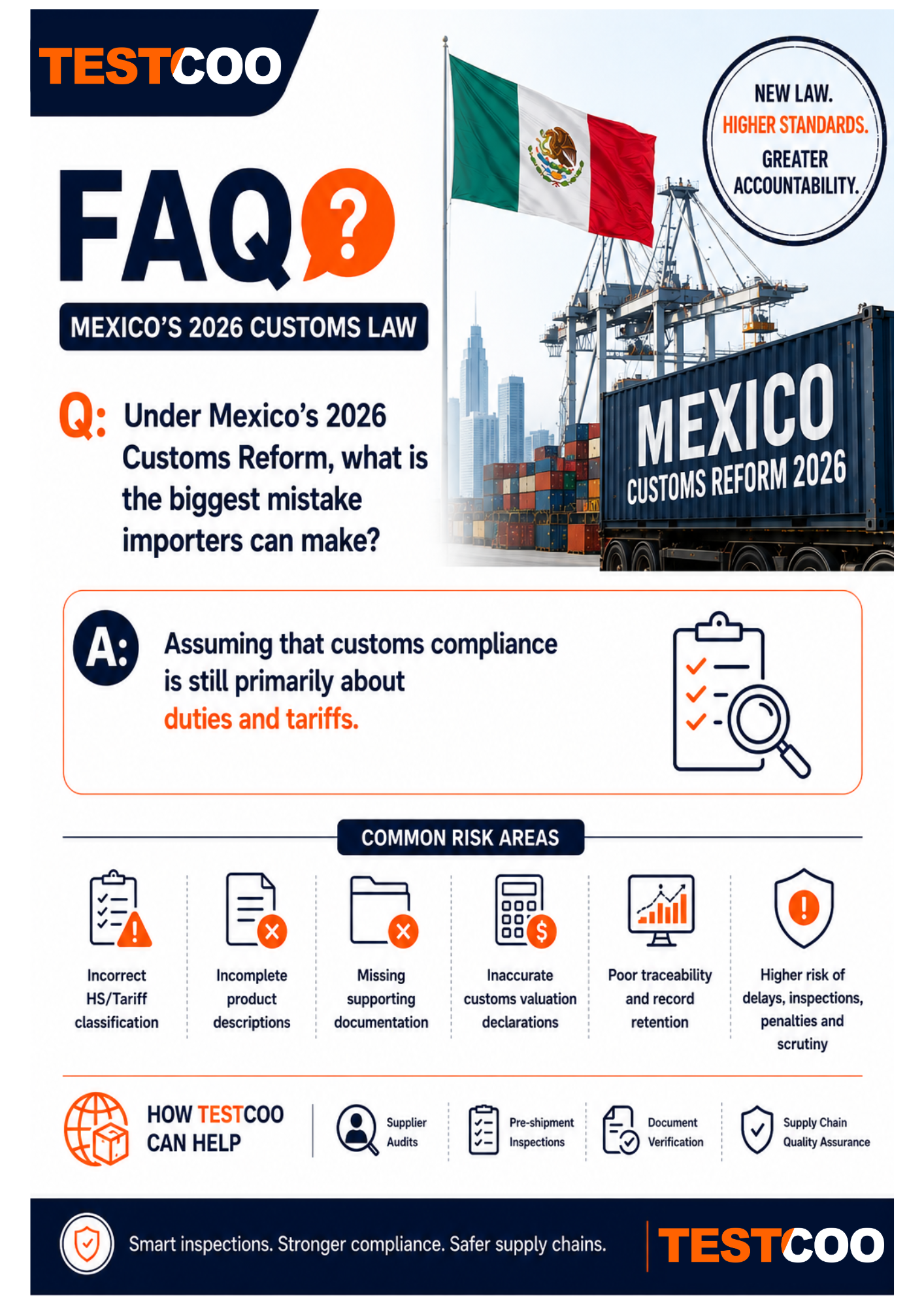
Choose Testcoo As Your Trusted Supply Chain Quality Assurance Partner While Importing into Mexico
Mexico’s 2026 Customs Law isn’t a minor tweak, it’s a fundamental shift toward real-time, digital and highly enforced border control. The days of loosely declared “gifts” or “samples” are ending. The age of pre-arrival data, automated risk scoring and stiff penalties is here.
The businesses that thrive will be those that start their compliance audits today, integrate with SAT’s digital window and treat customs as a core part of their supply chain and not a paperwork afterthought.
TESTCOO is a leading global third-party quality inspection company. We have offices in Asia and other parts of the world including Mexico. If you are importing into Mexico our inspection team will ensure that your goods meet all regulations and requirements. If you would like to explore quality control inspection or to discuss your future supply chain challenges, please get in touch with us.

Free Sample Report Performance Quality Control
Download a sample report to keep control of your supply chain!

Featured Articles
 AQL Table | How to Read It
 TOP 10 Common Defects in Garments Quality Inspection
 Product Packaging and Shipment Label requirements for Amazon FBA
 What Is ASTM-F2413-18? Protective Footwear Standard
 How to Conduct Third-Party Quality Control Inspections for Electric Scooters
 SMETA Audit-What is SMETA Audit?
 TESTCOO Supplier Verification/Certification Service SLCP, Higg FEM, GRS, GOTS
 Quality Control Inspection Company in China
 What is Quality Inspection? A Complete Guide
 Guidelines for Product Inspection in India
Category
- Production Inspection Service
- Factory Audit
- Softline Inspection
- Hardline Inspection
- Electrics Inspection
- Certification
- Checklist
- Manufacturers
- Quality Assurance Basics
- Products Recall
- AQL
- Guidence and Standard
- News
- Supplier Management
- Amazon
- Protective Equipment
- e-commerce quality control
- Indian Manufacturing
- Soft Goods Quality Control
- Supply Chain Management
- Supply Chain Resilience
- E-Commerce Quality Control
- ISO 2859
- Supply Chain Optimization
- Garment Industry
- Higg Index