


How to Choose a Previo en Origen Partner: 7 Questions Importers Must Ask
This is why leading cross-border procurement teams implement Previo en Origen (PEO), conducting the comprehensive physical examination, item count, serial number validation and NOM compliance checks directly at the factory or warehouse before the container sails.
However, a Previo en Origen report is only as reliable as the agency performing it on the ground. Your Mexican customs broker (Agente Aduanal) relies directly on the accuracy of origin inspection data to validate the draft entry document (Pedimento). Choosing the wrong provider risks legal exposure, audit rejections and costly port delays.
At TESTCOO, our specialized Previo en Origen (PEO) Inspection service acts as a direct operational bridge between your overseas suppliers and Mexican customs requirements. By deploying certified inspectors across major manufacturing hubs, we deliver standardized Previo en Origen reports within 24 hours, giving your Agente Aduanal complete confidence to clear cargo quickly.
What Are the Real Financial Risks of Relying on Destination Inspections in Mexico?
Many importers treat Previo en Origen as an optional logistics add-on until a single discrepancy at a Mexican port wipes out quarterly profit margins.
When cargo arrives in Mexico without an origin check, customs brokers must perform a previo en puerto inside the port terminal warehouse. This process involves destuffing the container, counting units, verifying commercial information and repacking, all while port storage clocks are running.
Read more: 5 Mistakes During Previo en Origen | TESTCOO

Case Study: The $38,000 Port Hold at Manzanillo
Many importers treat Previo en Origen as an optional step until a single destination error wipes out their quarterly profit margin:
- The Incident: An importer shipped two electronics containers from Ningbo to Manzanillo without an origin check. Upon arrival, the Agente Aduanal found missing NOM-024 Spanish labels on 15% of the goods and mismatched carton model numbers.
- The Impact: Clearance stalled immediately. The cargo spent 18 days in a bonded port warehouse awaiting physical re-labeling by specialized terminal labor, causing severe retail stockouts.
- The Financial Toll: The importer incurred over $38,000 in combined port storage (almacenaje), steamship demurrage (demoras), and terminal re-work fees.
- The Lesson: A $300 Previo en Origen check at the factory would have caught the label error instantly, allowing the vendor to fix it before sailing at zero port expense.
Comparison Metric | Previo en Origen (At Origin Factory) | Previo en Puerto (At Mexican Port Terminal) |
Inspection Cost | $250 to $350 per Man-Day | $10,000 to $40,000+ per container |
Defect Resolution | Supplier fixes labeling, counts, or defects at origin at zero extra freight cost | Requires expensive bonded warehouse labor inside Mexican port terminals |
Port Storage & Demurrage | ZERO port terminal storage (almacenaje) or shipping line demurrage (demoras) | Daily terminal storage ($150 to $300 per day) plus steamship line demurrage fees |
| Customs Risk | High Pedimento accuracy with pre-verified data prior to vessel departure | High risk of SAT audit holds, fines, and extended cargo delays |
Disclaimer: All cost figures are estimated market averages provided for reference only. Origin rates reflect typical market man-day fees in major sourcing regions, while destination costs represent estimated financial risk for extended port holds (combining daily storage of $150–$300/day, carrier demurrage, bonded labor, and customs fines). Actual costs may vary based on specific logistics providers, port terminals, and shipment parameters.
How Do You Choose the Right Previo en Origen Partner? (7 Questions to Ask)
When evaluating third-party quality control inspection companies to manage your Previo en Origen process, you need a technical partner fluent in Mexican customs standards. Ask these 7 operational questions before signing a service contract:
1. Does the Partner Understand Mexican Customs & NOM Labeling Requirements?
General quality control is not the same as a Mexican customs pre-inspection. Your PEO partner must train its field inspectors on specific Mexican regulatory standards, including:
- NOM-050-SCFI / NOM-024-SCFI: Commercial information and user manual requirements in Spanish.
- Harmonized System (HS) Tariff Verification: Physical attributes required for correct Mexican Fracción Arancelaria classification.
- Country of Origin Marking Rules: Verification of mandatory physical markings (Made in China, Made in Vietnam, etc.) required to avoid anti-dumping penalties.
2. Can Their Inspection Reports Be Integrated Directly with Your Mexican Agente Aduanal?
The primary goal of Previo en Origen is to give your Mexican customs broker pre-verified data so they can prepare the draft Pedimento before the vessel docks. Ask if the provider delivers structured digital data, including high-resolution photos of product nameplates, packaging labels, piece counts and serial numbers, formatted for rapid broker review.
3. Do They Have Direct Coverage Across Your Sourcing Hubs?
Relying on sub-contracted or freelance inspectors in secondary industrial zones can lead to inconsistent report quality and missed details. Ensure your provider operates a network of full-time, certified inspectors directly stationed across primary manufacturing regions in Asia, Europe and Latin America.
4. What Is Their Report Turnaround Time?
A Previo en Origen report that takes 4 to 5 days to generate creates a shipping bottleneck at the origin port. Choose a digitalized provider capable of delivering complete inspection files within 24 hours of inspection completion, ensuring cargo moves smoothly onto the scheduled vessel.
5. What International Accreditations and Quality Standards Do They Enforce?
Verify that the agency operates under strict international quality benchmarks:
- ISO/IEC 17020 (Accreditation for inspection bodies)
- ISO 9001 (Quality Management Systems)
- Standard AQL sampling protocols following ANSI/ASQ Z1.4 (ISO 2859-1)
6. How Are Integrity and Anti-Bribery Rules Enforced on the Factory Floor?
Because PEO reports hold legal implications for customs declaration, inspector independence is vital. Inquire about rotation schedules, unannounced supervisor audits and GPS-tracked mobile apps that record real-time inspector activity on the factory floor.
7. Does the Provider Offer Full-Cycle Quality Coverage?
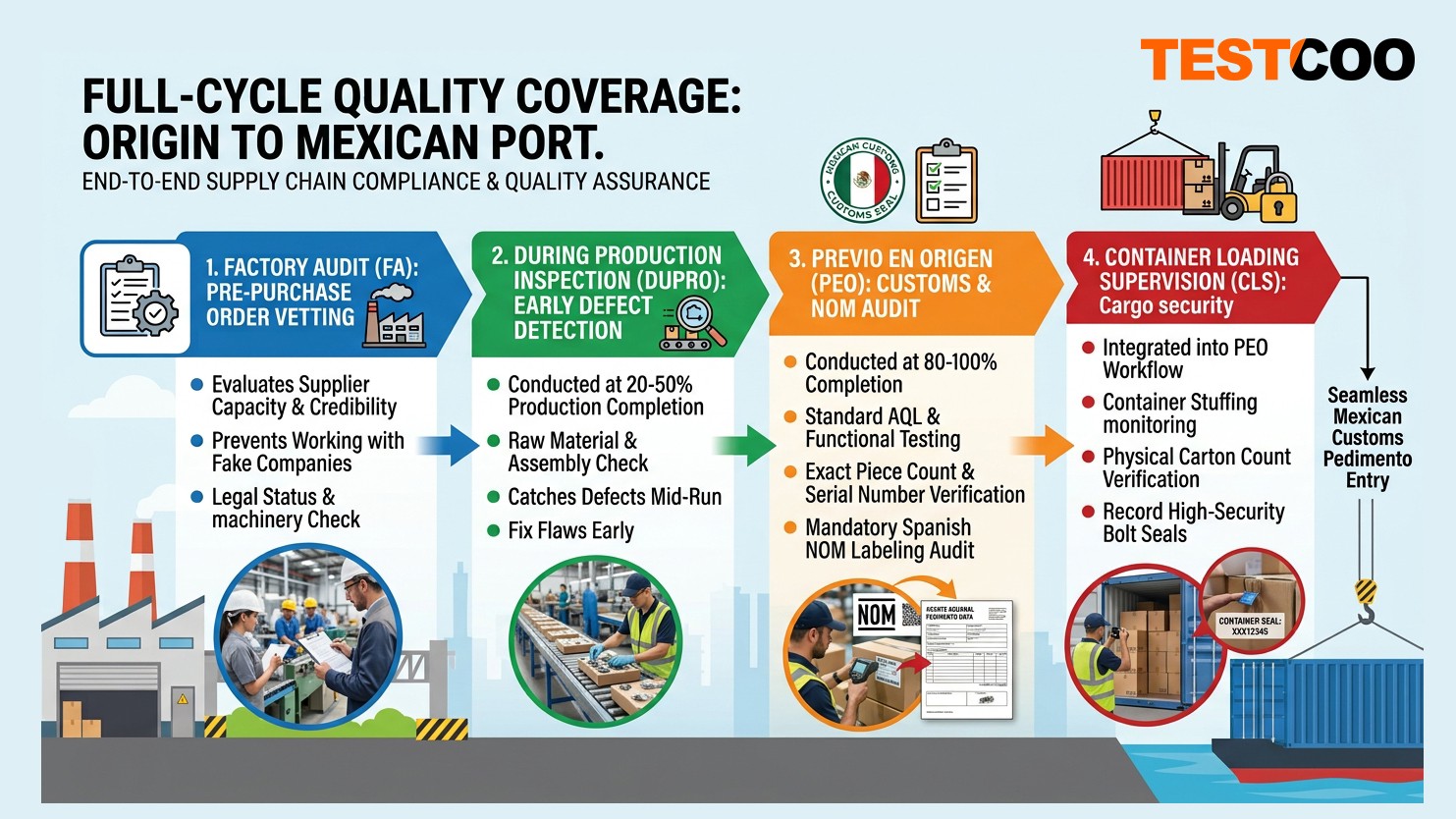
When assessing a provider's full-cycle quality capabilities, importers must recognize that Previo en Origen (PEO) extends well beyond a conventional Pre-Shipment Inspection (PSI), frequently referred to as a Final Random Inspection (FRI). Instead, PEO operates as a single, unified audit that combines three critical quality and compliance functions into one workflow:
- Product Quality & AQL Testing: Standard FRI checks for physical workmanship, functionality, and defect rates.
- Customs & NOM Compliance Audit: Specialized verification of exact physical piece counts, serial numbers, model variations, and mandatory Spanish NOM labeling to ensure accurate Pedimento entry.
- Integrated Container Loading Supervision (CLS): Non-negotiable monitoring of container stuffing and high-security seal verification, guaranteeing that the audited cargo directly matches container contents.
Because your Mexican customs broker (Agente Aduanal) relies entirely on this origin data, PEO acts as an all-in-one bridge between factory output and Mexican customs clearance. Combining this all-inclusive PEO workflow with earlier quality gates, such as a Factory Audit (FA) to vet supplier capacity or a During Production Inspection (DUPRO) to catch early defects, gives importers total end-to-end control.
Read More: Previo en Origen (PEO) vs. Final Random Inspection (FRI): What is the Difference | TESTCOO
What Is the Operational Workflow for a Previo en Origen Inspection?
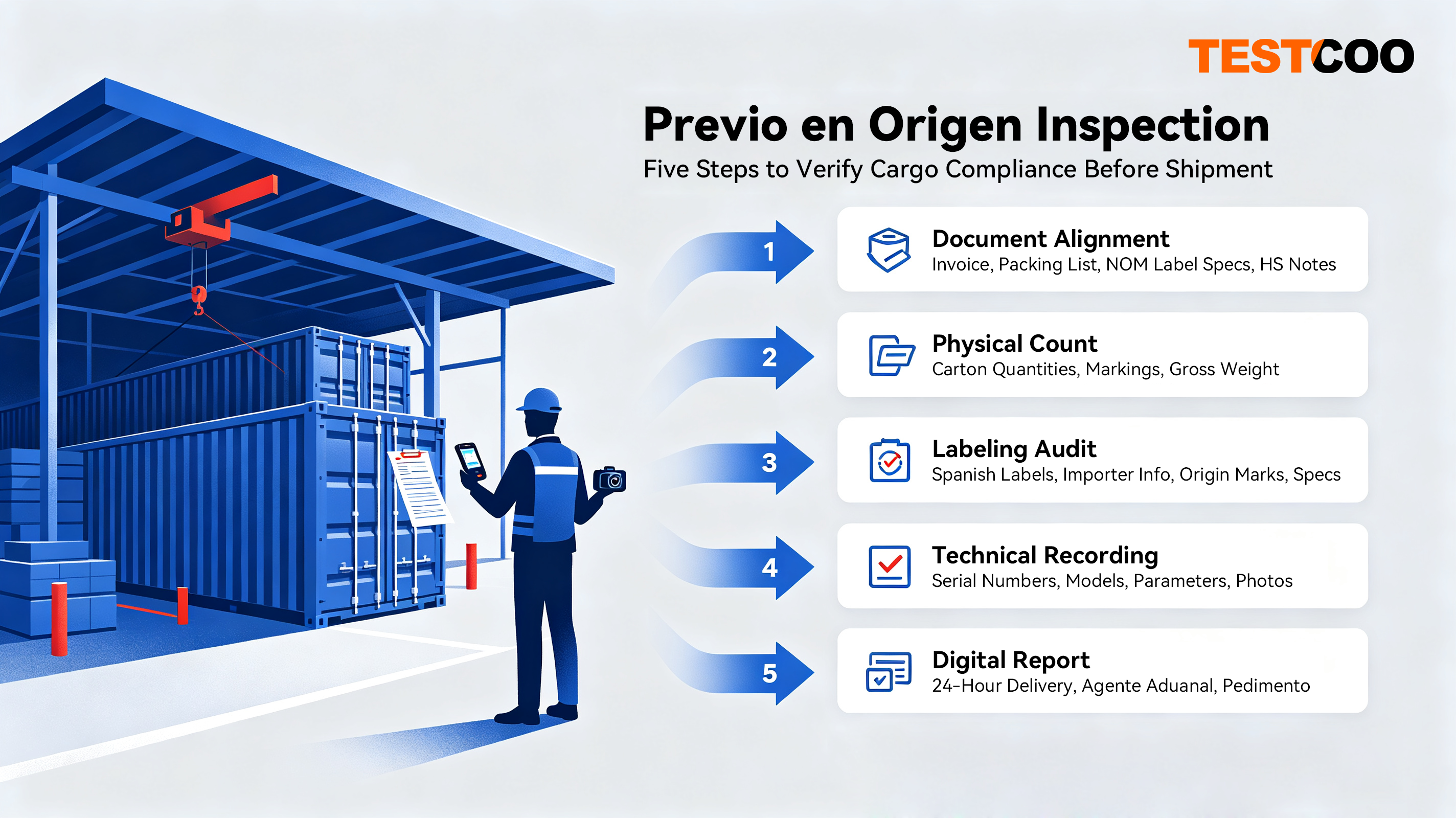
Understanding the operational execution of a Previo en Origen (PEO) inspection helps importers set precise expectations with both overseas suppliers and Mexican customs brokers. A standardized PEO workflow follows five key steps to ensure cargo is fully compliant before leaving origin:
- Document Alignment: The importer submits the commercial invoice, packing list, mandatory NOM labeling specifications, and HS tariff notes provided by the Agente Aduanal.
- On-Site Arrival & Physical Count: The inspector arrives at the origin facility to verify total carton quantities, box markings, and gross weights directly against the shipping manifest.
- NOM & Commercial Labeling Audit: A detailed check is conducted to audit Spanish-language consumer labels, importer information, country-of-origin marks, and core technical specs like voltage and dimensions.
- Serial Number & Technical Recording: The auditor captures photo evidence of serial number plates, model variations, and specific physical parameters required for Mexican customs entry.
- 24-Hour Digital Report Transmission: A comprehensive photo report and structured data file are delivered within 24 hours, giving the Agente Aduanal verified information to draft the Pedimento before vessel departure.
Read more: A 8-Step Checklist for Previo en Origen (PEO) | TESTCOO
Frequently Asked Questions (FAQ)
Q1: What is the difference between Previo en Origen (PEO) and Previo en Puerto?
Previo en Origen (PEO) is a physical cargo inspection conducted at the exporter's factory or origin warehouse before goods are loaded into ocean containers. Previo en Puerto is conducted inside the Mexican port terminal warehouse after cargo arrives. PEO prevents port congestion, eliminates daily terminal storage fees and allows importers to fix labeling errors before shipping.
Q2: Does Previo en Origen replace the need for a Mexican Agente Aduanal?
No. The Agente Aduanal (Customs Broker) remains legally responsible for submitting the Pedimento entry document to Mexican customs (SAT, Servicio de Administración Tributaria). However, Previo en Origen provides your broker with verified physical data, photos and exact counts in advance, allowing them to draft the Pedimento faster and clear cargo with minimal port hold risks.
Q3: Can Previo en Origen catch non-compliant NOM labels before shipping?
Yes. One of the core functions of a specialized Previo en Origen inspection is auditing product packaging and physical labels against mandatory Normas Oficiales Mexicanas (such as NOM-050 or NOM-024). If labels are incorrect or missing, the overseas supplier can re-label the shipment at the factory floor before loading.
Streamlining Your Mexican Import Compliance with TESTCOO
Executing a smooth import strategy into Mexico requires accuracy at origin. Choosing the right third-party quality control inspection companies turns origin quality control into a strategic advantage, reducing port storage expenses, preventing customs penalties and building audit-proof supply chains.
At TESTCOO, our dedicated global third-party inspection service delivers standardized Previo en Origen solutions tailored for Mexican customs requirements. Operating under an ISO/IEC 17020-accredited inspection management system, alongside ISO 9001 quality management and ISO 27001 information security certifications, our global auditor network delivers authoritative, image-backed inspection reports within 24 hours. We help cross-border procurement managers eliminate origin blind spots, align with their Agente Aduanal and maintain fast port clearance.


Free Sample Report Performance Quality Control
Download a sample report to keep control of your supply chain!

Featured Articles
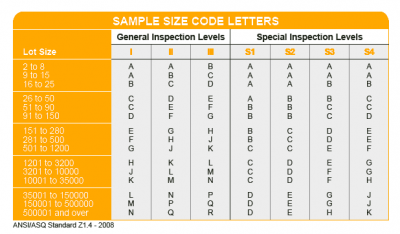 AQL Table | How to Read It
 TOP 10 Common Defects in Garments Quality Inspection
 Product Packaging and Shipment Label requirements for Amazon FBA
 What Is ASTM-F2413-18? Protective Footwear Standard
 How to Conduct Third-Party Quality Control Inspections for Electric Scooters
 SMETA Audit-What is SMETA Audit?
 TESTCOO Supplier Verification/Certification Service SLCP, Higg FEM, GRS, GOTS
 Quality Control Inspection Company in China
 What is Quality Inspection? A Complete Guide
 Guidelines for Product Inspection in India
Category
- Production Inspection Service
- Factory Audit
- Softline Inspection
- Hardline Inspection
- Electrics Inspection
- Certification
- Checklist
- Manufacturers
- Quality Assurance Basics
- Products Recall
- AQL
- Guidence and Standard
- News
- Supplier Management
- Amazon
- Protective Equipment
- e-commerce quality control
- Indian Manufacturing
- Soft Goods Quality Control
- Supply Chain Management
- Supply Chain Resilience
- E-Commerce Quality Control
- ISO 2859
- Supply Chain Optimization
- Garment Industry
- Higg Index