


Importing Electronics to Mexico: NOM Standards & Previo en Origen (PEO) Guide
To avoid demurrage charges and customs holds, cross-border buyers rely on a two-pronged strategy: verifying product safety through third-party quality control and executing a Previo en Origen (PEO), an origin-level preliminary customs inspection before containers are loaded.
Key Takeaways for Importers:
- Mandatory Technical Compliance: Selling electronics in Mexico legally requires strict adherence to mandatory NOM safety and labeling standards.
- Quality vs. Customs Alignment: Final Random Inspection (FRI) protects your product quality via AQL sampling, while Previo en Origen (PEO) ensures 100% physical match with Mexican customs documentation (Pedimento).
- Upstream Risk Reduction: Combining FRI and PEO into a single factory visit before shipment eliminates port delays and prevents expensive re-labeling fees in Mexican bonded warehouses.
Read More: A 8-Step Checklist for Previo en Origen (PEO) | TESTCOO
Why Is NOM Compliance and Previo en Origen (PEO) Critical When Sourcing Electronics for Mexico?
Selling electrical or electronic consumer goods in Mexico requires strict adherence to mandatory technical regulations overseen by the Secretariat of Economy (Secretaría de Economía). Importing uncertified or improperly verified products risks port seizures, heavy fines up to 4% of annual revenue, and total market bans.
Conducting a Previo en Origen (PEO) ensures that physical goods, serial numbers, and mandatory NOM markings are audited at the source factory before the vessel departs, significantly accelerating customs clearance upon arrival in Mexico.
Read More: A Guide for Mexican Previo en Origen (PEO) | TESTCOO
Essential NOM Standards Overview
NOM Standard Code | Regulated Scope | Common Compliance & Customs Bottlenecks |
NOM-001-SCFI-2018 | Electronics powered by grid or battery | Flame-retardant failure, transformer/adapter lack of certification. |
NOM-003-SCFI-2014 | Electrical wiring, switches, appliances | High-voltage drop test failure, improper wiring safety margins. |
NOM-019-SCFI-1998 | Data-processing equipment, laptops, IT | Insufficient power supply protection, missing local holder approval. |
NOM-024-SCFI-2013 | Packaging, user manuals, warranties | Missing importer RFC tax ID, non-Spanish text, improper rating labels. |
NOM-208-SCFI-2016 | RF-enabled devices (Wi-Fi, Bluetooth) | Missing IFETEL modular/device certification reports. |
What Sourcing Failure Risks Exist in Cross-Border Consumer Goods Supply Chains?
Navigating cross-border manufacturing without rigorous quality supervision exposes brands to financial losses. Sourcing teams often struggle with overseas production due to language barriers, sample swapping, and inadequate factory-level testing.
Case Study: $140,000 Electronics Shipment Seized at Port Manzanillo
A North American consumer electronics brand contracted a South China manufacturer to produce 15,000 smart home power strips destined for Mexican retail chains. The supplier assured the buyer that the goods were "NOM-compliant." However, because no Previo en Origen (PEO) was conducted at the origin factory, customs inspectors during arrival clearance at Port Manzanillo discovered two fatal discrepancies:
- The Spanish commercial label lacked the local importer's RFC details required under NOM-024-SCFI.
- Internal wiring insulation failed the flame-retardant threshold required by NOM-001-SCFI.
Without an independent pre-shipment inspection, the shipment was held at customs. Demurrage charges exceeded $32,000, and the entire batch was forced into expensive local re-labeling and secondary laboratory re-testing, delaying the product launch by 11 weeks.
An on-site cross-border supplier quality audit combined with a formal Previo en Origen (PEO) catches these engineering, labeling, and import compliance errors before cargo is loaded onto containers.
Read More: 5 Mistakes During Previo en Origen | TESTCOO

How Does a Standard Global Third-Party Inspection Workflow Function?
Executing an end-to-end quality assurance program requires structured, step-by-step verification throughout the production lifecycle. Experienced buyers rely on standardized field procedures to maintain quality control across global supply networks.
1.Cross-Border Supplier Quality Audit
Cross-Border Supplier Quality Audit conducted prior to purchase order issuance. Auditors conduct an on-site evaluation of the factory's ISO 9001 quality system, raw material traceability, production capacity, sub-tier supplier control, and laboratory testing capabilities to confirm the facility can meet NOM compliance specifications.
2.During Production Check (DUPRO)
During Production Check (DUPRO) triggered at 20% to 50% production completion. Field inspectors evaluate early finished goods from the assembly line. This step identifies core functional defects, assembly line flaws, or incorrect component usage early enough to allow corrective action without delaying vessel schedules.
3.Final Random Inspection (FRI) / Pre-Shipment Inspection (PSI)
Final Random Inspection (FRI) / Pre-Shipment Inspection (PSI) executed when goods are 100% completed and 80%+ packaged. Standard FRI focuses strictly on product quality and functionality through statistical Acceptable Quality Limit (AQL) sampling (ANSI/ASQ Z1.4). Inspectors verify visual appearance, dimensions, high-voltage/drop testing, and functional performance to answer: "Is the product well-made and defect-free?"
4.Previo en Origen (PEO) Customs Inspection
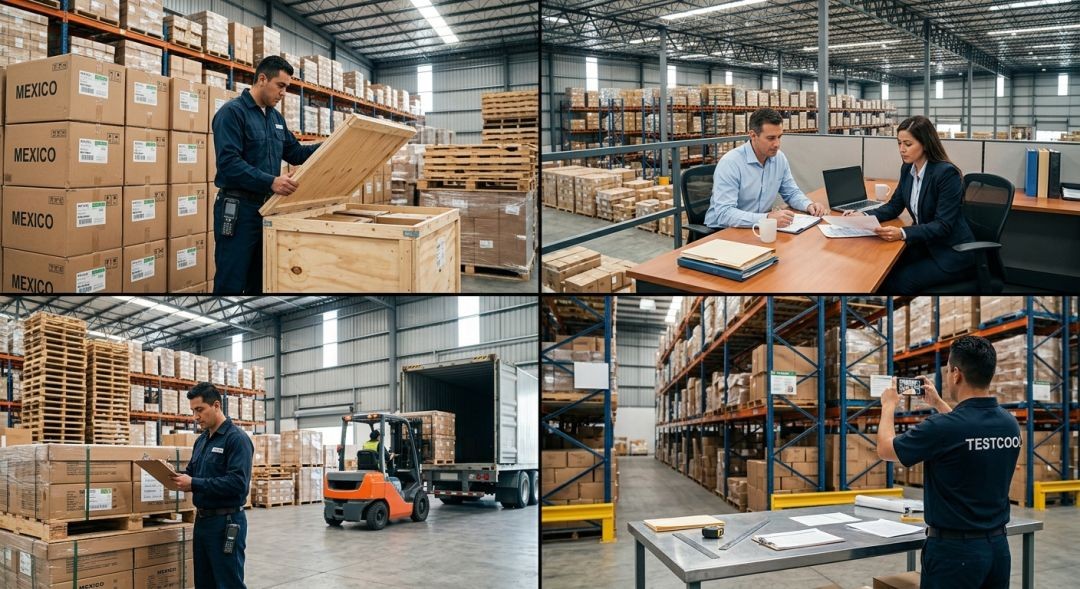
Executed in coordination with the Mexican customs broker (Agente Aduanal). PEO focuses entirely on legal and customs compliance under Mexican Customs Law (Ley Aduanera). Inspectors perform a 100% physical piece count, verify HS code pre-classification, reconcile physical cargo against the draft pedimento / packing list, and verify physical NOM-024-SCFI labeling.
FRI vs. PEO at a Glance
- FRI (Quality Focus): "Is the product built correctly and defect-free according to AQL standards?"
- PEO (Customs Focus): "Does the cargo 100% match the Mexican customs broker's paperwork and labeling rules?"
- The Combined Approach: Third-party inspection agencies can execute FRI and PEO during a single integrated factory visit, saving travel costs and delivering a unified quality/customs report.
Read More: Previo en Origen (PEO) vs. Final Random Inspection (FRI): What is the Difference | TESTCOO
5.Loading Supervision (LS)
Loading Supervision (LS) performed at the factory or warehouse loading dock. Inspectors verify container structural integrity, inspect carton condition, monitor load balance, record seal numbers, and ensure proper cargo handling to prevent moisture or physical damage during transit.
↵
What Are the Typical Costs and Timeline Benchmarks for Third-Party QC?
Cost transparency and execution speed are vital when scheduling third-party quality inspections and PEO procedures across international manufacturing hubs.
Service Type | Average Cost Range (USD) | Standard Turnaround Time | Core Deliverables |
Final Random Inspection (FRI) | $280 – $350 / Man-Day | 24 Hours post-inspection | Photo-backed AQL quality report, defect breakdown, functional testing log. |
Previo en Origen (PEO) Inspection | $280 – $380 / Man-Day | 24 Hours post-inspection | Official PEO customs report, 100% quantity audit, draft pedimento data match. |
Combined FRI + PEO Visit | $350 – $480 / Man-Day | 24 Hours post-inspection | Dual-purpose report covering both AQL product quality and PEO customs compliance. |
During Production Check (DUPRO) | $280 – $350 / Man-Day | 24 Hours post-inspection | Line yield report, early defect identification, CAPA recommendations. |
Factory Audit Service | $450 – $650 / Audit | 24 to 48 Hours | Comprehensive facility score, QMS evaluation, capacity verification. |
Loading Supervision | $250 – $300 / Container | Same-Day / 24 Hours | Container seal validation, loading photo log, carton count verification. |
Disclaimer: Pricing and timeline benchmarks provided in this table are estimates based on standard global market averages and are subject to change based on order size, product complexity, geographic location, inspector travel requirements, and specific service provider terms.
What Are Common QC Mistakes Buyers Make in Sourcing Electronics?
Even experienced procurement teams fall into preventable quality traps when expanding into Latin American markets:
- Assuming Factory Self-Declarations Are Valid: Overseas suppliers frequently claim products are "certified for North America." However, US FCC or CE mark documentation is not recognized by Mexican customs without accredited NOM test reports and local certification holder approval.
- Postponing Packaging & PEO Verification: Waiting until goods arrive at port to check Spanish translation accuracy under NOM-024 or verify customs counts is a major cause of customs delays. Packaging artwork, manual texts, rating labels, and Previo en Origen (PEO) checks must be verified at origin.
- Skipping Sample-to-Mass Production Cross-Checks: Factories may send compliant golden samples for lab testing, then substitute cheaper internal capacitors, transformers, or battery cells during mass assembly. On-site During Production Check (DUPRO) prevents component degradation.
- Neglecting Remote Real-Time Monitoring: Relying solely on delayed paper reports leaves buyers reactive. Modern quality management relies on digital dashboard tracking and real-time operational visibility.
Future QC Trends: Digitalized Inspection and Regulatory Updates
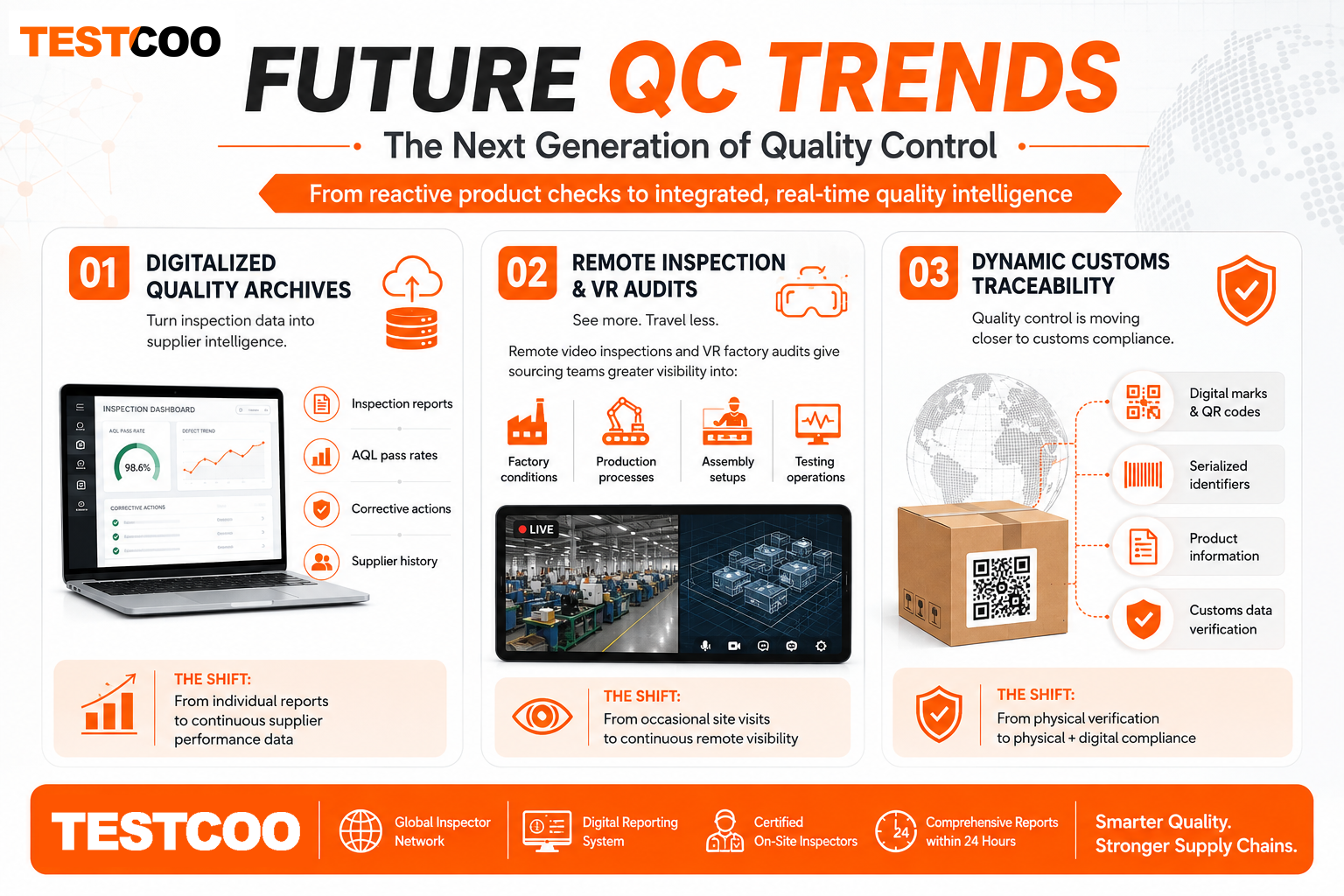
The global third-party inspection landscape is shifting from reactive product checks to integrated, real-time quality intelligence. Key trends shaping cross-border sourcing include:
- Digitalized Quality Archives: Forward-thinking brand operators maintain permanent cloud archives for all supplier inspection reports, AQL pass rates, and corrective action histories to power data-driven supplier performance scoring.
- Remote Video Inspection & VR Audits: Remote video inspections and VR factory audits complement on-site technical teams, allowing global sourcing directors to view factory floor conditions, assembly setups, and high-voltage testing live without international travel.
- Dynamic Customs Traceability: Emerging trade rules, including updated Mexican customs guidelines incorporating serialized QR verification codes on physical compliance labels and integrated Previo en Origen (PEO) digital reporting, require third-party inspectors to validate digital mark accuracy prior to packing.
Future QC Trends: Digitalized Inspection and Regulatory Updates
The global third-party inspection landscape is shifting from reactive product checks to integrated, real-time quality intelligence. Key trends shaping cross-border sourcing include:
- Digitalized Quality Archives: Forward-thinking brand operators maintain permanent cloud archives for all supplier inspection reports, AQL pass rates, and corrective action histories to power data-driven supplier performance scoring.
- Remote Video Inspection & VR Audits: Remote video inspections and VR factory audits complement on-site technical teams, allowing global sourcing directors to view factory floor conditions, assembly setups, and high-voltage testing live without international travel.
- Dynamic Customs Traceability: Emerging trade rules, including updated Mexican customs guidelines incorporating serialized QR verification codes on physical compliance labels and integrated Previo en Origen (PEO) digital reporting, require third-party inspectors to validate digital mark accuracy prior to packing.
Frequently Asked Questions
Q1: Can CE or FCC certificates replace NOM certification for electronics imported into Mexico?
No. CE and FCC certifications are not accepted by Mexican customs authorities. All applicable electrical and electronic consumer goods must undergo mandatory testing by accredited laboratories to meet specific NOM standards (e.g., NOM-001, NOM-003, NOM-019) and carry an official NOM certificate issued by a Mexican certification body.
Q2: What is the main difference between a Final Random Inspection (FRI) and Previo en Origen (PEO)?
FRI evaluates product quality, workmanship, and defect rates using statistical AQL sampling to protect brand standards. PEO evaluates legal customs compliance, verifying 100% piece counts, HS codes, and NOM labeling against the Mexican customs broker's draft pedimento to ensure fast port clearance.
Q3: Can a Previo en Origen (PEO) and an FRI be performed during the same visit?
Yes. Third-party inspection companies can combine both protocols into a single, integrated factory visit once goods are 80%+ packed. Inspectors execute AQL defect checks while simultaneously completing PEO customs audits, saving time and lowering inspection fees.
Q4: How does third-party packaging verification help with NOM-024-SCFI compliance?
Inspectors verify the physical product labels, outer box artwork, user manuals, and warranty documentation against NOM-024 rules on-site. They confirm that mandatory Spanish text, electrical input/output specifications, country of origin, and local importer RFC details are accurately printed before goods are sealed into containers.
Q5: What happens if a production lot fails an AQL pre-shipment inspection or PEO check?
When a lot fails AQL standards or presents PEO labeling discrepancies, the inspection agency issues a detailed non-conformity report identifying the exact defect count (critical, major, minor). The buyer can hold payment, request factory re-work, and schedule a re-inspection before authorizing container loading.
Essential Sourcing Action Steps
Successfully launching consumer goods in Mexico demands proactive supply chain management. Aligning your overseas factories with mandatory NOM safety standards, enforcing strict AQL sampling before shipment, and working with localized quality inspectors prevents port delays and keeps your margins secure.


Free Sample Report Performance Quality Control
Download a sample report to keep control of your supply chain!

Featured Articles
 AQL Table | How to Read It
 TOP 10 Common Defects in Garments Quality Inspection
 Product Packaging and Shipment Label requirements for Amazon FBA
 What Is ASTM-F2413-18? Protective Footwear Standard
 How to Conduct Third-Party Quality Control Inspections for Electric Scooters
 SMETA Audit-What is SMETA Audit?
 TESTCOO Supplier Verification/Certification Service SLCP, Higg FEM, GRS, GOTS
 Quality Control Inspection Company in China
 What is Quality Inspection? A Complete Guide
 Guidelines for Product Inspection in India
Category
- Production Inspection Service
- Factory Audit
- Softline Inspection
- Hardline Inspection
- Electrics Inspection
- Certification
- Checklist
- Manufacturers
- Quality Assurance Basics
- Products Recall
- AQL
- Guidence and Standard
- News
- Supplier Management
- Amazon
- Protective Equipment
- e-commerce quality control
- Indian Manufacturing
- Soft Goods Quality Control
- Supply Chain Management
- Supply Chain Resilience
- E-Commerce Quality Control
- ISO 2859
- Supply Chain Optimization
- Garment Industry
- Higg Index