


What Is Previo en Origen (PEO): A Complete Guide for Importers
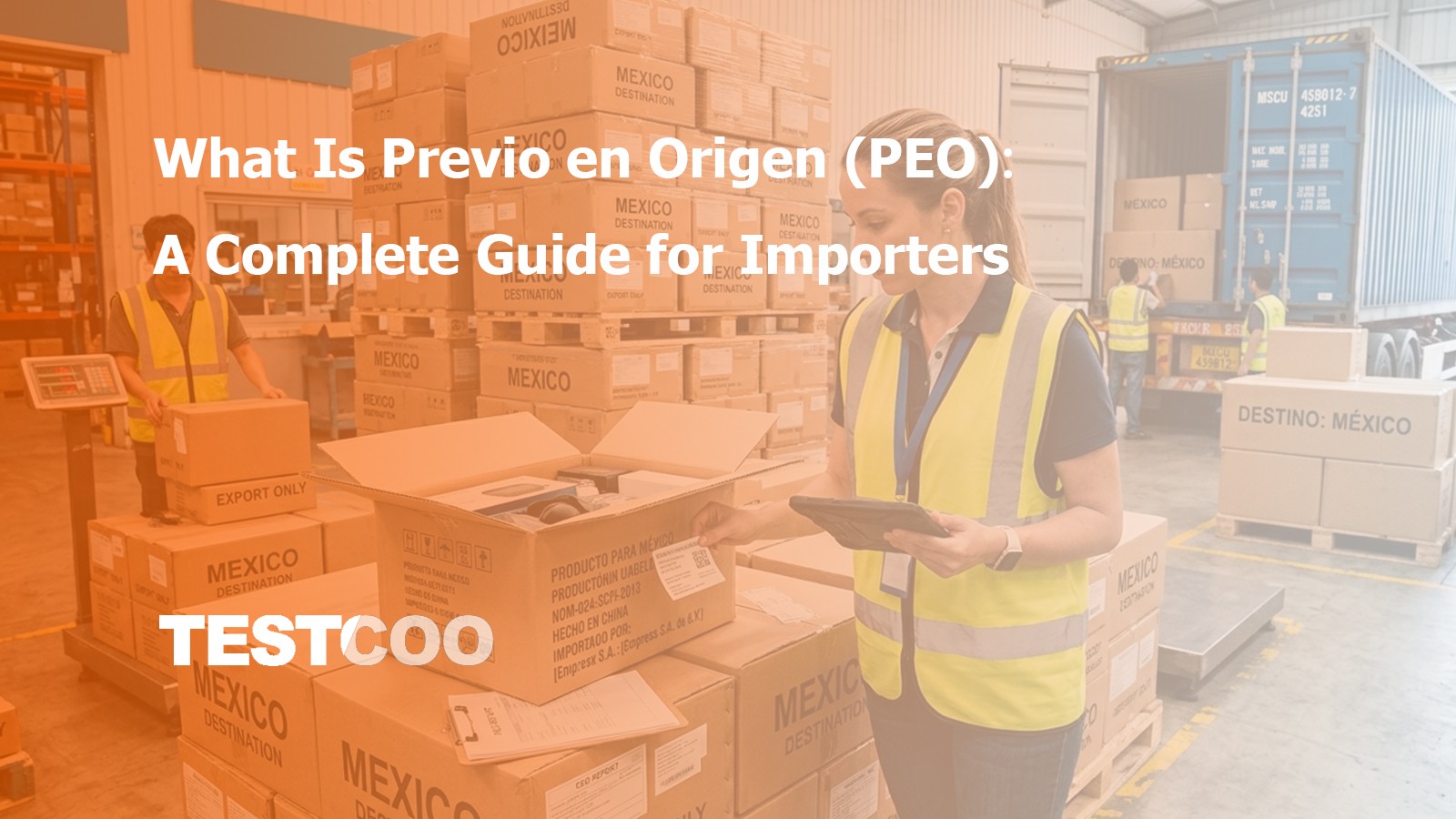
Previo en Origen (PEO), or "Inspection at Origin," is the industry-standard solution to this bottleneck. By moving the customs verification process from the Mexican border to the factory floor in the country of manufacture, you ensure your cargo is "Customs-Ready" before it ever touches a vessel.
What Is Previo en Origen (PEO) in Global Supply Chains?
In the context of Mexican Customs Law (Article 42), Previo en Origen is more than a quality check; it is a regulatory compliance protocol. While a standard final random inspection (FRI) focuses on product quality (AQL, function, and aesthetics), PEO is a technical audit centered on legal and administrative readiness.
For global procurement managers, the goal of PEO is simple: to ensure that the physical goods, the packing list, and the commercial invoice are in perfect harmony. When customs officials in Mexico verify a shipment that has undergone a professional PEO, the margin for error is virtually eliminated, allowing for faster customs clearance and reduced administrative overhead.
Why Is PEO the Critical Link for Mexican Imports?
Many importers mistakenly believe that a factory's word is sufficient for customs documentation. However, our years of experience in global third-party inspection service projects show that factory-provided data is often inconsistent with the rigorous standards required by Mexican authorities.
1. Eliminating the "Red Channel" Risk
Customs officials in Mexico use automated risk-assessment systems. If your documentation history is clean, you are more likely to pass the "Green Channel" (immediate release). PEO documentation creates a verifiable history of compliance, drastically lowering the statistical probability of your shipments being flagged for secondary inspections.
2. Mandatory NOM Compliance
Mexico’s Official Mexican Standards (NOMs) are notoriously strict. If your goods arrive at the port without the correct Spanish-language labeling, safety certifications, or energy-efficiency marks, you will be forced to re-label them at a bonded warehouse. This process can take weeks and cost thousands of dollars. PEO identifies these labeling gaps during production, allowing for easy, low-cost corrections at the factory.
3. Protecting Against Cargo Discrepancies
Have you ever ordered 10,000 units but received 9,800, or found a different product model in the box? PEO includes a 100% physical count and verification against the Packing List. This ensures that the quantity and SKU details declared in your electronic customs entry (Pedimento) are 100% accurate.

Standard Operation Process: The PEO Lifecycle
A professional PEO requires a structured approach. At TESTCOO, our process for global third-party quality control inspection companies follows these exact steps to ensure full compliance:
Phase | Activity | Focus Area |
Documentation Review | Audit of PO, Invoice, and Packing List | Regulatory alignment |
Labeling Audit | Verification of NOM and mandatory marks | Legal compliance |
Physical Verification | Full count and unit-by-unit check | Declared vs. actual cargo |
HS Code Assessment | Checking classification accuracy | Tariff/Duty optimization |
Loading Supervision | Final container seal and structural check | Shipment integrity |
By digitizing this workflow, we build a permanent supplier quality archive for your brand, allowing you to track which factories consistently meet compliance standards and which represent a higher risk to your bottom line.

Real-World Case: Avoiding the $10,000 Storage Fine
In a recent project, a cross-border e-commerce client sourced a large batch of consumer electronics from a factory in Southeast Asia. The supplier insisted that all labels were correct. However, our global third-party inspection service team performed a PEO and discovered that the NOM labeling was missing the required import company name and tax ID.
Because this was caught during the PEO, the factory printed and applied the correct labels in four hours. Had the goods arrived at the Manzanillo port, the correction would have required a specialized bonded warehouse, incurring over $10,000 in storage and service fees, not to mention a three-week delay that would have missed the client's peak sales season.
PEO Compliance: Frequently Asked Questions (FAQs)
Q1: How does PEO differ from a standard quality control inspection?
A standard QC inspection focuses on product defects (scratches, loose threads, function). PEO focuses on customs data integrity (labels, quantities, document verification, and tariff classification). They are often performed simultaneously to maximize efficiency.
Q2: Does PEO replace the need for a customs broker?
No. PEO is a tool that empowers your customs broker. By providing them with a certified PEO report, you give them the data they need to file a more accurate Pedimento, reducing their liability and increasing their speed of filing.
Q3: What happens if the PEO identifies a discrepancy?
The benefit of PEO is that it gives you the "power of the deposit." If a discrepancy is found, you can demand the factory correct it before the final payment is released and before the goods are shipped.
Take Control of Your Customs Compliance
The complexity of importing into Mexico is significant, but it is manageable when you stop treating customs clearance as a passive event that happens at the port. By integrating Previo en Origen into your standard procurement cycle, you move from a reactive model, where you deal with delays and fines, to a proactive model that guarantees speed and compliance.
As the industry shifts toward digitalized, transparent quality control, TESTCOO continues to set the standard for global third-party quality control inspection companies. Our localized teams are stationed in all major manufacturing hubs, ready to perform the rigorous PEO protocols that keep your supply chain moving.


Free Sample Report Performance Quality Control
Download a sample report to keep control of your supply chain!

Featured Articles
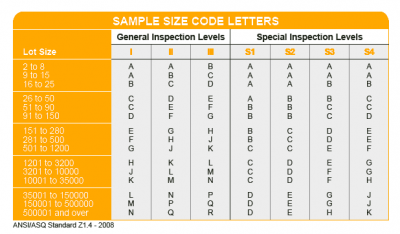 AQL Table | How to Read It
 TOP 10 Common Defects in Garments Quality Inspection
 Product Packaging and Shipment Label requirements for Amazon FBA
 What Is ASTM-F2413-18? Protective Footwear Standard
 How to Conduct Third-Party Quality Control Inspections for Electric Scooters
 SMETA Audit-What is SMETA Audit?
 TESTCOO Supplier Verification/Certification Service SLCP, Higg FEM, GRS, GOTS
 Quality Control Inspection Company in China
 What is Quality Inspection? A Complete Guide
 Guidelines for Product Inspection in India
Category
- Production Inspection Service
- Factory Audit
- Softline Inspection
- Hardline Inspection
- Electrics Inspection
- Certification
- Checklist
- Manufacturers
- Quality Assurance Basics
- Products Recall
- AQL
- Guidence and Standard
- News
- Supplier Management
- Amazon
- Protective Equipment
- e-commerce quality control
- Indian Manufacturing
- Soft Goods Quality Control
- Supply Chain Management
- Supply Chain Resilience
- E-Commerce Quality Control
- ISO 2859
- Supply Chain Optimization
- Garment Industry
- Higg Index