


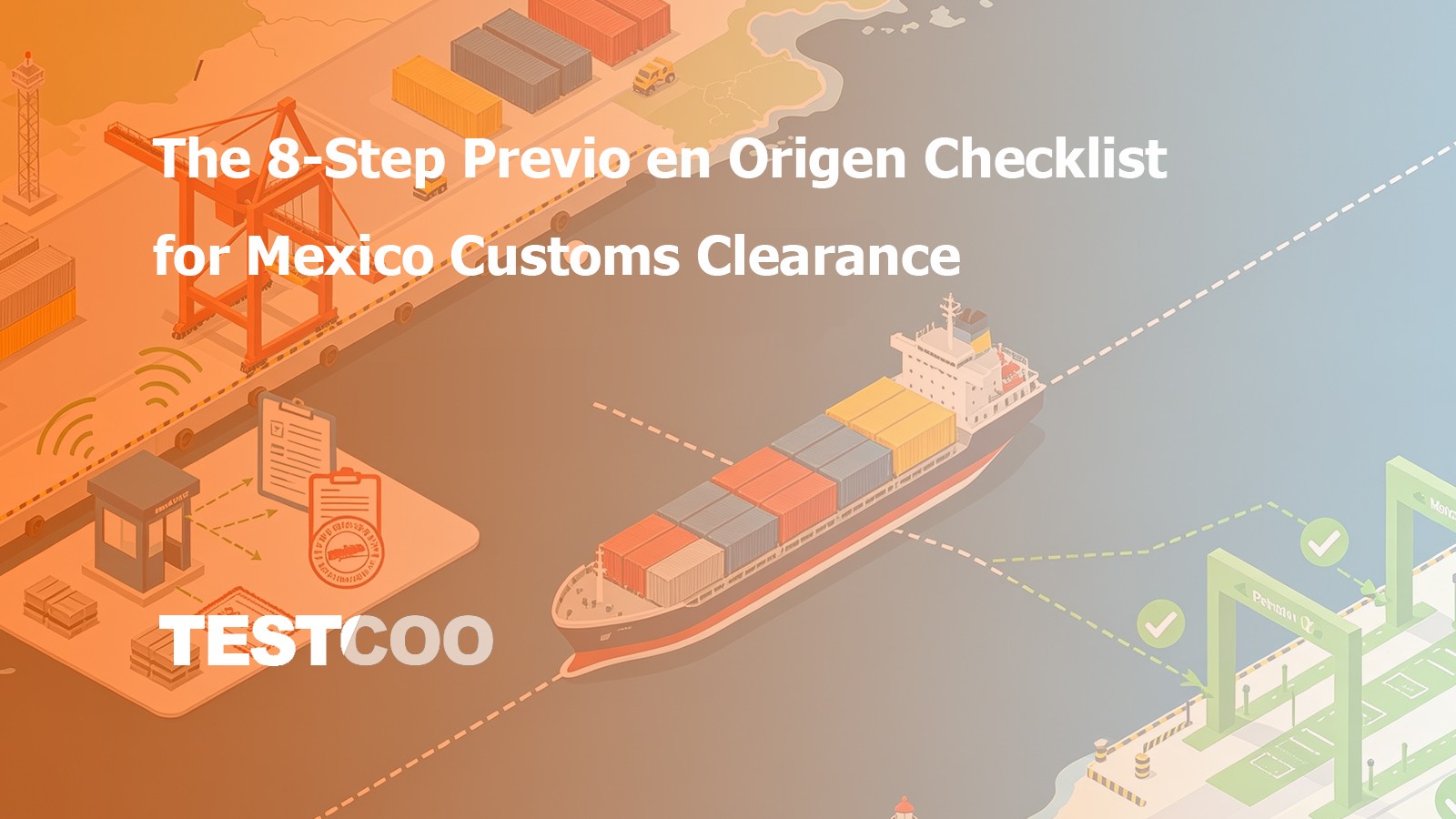
The 8-Step Previo en Origen Checklist for Mexico Customs Clearance
However, this strategic move is not without its operational complexities. While the physical distance is shorter, the regulatory distance between a factory floor in Asia (or even within Mexico) and the final point of sale can be vast. For procurement and supply chain managers accustomed to manufacturing in less regulated environments, the reality of importing into Mexico can be a rude awakening.
Mexican customs, operated by the National Customs Agency of Mexico (ANAM), is renowned for its diligence. It operates under a legal framework that mandates strict compliance with documentary and physical requirements. When cargo arrives at a Mexican port of entry, whether at a land crossing like Laredo or Tijuana, or a seaport like Manzanillo or Veracruz and does not perfectly match the import declaration (pedimento), it is flagged for a mandatory physical inspection known as a reconocimiento aduanero.
This is where the supply chain breaks down. A standard pre-shipment quality inspection, which verifies that goods are not defective, does not suffice for Mexican customs. If an HS code is slightly incorrect, if the physical piece count is off by even a few units, or if mandatory NOM (Normas Oficiales Mexicanas) labels are missing or incorrect, the shipment is immediately detained.
Cargo detention is not merely a delay; it is a financial catastrophe. The shipment is moved to a bonded warehouse, where daily storage charges (almacenaje) and demurrage fees on the container begin to accrue, often reaching hundreds of dollars per day. These costs, combined with potential government fines and the expense of re-labeling goods inside the customs zone, can quickly erase the profit margin of an entire shipment. Furthermore, the resulting delays in distribution can damage critical retail relationships.
The strategic solution to this high-stakes bottleneck is not to avoid inspections, but to shift the verification process upstream. This is achieved through a Previo en Origen (PEO).
Understanding the Previo en Origen (PEO)
A Previo en Origen, translated as "Prior Inspection at Origin," is a high-scrutiny compliance verification performed by third-party experts while the goods are still securely at the overseas manufacturing facility before they are loaded into the container.
While a standard Pre-Shipment Inspection (PSI) answers the question, "Is this product well-made and defect-free?", a PEO inspection answers a fundamentally different, legally focused question: "Does this specific cargo physically match the official import paperwork and does it satisfy every single regulatory mandate required by Mexican law?"
By conducting a PEO, importers gain the ability to identify and rectify discrepancies while it is still inexpensive and easy to do so at the factory. If cartons are mislabeled, they can be re-labeled in China. If the quantity is incorrect, the factory can remedy it before the goods leave the gate.
This proactive approach ensures that when the container arrives at the Mexican border, the physical goods and the digital documentation (the draft pedimento) are in perfect 100% alignment. This facilitates a "green light" or "desaduanamiento libre," allowing the cargo to clear customs in hours rather than weeks.
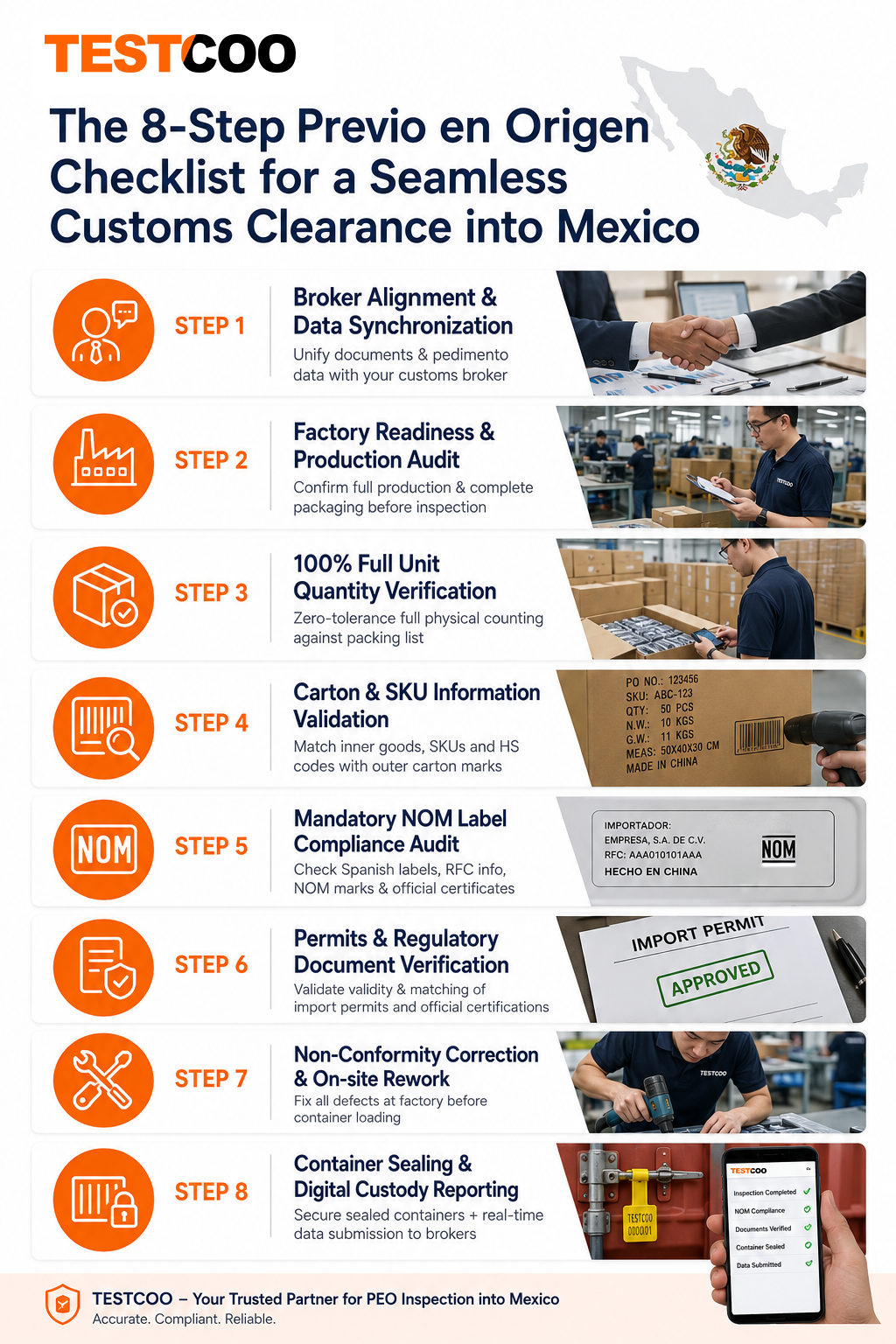
To execute a successful PEO, you cannot rely on ad hoc checks. You need a standardized, rigorous methodology. Follow this critical 8-step checklist.
The 8-Step PEO Operational Checklist
This checklist outlines the actions required to transform a high-risk border crossing into a seamless logistical operation.
Step 1: Broker Alignment and Data Synchronization
The foundation of a successful PEO is data. An inspection is useless if the inspector is verifying the goods against the wrong information. It is critical to establish a seamless communication loop between the purchasing team, the supplier, the inspection body and your designated Mexican customs broker (agente aduanal).
The Action: The importer must ensure that the Mexican customs broker is provided with all final commercial documents: the commercial invoice, the detailed packing list and any applicable certificates of origin (e.g., USMCA/T-MEC) to claim preferential duty treatment, before the inspection begins.
The PEO Goal: The inspection company must be armed with the same draft pedimento data that the broker intends to file with ANAM. The inspector’s role is to physically verify the cargo against this specific data set.
Step 2: Factory Readiness and Production Audit
Before an inspector steps foot on the manufacturing floor, the supply chain must verify that production milestones have actually been met to avoid wasted inspection fees or incomplete verification cycles.
The Action: Confirm with the vendor that 100% of the goods are manufactured and at least 80% to 100% are fully packed and ready for distribution before dispatching the third-party inspector to the overseas warehouse.
The PEO Goal: To ensure that the inspector has access to the full, consolidated batch rather than fragmented production runs, guaranteeing a comprehensive evaluation.
Step 3: Rigorous 100% Piece Count Verification
This is the most significant operational difference between a standard quality check and a PEO. Standard pre-shipment inspections for quality almost always utilize AQL (Acceptable Quality Limit) statistical sampling tables (e.g., ISO 2859-1). This is acceptable for determining if an overall batch meets quality standards, but it is wholly unacceptable for Mexican customs compliance.
Mexican customs operates on a near-zero-tolerance policy for quantity discrepancies. If a shipment is declared as 10,000 units and a physical inspection reveals there are 10,005 or 9,995 units, the shipment will be detained on suspicion of contraband or tax evasion.
The Action: The PEO inspector must perform a rigorous 100% physical count of all master cartons being shipped. In cases of high-value or highly regulated goods, it may be necessary to open master cartons and count individual inner boxes to verify the total unit count matches the packing list.
The PEO Goal: To reconcile exact physical quantities against the draft packing list. If a carton is labeled as containing 50 pieces, the inspector must verify that there are indeed 50 pieces inside. This eliminates "short-ship" (which causes inventory issues) or "over-ship" (which causes customs issues) discrepancies.
Step 4: Master Carton & SKU Integrity Check
Beyond the total carton count, the contents of individual master cartons must correspond precisely to the declared Stock Keeping Units (SKUs). Problems frequently arise in mixed-container shipments when cartons are not properly segregated, or when exterior carton markings do not accurately reflect the actual merchandise inside.
The Action: The PEO inspector does not just count sealed cartons; they must randomly (or systematically, depending on the shipment size) open master cartons to verify that the SKU, color, size, or model variant inside matches what is written on the outside of the carton and on the commercial invoice.
The PEO Goal: To ensure accurate segregation and declaration of goods. This is especially crucial when different items within the same container carry different Harmonized System (HS) tariff codes. Misdeclaring an HS code, even accidentally, to fall into a lower duty category is a major compliance violation. The PEO verifies that the goods match the codes your broker is using.
Step 5: Detailed NOM (Normas Oficiales Mexicanas) Compliance Audit
This is arguably the single most important regulatory hurdle for imports into Mexico. The Official Mexican Standards (Normas Oficiales Mexicanas, or NOMs) are mandatory safety and commercial information standards for a vast array of products, including electronics, textiles, toys, pre-packaged foods and tires.
Products that require NOM compliance cannot be legally commercialized in Mexico without the correct labeling. If goods arrive at the border without the required NOM mark on the product or packaging, or if the information on the label is incorrect, the cargo will be seized.
The Action: The PEO inspector conducts a meticulous audit of product and packaging labeling against the specific NOM standard applicable to that product category.
The PEO Goal: To verify that all mandatory information is present, accurate and in Spanish, including the specific NOM mark, importer name/address/RFC tax ID, country of origin and electrical/safety ratings. The inspector validates that physical labels match the official NOM certificate held by the importer of record.
Step 6: Verification of Permits and Certifications
For certain sensitive or highly regulated goods, standard customs documentation is not enough. Importers must possess specific import permits from Mexican government agencies such as the Ministry of Economy (Secretaría de Economía), COFEPRIS (for health-related products) and SEMARNAT (for environmental regulations).
The Action: The PEO inspector verifies that all necessary NOM certificates, import permits, or NOM exemption letters are not only available but that they are valid and correspond exactly to the specific goods being packed (down to the model number and serial number ranges, if applicable).
The PEO Goal: To prevent situations where a product is detained because the specific model number is not explicitly covered by the general import permit on file. The PEO acts as a final documentary cross-check before the goods enter the high-risk transit phase.
Step 7: Corrective Action & Reworking (If Deficiencies Found)
Catching an error at the factory level is only valuable if there is a protocol in place to fix it before the container doors are locked.
The Action: If the inspector flags non-compliant labels, missing pieces, or damaged units during the audit, the importer mandates a factory rework window. Workers correct labels, sort out defective pieces, or adjust counts on the spot.
The PEO Goal: To ensure absolute compliance is achieved before the goods transition out of the origin facility, turning potential border failures into resolved minor hiccups.
Step 8: Container Sealing and Digital Chain of Custody & Reporting
Once the Previo en Origen is fully complete and any corrective actions are finalized, the final step involves locking down the cargo and transmitting data instantly to stakeholders.
The Action: The PEO inspector witnesses the loading of goods into the container, applies a high-security serialized bolt seal and logs the exact serial number alongside photographic proof. Simultaneously, the inspection data is fed directly into a digital platform for the customs broker.
The PEO Goal: To establish an unbroken digital chain of custody and allow the Mexican customs broker to finalize the pedimento filing accurately before the vessel or truck reaches the border.
Case Study: The Cost of Skipping a Previo
To understand the value of this checklist, consider a real-world scenario frequently encountered in nearshoring operations.
- The Company: A US-based electronics manufacturer shipping consumer headphones from a contract manufacturer in Shenzhen to their distribution center in Mexico City.
- The Process: They book a standard Pre-Shipment Inspection (PSI) for quality, which passes with a 2.5 AQL. They then proceed to ship the container.
- The Border Crossing: The container arrives at the Laredo crossing. Mexican customs selects the shipment for a reconocimiento aduanero (physical inspection).
- The Findings:
- NOM Labeling: The customs agent finds that the importer's RFC (tax ID) is missing from the Spanish language warning label on the individual retail boxes.
- Piece Count: The manifest declares 5,000 units. The physical count finds 4,992 units, a discrepancy of 8 units caused by factory packing errors.
- The Consequences:
- Cargo Detention: The shipment is impounded in a bonded warehouse.
- Storage & Demurrage: The container sits for 14 days while waiting for a resolution. Daily fees: $350 USD (storage) + $200 USD (chassis rental/demurrage) = $7,700 USD in direct costs.
- Fines: A fine is levied by ANAM for the inaccurate declaration (the piece count discrepancy), totaling approximately $3,000 USD.
- Rework Costs: A local re-labeling service must be hired to open all 500 master cartons, unpack the 4,992 units, apply the correct stickers and repack. Cost: $4,500 USD.
- Total Tangible Costs: $15,200 USD.
- Intangible Costs: Two weeks of stockouts for major retail partners, leading to lost sales and potential damage to long-term business relationships.
How a PEO Checklist Would Have Prevented This: A PEO inspection following the 8-step framework would have identified the missing RFC on the NOM label in Shenzhen for immediate correction and discovered the piece count error during the 100% verification step, avoiding the $15,200 USD in penalties and fees entirely.

Frequently Asked Questions (FAQ)
Q1: What is the key difference between a Final Random Inspection (FRI) and a Previo en Origen (PEO)?
While a Final Random Inspection (FRI) focuses on product quality, workmanship defects and functionality using statistical sampling (AQL), a Previo en Origen (PEO) is a strict customs and regulatory compliance audit. A PEO involves a 100% physical piece count, exact SKU verification against the draft pedimento and a comprehensive check of mandatory Mexican regulations like NOM labeling to ensure seamless customs clearance.
Q2: Is a Previo en Origen mandatory under Mexican Customs Law (Ley Aduanera)?
No, performing the inspection at origin is not strictly required by law; however, 100% accuracy upon entry into Mexico is mandatory. Under Ley Aduanera, any discrepancy between your physical cargo and import documentation results in mandatory physical inspections (reconocimiento aduanero), fines and potential cargo seizure. A PEO makes compliance proactive rather than reactive.
Q3: How far in advance should I schedule a Previo en Origen inspection?
You should schedule a PEO as soon as production reaches 100% completion and at least 80% to 100% packaging readiness. Ideally, book the inspector 3 to 5 days before your planned container loading date to allow sufficient time for inspection, data synchronization with your agente aduanal and any necessary factory reworks.
Q4: What happens if non-compliance or labeling errors are found during a PEO?
Because the inspection happens at origin, non-compliant items can be fixed immediately. If mandatory NOM labels are missing information (like the importer’s RFC ID) or piece counts are inaccurate, the factory can re-label, repack, or adjust numbers on the spot before the container is locked, preventing costly border delays and re-labeling fees in Mexico.
Q5: Can a Previo en Origen be performed for shipments originating outside of Asia?
Yes. While high-volume manufacturing often takes place in Asia, a PEO can be conducted at any origin warehouse or factory globally, including Europe, South America, or even within the US before cross-border trucking, to guarantee that cargo heading to Mexican ports or land borders meets ANAM regulatory requirements.
Securing Your Supply Chain with Expert PEO Services
Executing a Previo en Origen inspection is not a task for inexperienced generalists. It requires hands-on field expertise, thorough mastery of Mexico’s Ley Aduanera (Customs Law), plus the capability to quickly dispatch certified inspectors with specialized know-how of NOM labeling specifications across various product categories.
Never leave your cross-border compliance to luck. Work with TESTCOO’s expert team to arrange certified inspectors stationed right at your overseas manufacturing hubs.
Our digital platform offers unmatched transparency and enables real-time data synchronization with your customs broker. With our 8-step PEO checklist, we turn high-risk border clearance into a predictable and hassle-free logistics process.


Free Sample Report Performance Quality Control
Download a sample report to keep control of your supply chain!

Featured Articles
 AQL Table | How to Read It
 TOP 10 Common Defects in Garments Quality Inspection
 Product Packaging and Shipment Label requirements for Amazon FBA
 What Is ASTM-F2413-18? Protective Footwear Standard
 How to Conduct Third-Party Quality Control Inspections for Electric Scooters
 SMETA Audit-What is SMETA Audit?
 TESTCOO Supplier Verification/Certification Service SLCP, Higg FEM, GRS, GOTS
 Quality Control Inspection Company in China
 What is Quality Inspection? A Complete Guide
 Guidelines for Product Inspection in India
Category
- Production Inspection Service
- Factory Audit
- Softline Inspection
- Hardline Inspection
- Electrics Inspection
- Certification
- Checklist
- Manufacturers
- Quality Assurance Basics
- Products Recall
- AQL
- Guidence and Standard
- News
- Supplier Management
- Amazon
- Protective Equipment
- e-commerce quality control
- Indian Manufacturing
- Soft Goods Quality Control
- Supply Chain Management
- Supply Chain Resilience
- E-Commerce Quality Control
- ISO 2859
- Supply Chain Optimization
- Garment Industry
- Higg Index