


AQL Calculator and Quality Checks: From Inspection Data to Quality Decisions
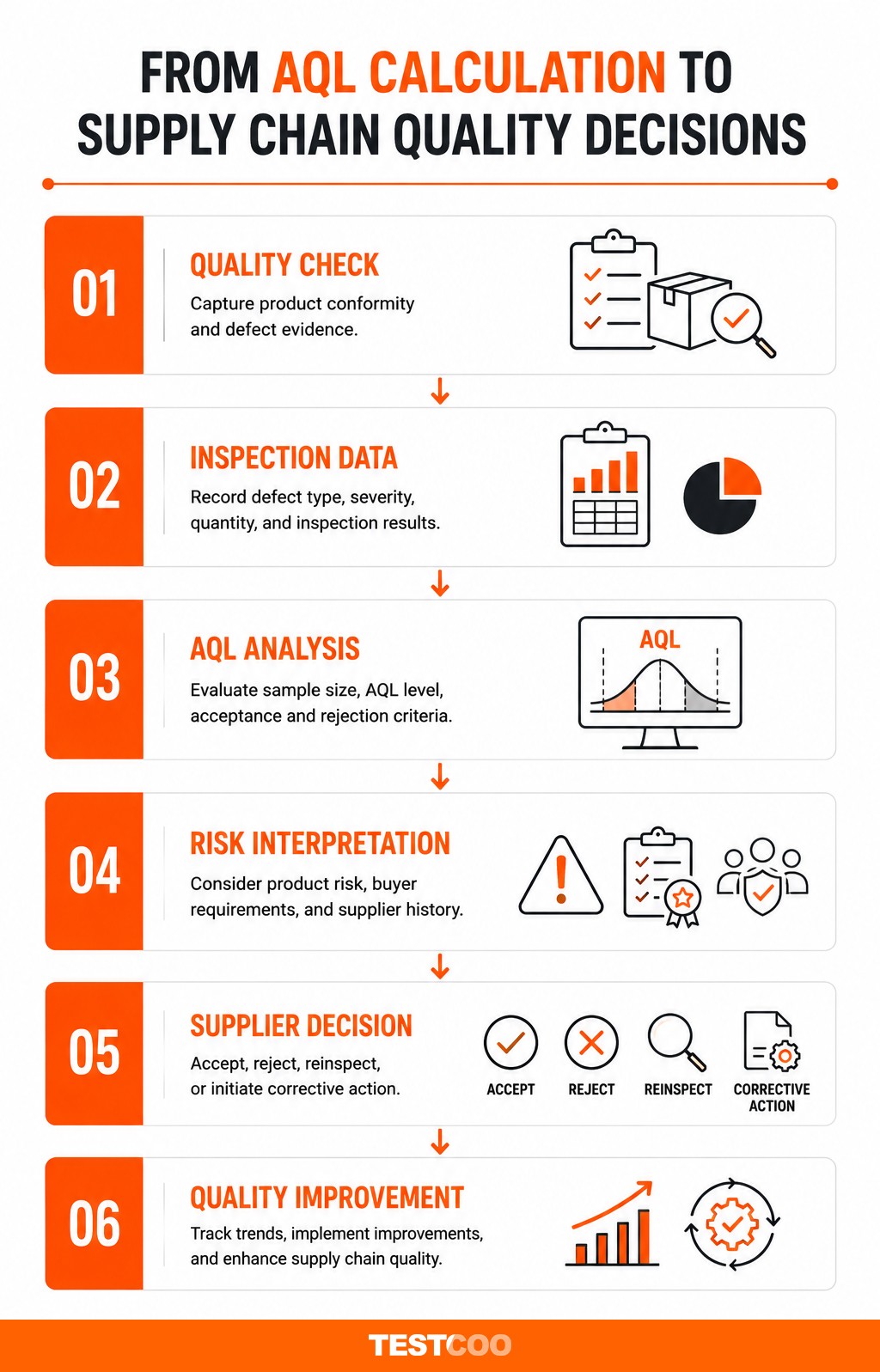
In modern textile and manufacturing supply chains, a quality check is more than a final inspection used to identify defective products. Properly structured inspection data can reveal whether defects are isolated incidents, recurring process problems or indicators of broader supplier quality risks. As buyers manage increasingly complex supplier networks, quality teams need to evaluate inspection results alongside product specifications, defect severity, supplier history and production conditions rather than relying on a simple pass or fail outcome. This article examines how quality checks generate actionable quality information, how defect classification and historical inspection data support better decisions and how these insights can strengthen supplier quality management and supply chain risk control.
What Does a Quality Check Really Tell You About Product Risk?
A quality check provides structured evidence about product conformity, production consistency and potential supplier risks. Its value depends not only on finding defects, but also on understanding the nature, frequency, severity and recurrence of those defects and what they reveal about the underlying production process.
How Quality Checks Move Beyond Simple Defect Detection
A quality check should answer more than whether a product passes or fails inspection. The inspection process provides an opportunity to determine what went wrong, how frequently the problem occurs and whether the finding represents an isolated product defect or a broader production issue.
A structured quality check should therefore capture information such as:
- Defect type and severity
- Location or production stage of the defect
- Quantity or frequency of defects
- Applicable product specifications
- Inspection and sampling results
- Relevant production or supplier information
This approach turns inspection from a simple defect detection activity into a source of quality intelligence that can support subsequent decisions.
Why Defect Classification Matters for Quality Decisions
Defect classification is important because not every nonconformity creates the same level of product or commercial risk. Critical, major and minor defects may have very different consequences depending on the product, buyer requirements, intended use and applicable compliance obligations.
A measurement deviation in an apparel order, for example, may affect fit and customer acceptance, while incorrect product labeling may create a broader compliance or market access concern. Similarly, a cosmetic fabric imperfection may have a different commercial impact from a defect that affects product functionality or safety.
Consistent classification allows quality teams to evaluate inspection findings against defined acceptance criteria rather than relying heavily on individual inspector judgment. It also creates more useful historical data, making it easier to identify which defect categories contribute most frequently to supplier quality problems.
However, defect classification should not be viewed in isolation. A defect that appears infrequently may still require immediate attention if it involves product safety, regulatory compliance, or a critical customer requirement.
How Inspection Results Build Supplier Quality Intelligence
Individual inspection reports become significantly more valuable when they are analyzed across orders, production periods and suppliers. Historical quality data can reveal patterns that are difficult to identify from a single inspection.
For example, if one garment factory repeatedly shows measurement deviations across several orders, the issue may indicate weaknesses in production specifications, operator training, or internal quality controls. Similarly, repeated fabric shade variation from a particular supplier may indicate problems in dyeing consistency or material control rather than isolated defects in individual shipments.
By comparing inspection results over time, companies can evaluate:
- Recurring defect patterns
- Supplier quality performance
- Inspection failure trends
- Corrective action effectiveness
- Quality differences between factories or production periods
This broader view helps companies move from reacting to individual inspection failures toward managing supplier quality based on evidence. It also provides a stronger foundation for sourcing decisions, supplier improvement programs and risk-based inspection planning.
Ultimately, the purpose of a quality check is not simply to determine whether a shipment can proceed. Its greater value lies in generating reliable information that helps companies understand where quality risks originate, how frequently they occur and whether suppliers are improving over time.
Read More: Quality Check in Manufacturing: A Step-by-Step Guide for Global Buyers
An AQL calculator supports inspection decisions by translating lot size, inspection level, sample size, AQL value and defect results into a structured sampling decision. Its primary value is consistency: rather than relying on informal judgment to determine how many units to inspect or how many defects can be accepted, quality teams can apply a defined sampling methodology to comparable inspection scenarios.
What Inputs Does an AQL Calculator Actually Use?
An AQL calculator typically works with several inspection parameters, including the lot size, inspection level, selected AQL values and the applicable sampling plan. These inputs determine the sample size and the corresponding acceptance and rejection criteria for the inspection.
An apparel shipment may contain thousands of garments, but inspecting every unit may not be practical. An AQL-based sampling plan provides a structured method for selecting a representative sample and establishing the criteria used to evaluate the inspection result. The calculator therefore helps quality teams move from the total production quantity to a defined inspection scope.
The selected AQL should also reflect the applicable product requirements and buyer specifications. It should not be treated as a universal number that can be applied to every product, supplier, or order.
Why Does Sample Size Not Automatically Determine Inspection Quality?
A larger sample does not necessarily mean that an inspection provides better quality control. Inspection effectiveness depends on how the sampling plan is designed and executed, how defects are classified and whether the selected criteria are appropriate for the product and its risk profile.
AQL sampling should therefore be viewed as one component of a broader inspection system. The quality of the decision depends on the relationship between sampling methodology, inspection execution, product requirements and risk management.
How Should AQL Results Be Interpreted Beyond Pass or Fail?
An AQL result should be interpreted as a sampling-based acceptance decision, not as proof that every unit in the lot is defect free. A lot that meets the applicable acceptance criteria may still contain defective units outside the inspected sample.
Quality teams should therefore consider the inspection result together with defect severity, product specifications, buyer requirements, supplier history and previous inspection performance. A failed result should similarly trigger further analysis rather than being treated as an isolated numerical outcome.
For suppliers with recurring inspection failures, the appropriate response may involve root cause analysis, corrective action, additional inspections, or supplier performance review. This makes AQL more useful as part of a broader quality decision process rather than simply a calculator that produces an acceptance or rejection result.
Read More:AQL: A Practical Guide to Product Inspection | Testcoo

How Should Companies Choose AQL Levels for Different Product Risks?
Companies should choose AQL levels according to product risk, defect severity, customer requirements and the consequences of quality failure rather than applying a single default value across all inspections. AQL selection should support the company's overall quality strategy while remaining consistent with applicable sampling standards, buyer specifications and contractual requirements.
Why Does One AQL Level Not Fit Every Product?
Different products carry different quality and commercial risks, so applying the same AQL approach to every product can create an inappropriate level of inspection control. An apparel product, household appliance, electronic device and safety related component may have very different consequences when a defect reaches the market.
For textile products, appearance and workmanship requirements may be particularly important, while other products may place greater emphasis on functional performance or safety. Companies should therefore consider the intended use of the product, customer expectations, regulatory obligations and the potential consequences of nonconformity when establishing inspection criteria.
How Do Critical, Major and Minor Defects Affect AQL Decisions?
Defect classification provides an important foundation for applying AQL criteria because critical, major and minor defects can have substantially different consequences.
A critical defect may create a safety or regulatory concern and therefore require controls beyond a conventional sampling acceptance decision. Major defects may affect product function, usability, appearance, or customer acceptance, while minor defects may have a lower impact on the product's intended use.
This distinction allows inspection teams to evaluate defects according to their potential consequences rather than treating every defect as equivalent. In practice, companies should establish clear definitions and acceptance criteria before inspection begins so that inspectors, suppliers and buyers share the same understanding of what constitutes an acceptable result.
AQL should also not be used to override mandatory safety or regulatory requirements. Where a specific product requirement requires compliance, that requirement remains applicable regardless of the calculated sampling outcome.
When Should Buyer Specific Requirements Take Priority?
Buyer specific inspection requirements should take priority when they are contractually agreed or form part of the applicable product specification. Retailers and brands may establish their own inspection manuals, defect classifications, sampling requirements, or acceptance criteria based on their product categories and risk tolerance.
For suppliers serving multiple international buyers, this can create different inspection requirements for otherwise similar products. Quality teams therefore need to confirm the applicable specification and inspection protocol for each order rather than automatically applying a standard AQL setting.
A mature inspection program should connect AQL methodology with buyer requirements, product risk, defect classification and supplier performance. This approach prevents AQL from becoming a purely numerical exercise and makes it a practical component of risk based quality management.
How Can Quality Check Data Improve Supplier Quality Management?
Quality check data becomes more valuable when companies use it to identify supplier trends rather than treating each inspection report as an isolated record. By analyzing inspection results across orders, factories and production periods, quality teams can identify recurring defects, evaluate supplier performance and determine where corrective or preventive action is needed.
How Can Historical Inspection Data Reveal Recurring Defects?
A single inspection failure may result from an isolated production error, but repeated findings across different orders can indicate a deeper supplier quality problem. Historical inspection data allows companies to identify patterns that may not be visible from individual reports.
For textile suppliers, recurring issues may include sewing defects, measurement deviations, fabric shade variation, packaging errors, or incorrect labeling. Tracking these findings over time helps quality teams determine whether the problem is associated with a specific factory, product category, production line, or season.
This information can also support more targeted supplier improvement. Instead of repeatedly identifying the same defect during final inspection, companies can investigate the underlying production process and require corrective action before the problem affects additional orders.
How Can Digital Inspection Systems Make AQL and Quality Checks More Effective?
Digital inspection systems make AQL and quality checks more effective by connecting inspection execution, reporting, supplier information and historical quality data within a centralized workflow. The goal is not simply to replace paper or spreadsheets with digital forms, but to make inspection information easier to access, compare, analyze and act upon.
How Does Centralized Inspection Data Improve Quality Visibility?
When inspection schedules, orders, inspection results, supplier information and reports are managed through disconnected spreadsheets and emails, quality teams can struggle to obtain a complete view of ongoing inspection activities. Digital inspection management brings these records into a more structured workflow.
Centralized data also creates a stronger foundation for comparing supplier performance and identifying recurring quality risks across different orders and sourcing regions.
How Can Testcoo Connect Inspection Results With Supplier Performance?
Testcoo integrates inspection management with supplier and quality data so that inspection results can contribute to broader supplier performance analysis. Instead of treating an AQL result as an isolated pass or fail record, companies can connect inspection findings with historical orders, defect trends, supplier KPIs and corrective action follow up.
This can help quality teams identify patterns such as repeated sewing defects from a specific factory, increasing quality issues during peak production periods, or persistent problems with particular product categories. These insights support more informed supplier evaluation and quality improvement decisions.
Testcoo therefore positions inspection data as part of a broader supply chain quality management process rather than as a standalone inspection report.
How Does Testcoo Support Consistent Inspection Execution?
Testcoo supports standardized digital inspection workflows that help companies maintain consistency across suppliers, orders and inspection teams. Inspection processes can incorporate defined inspection requirements, AQL sampling procedures, defect classification, reporting workflows and inspector performance management.
Standardization is particularly important when companies operate across multiple sourcing regions where inspection execution may otherwise vary between factories or inspection teams. Consistent workflows improve the comparability of inspection results and strengthen the traceability of quality records.
By combining standardized inspection execution with centralized data and supplier performance visibility, Testcoo supports companies in turning routine quality checks into a more scalable quality management process.
Frequently Asked Questions
1.Is an AQL calculator enough to decide whether a shipment should be accepted?
No. An AQL calculator supports sampling and acceptance decisions, but it does not replace product specifications, inspection procedures, defect classification, or buyer requirements. The final quality decision should also consider the severity of defects, inspection findings, supplier history and applicable compliance requirements.
2.Does passing an AQL inspection mean the entire lot is defect free?
No. AQL inspection uses sampling, so the result provides an acceptance decision based on the inspected sample rather than proving that every unit in the lot is defect free. Companies should therefore interpret AQL results together with product risk, inspection evidence and supplier quality history.
3.Can companies use different AQL levels for critical, major and minor defects?
Yes. Defect classifications can be subject to different acceptance criteria because critical, major and minor defects present different levels of product and commercial risk. However, safety or regulatory requirements should not be treated as ordinary AQL acceptance criteria and may require additional controls.
4.What is the difference between an AQL calculator and an inspection checklist?
An AQL calculator helps determine sampling and acceptance criteria based on the applicable sampling plan, while an inspection checklist defines what inspectors need to examine and verify. They serve different purposes and work best together within a standardized inspection process.
5.Can AQL be used for every type of product inspection?
AQL sampling can be used across many manufacturing and quality inspection applications, but the appropriate sampling approach depends on the product, inspection objective, applicable standards and buyer requirements. Some safety, functional, regulatory, or high-risk characteristics may require additional testing or inspection beyond AQL sampling.
How Can Companies Turn Quality Check Data Into Better Inspection Decisions?
A quality check should be more than a final pass or fail decision. When AQL sampling, defect classification, inspection results, supplier history and corrective actions are connected, companies can gain a clearer understanding of product and supplier risk. This allows quality teams to identify recurring defects, evaluate supplier performance and move from isolated defect detection toward more consistent and preventive quality management.
Digital inspection systems can further strengthen this process by centralizing inspection workflows, quality records, supplier performance data and corrective action tracking. Testcoo supports companies in standardizing inspection execution, improving supplier quality visibility and turning inspection data into actionable quality intelligence. By combining structured AQL inspection with broader supplier and quality management, companies can make more informed decisions while improving operational efficiency and long term supply chain quality.




Free Sample Report Performance Quality Control
Download a sample report to keep control of your supply chain!

Featured Articles
 AQL Table | How to Read It
 TOP 10 Common Defects in Garments Quality Inspection
 Product Packaging and Shipment Label requirements for Amazon FBA
 What Is ASTM-F2413-18? Protective Footwear Standard
 How to Conduct Third-Party Quality Control Inspections for Electric Scooters
 SMETA Audit-What is SMETA Audit?
 TESTCOO Supplier Verification/Certification Service SLCP, Higg FEM, GRS, GOTS
 Quality Control Inspection Company in China
 What is Quality Inspection? A Complete Guide
 Guidelines for Product Inspection in India
Category
- Production Inspection Service
- Factory Audit
- Softline Inspection
- Hardline Inspection
- Electrics Inspection
- Certification
- Checklist
- Manufacturers
- Quality Assurance Basics
- Products Recall
- AQL
- Guidence and Standard
- News
- Supplier Management
- Amazon
- Protective Equipment
- e-commerce quality control
- Indian Manufacturing
- Soft Goods Quality Control
- Supply Chain Management
- Supply Chain Resilience
- E-Commerce Quality Control
- ISO 2859
- Supply Chain Optimization
- Garment Industry
- Higg Index