


Vietnam RSL Compliance 2026: Do You Need Testing for Every Shipment or Rely on Customs Checks?
Vietnam’s textile and apparel export sector is facing increasing scrutiny in 2026 as chemical compliance enforcement becomes more closely integrated with customs procedures. While the regulatory framework itself, primarily defined by national technical regulation QCVN 01:2017/BCT and Circular 21/2017/TT-BCT, has not introduced radically new substance limits, the way compliance is verified has evolved. Exporters are no longer only evaluated based on pre-export documentation, but also through risk-based customs inspections that can occur without prior notice at major ports such as Hai Phong. This shift has created uncertainty around testing frequency, cost control and responsibility allocation across the supply chain.
Understanding how Vietnam balances mandatory compliance requirements with increasingly active spot-check mechanisms is therefore essential for exporters aiming to reduce delays, avoid penalties and maintain consistent shipment performance.
What Is Vietnam’s RSL Regulation Framework and What Does It Require?
Vietnam’s Restricted Substances List (RSL) requirements for textiles are defined through a combination of national technical regulations and ministerial circulars, forming a relatively focused but strictly enforced compliance system. The framework is primarily built on QCVN 01:2017/BCT, which establishes chemical limits for textile products and Circular 21/2017/TT-BCT, which governs how these requirements are implemented and enforced in practice.
Defined Chemical Scope
Compared with broader international systems such as EU REACH, Vietnam’s RSL framework is more narrowly defined, concentrating on a limited number of high-risk substances commonly associated with textile finishing processes. The regulation focuses primarily on formaldehyde content and azo dyes that release carcinogenic aromatic amines.
Key limits include:
- Formaldehyde:
- ≤30 mg/kg for infant products
- ≤75 mg/kg for products in direct skin contact
- ≤300 mg/kg for non-direct contact products
- Azo dyes:
- ≤30 mg/kg for each restricted aromatic amine
These thresholds are specified in QCVN 01:2017/BCT and aligned with international baseline safety expectations, although the scope is significantly narrower than multi-substance frameworks such as REACH.
Compliance Requirements and Declaration Mechanism
In Vietnam, compliance is not only defined by substance limits but also by a formal conformity declaration process (DoC)that must be completed before products are circulated in the market. This process requires exporters or importers to demonstrate that products meet QCVN requirements through testing and documentation.
Key requirements include:
- Product testing conducted by recognized laboratories
- Submission of conformity declaration documents
- Retention of technical files for inspection
Unlike some markets that mandate third-party certification, Vietnam allows a combination of:
- Self-declaration based on test results
- Certification via designated conformity assessment bodies
However, authorities retain the right to verify compliance at any stage, especially during customs clearance. This creates a system where compliance is mandatory, but testing frequency is not explicitly fixed by law.
Read More: Vietnam: A Booming Hub for Quality Inspections and Audits
Are RSL Tests Mandatory for Every Shipment in Vietnam?
Within Vietnam’s dual compliance framework—where mandatory conformity requirements coexist with risk-based customs spot checks—RSL testing is not legally required for every individual shipment, but full compliance with QCVN 01:2017/BCT remains обязатель at all times.
Vietnam’s regulatory approach focuses on ensuring that products meet defined chemical limits rather than prescribing fixed testing frequency. Exporters are therefore expected to maintain valid conformity documentation supported by test reports and technical files, which can be requested during customs clearance or post-market surveillance. This means that while testing is not explicitly mandated per shipment, the ability to demonstrate compliance is mandatory.
In practice, this creates a gap between regulation and commercial expectations. International buyers often require batch-level testing for each order to mitigate downstream liability, effectively transforming a flexible regulatory requirement into a fixed operational standard. Exporters who attempt to reduce testing frequency may lower immediate costs, but they increase exposure to customs spot checks, where unverified shipments face a higher risk of detention and re-testing.
A more effective approach is to adopt a risk-based testing strategy, aligning testing frequency with supplier stability, material risk level and production consistency, rather than applying uniform testing across all shipments.
Why Are Shipments Randomly Checked for RSL at Ports
As Vietnam increasingly shifts from pre-export compliance reliance to customs-driven spot check enforcement, shipments are selected for RSL inspection based on a dynamic risk evaluation system rather than random or arbitrary selection.
Rather than applying a fixed inspection ratio, customs authorities evaluate shipments dynamically based on multiple risk indicators. These include the exporter’s historical compliance record, the consistency of submitted documentation, product classification and even anomalies in declared values or materials. As Vietnam continues to digitize its customs infrastructure, these risk signals are increasingly processed through integrated systems, allowing authorities to trigger inspections with greater precision.
In this context, being selected for inspection does not necessarily indicate that a shipment has been specifically targeted. Instead, it reflects a broader regulatory trend in which compliance verification is shifting from pre-export certification to real-time enforcement at the border. Exporters with stable compliance performance may still be inspected periodically, while those with inconsistent documentation or prior issues are likely to face more frequent checks.
Read More: Final Random Inspection: Your Last Line of Defense Before Shipping
Has Vietnam Increased RSL Inspection Frequency in 2026?
Under the evolving balance between mandatory compliance obligations and enhanced customs spot check mechanisms, Vietnam has not officially increased inspection frequency through fixed quotas, but enforcement intensity has effectively risen in practice.
One of the key drivers behind this shift is the ongoing modernization of Vietnam’s chemical management and customs systems. Regulatory updates have enhanced coordination between compliance authorities and customs, enabling more efficient identification of high-risk shipments. At the same time, digitalization efforts have improved data sharing and risk profiling capabilities, allowing customs to expand inspection coverage without formally changing inspection ratios.
As a result, exporters are experiencing what can be described as a perceived increase in inspection frequency, particularly for textile products. This is further amplified by stricter document verification processes, where incomplete or inconsistent conformity declarations can trigger additional scrutiny even before physical sampling occurs.
For exporters, the implication is clear: compliance risk is no longer limited to whether products meet chemical thresholds, but also depends on how consistently compliance is documented and presented across shipments.
What Happens If RSL Testing Fails at Vietnam Customs?
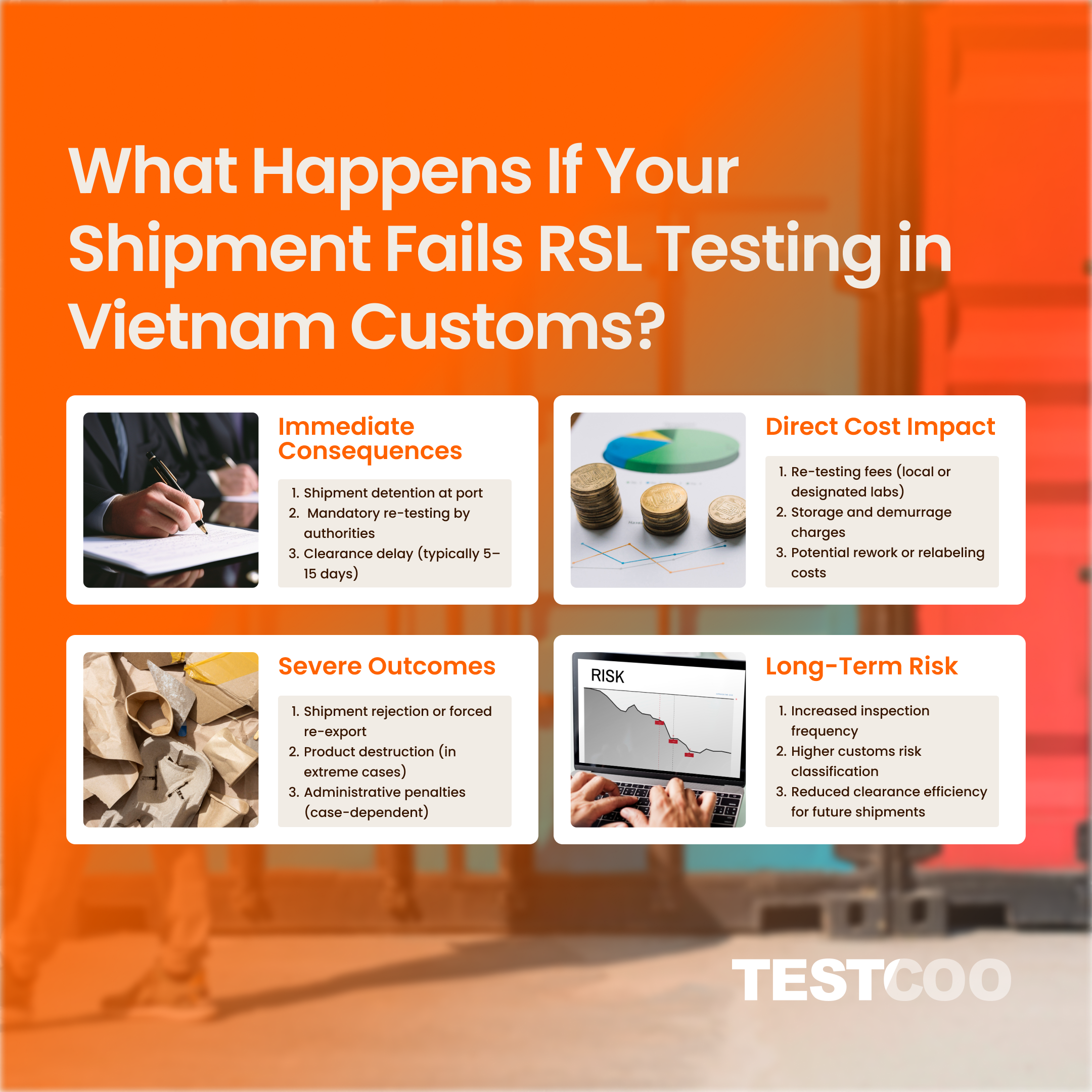
At the initial stage, shipments are typically detained and subjected to mandatory re-testing, either to confirm results or to provide the exporter with an opportunity to verify compliance through designated laboratories. During this period, cargo remains at the port, generating storage and demurrage costs that can accumulate rapidly.
If non-compliance is confirmed, authorities may impose several actions:
- Administrative penalties based on violation severity
- Requirement for re-export or withdrawal from the market
- Destruction of goods in severe cases involving safety risks
Beyond immediate penalties, failed inspections can significantly affect future shipments. Vietnam customs applies a risk profiling mechanism, meaning that exporters associated with non-compliant shipments may be classified as higher risk, leading to increased inspection frequency and longer clearance times going forward.
In addition, the commercial impact often extends upstream and downstream in the supply chain. Buyers may impose contractual penalties and disputes can arise between material suppliers and garment manufacturers regarding responsibility for the failure.
Read More: Services Quality Inspection in Vietnam
How Does RSL Inspection Work for LCL Shipments?
Within Vietnam’s customs spot check framework, LCL (less-than-container-load) shipments introduce additional compliance complexity, as inspection is conducted at the shipment declaration level rather than strictly by individual purchase orders.
This creates a structural risk in LCL logistics, where products from different factories, materials, or production batches are grouped together. Even if most goods in the container meet compliance requirements, the presence of one failing item can trigger broader inspection actions, including extended detention or expanded sampling.
In practice, customs may:
- Select samples from specific product lines within the shipment
- Expand inspection scope if inconsistencies are identified
- Apply control measures to the entire declaration if risk is confirmed
For exporters, this means that LCL shipments require stricter upstream coordination, particularly in supplier selection and material control. Without consistent RSL compliance across all contributing parties, the cost advantage of LCL shipping can be offset by increased inspection risk and potential delays.
Who Pays If Fabric Passes but Garment Fails RSL Testing?
When RSL compliance is assessed through final-stage verification such as customs spot checks, discrepancies between fabric-level and garment-level test results can create complex liability issues across the supply chain.
When fabric-level testing indicates compliance but the finished garment fails RSL testing, responsibility allocation becomes a complex issue involving both technical and contractual factors. From a technical perspective, compliance at the fabric stage does not guarantee that the final product will meet chemical requirements, as additional processes such as dyeing, printing, washing and finishing can introduce or alter restricted substances.
This means that responsibility must be evaluated across multiple stages of production, including:
- Fabric sourcing and initial chemical composition
- Wet processing and finishing treatments
- Handling, storage and contamination risks
In commercial practice, liability is rarely determined solely by test results and is instead governed by contractual agreements between parties. Fabric suppliers are typically responsible for the compliance of raw materials, while garment manufacturers assume responsibility for the final product delivered to buyers. However, in export scenarios, buyers often hold the final exporter or manufacturer accountable, regardless of where the issue originated.
As a result, cost allocation for re-testing, delays, or shipment replacement can vary significantly depending on contract terms. Without clearly defined quality agreements, disputes may arise over who should bear:
- Re-testing costs
- Production rework expenses
- Logistics delays or air freight replacements
To mitigate this risk, exporters increasingly implement integrated quality control systems that combine material verification, during production inspection and final product testing, ensuring that compliance is maintained throughout the entire production chain rather than validated only at isolated stages.
Frequently Asked Questions (FAQs)
1. Is RSL testing mandatory for every shipment in Vietnam?
No, but all products must comply with QCVN 01:2017 and customs may request proof at any time.
2. Why was my shipment randomly tested at Hai Phong port?
Vietnam customs uses a risk-based system where textile shipments are frequently selected for spot checks.
3. Has Vietnam increased RSL inspection frequency in 2026?
There is no fixed increase, but enforcement has become stricter with higher inspection probability.
4. What happens if RSL testing fails at customs?
Shipments may be detained, re-tested, fined, or even rejected depending on the severity.
↵
5. How can exporters reduce RSL compliance risks?
By implementing risk-based testing, supplier control and during production inspection.
How Can Third-Party Testing and Inspection Reduce RSL Risks in Vietnam?
As Vietnam’s RSL enforcement increasingly relies on customs-side verification rather than fixed pre-export testing requirements, the role of third-party testing and inspection has shifted from optional quality support to a critical component of risk management. Exporters are no longer only managing compliance at a documentation level, but across the entire production lifecycle, where inconsistencies in materials, processes, or supplier performance can lead to unexpected failures during customs checks.
Third-party inspection providers help bridge this gap by introducing independent verification at key control points, ensuring that compliance is not left to final-stage testing alone. Instead of reacting to failures at the port, exporters can proactively identify and mitigate risks earlier in the production process, where corrective actions are still feasible and cost-efficient.
A structured third-party approach typically includes:
- Material-level verification to confirm that fabrics and trims meet RSL requirements before production begins
- During Production Inspection (DUPRO) to monitor chemical risk factors introduced during dyeing, printing, or finishing processes
- Final Random Inspection (FRI) testing coordination to validate final product compliance before goods leave the factory
- Documentation review and conformity support to ensure alignment with QCVN 01:2017/BCT and customs expectations
This integrated model is particularly valuable in complex supply chains, such as LCL shipments or multi-supplier production, where a single point of failure can impact the entire shipment. By combining on-site inspection with laboratory testing oversight, exporters gain greater visibility into compliance consistency and reduce reliance on last-minute verification.
From a commercial perspective, the cost of implementing third-party inspection is typically lower than the cumulative impact of customs delays, re-testing, shipment rejection, or buyer claims. More importantly, it enables exporters to move from a reactive compliance model to a predictive and controlled system, which is increasingly necessary under Vietnam’s evolving regulatory environment.
At Testcoo, we support exporters with tailored RSL compliance solutions across Vietnam, including on-site inspection, coordinated laboratory testing and real-time reporting. Our localized teams and standardized workflows help identify risks early, ensure consistency across production batches and reduce the likelihood of customs disruption. By integrating testing and inspection into your production process, you can achieve more stable compliance outcomes while maintaining cost efficiency and delivery reliability.

Free Sample Report Performance Quality Control
Download a sample report to keep control of your supply chain!

Featured Articles
 AQL Table | How to Read It
 TOP 10 Common Defects in Garments Quality Inspection
 Product Packaging and Shipment Label requirements for Amazon FBA
 What Is ASTM-F2413-18? Protective Footwear Standard
 How to Conduct Third-Party Quality Control Inspections for Electric Scooters
 SMETA Audit-What is SMETA Audit?
 TESTCOO Supplier Verification/Certification Service SLCP, Higg FEM, GRS, GOTS
 Quality Control Inspection Company in China
 What is Quality Inspection? A Complete Guide
 Guidelines for Product Inspection in India
Category
- Production Inspection Service
- Factory Audit
- Softline Inspection
- Hardline Inspection
- Electrics Inspection
- Certification
- Checklist
- Manufacturers
- Quality Assurance Basics
- Products Recall
- AQL
- Guidence and Standard
- News
- Supplier Management
- Amazon
- Protective Equipment
- e-commerce quality control
- Indian Manufacturing
- Soft Goods Quality Control
- Supply Chain Management
- Supply Chain Resilience
- E-Commerce Quality Control
- ISO 2859
- Supply Chain Optimization
- Garment Industry
- Higg Index