


Why Retail Brands Depend on Third-Party Inspection Companies for Apparel Quality
To achieve this consistency, a growing number of retailers are turning to external experts. In fact, the global Third Party Garment Inspection market was valued at US$ 468 million in 2024 and is projected to reach USD 603 million by 2031, growing at a CAGR of 3.7%. This growth underscores a fundamental shift in how quality is managed.
This article explores the strategic reasons behind this dependency, answering the key questions retail professionals have about third-party inspection.
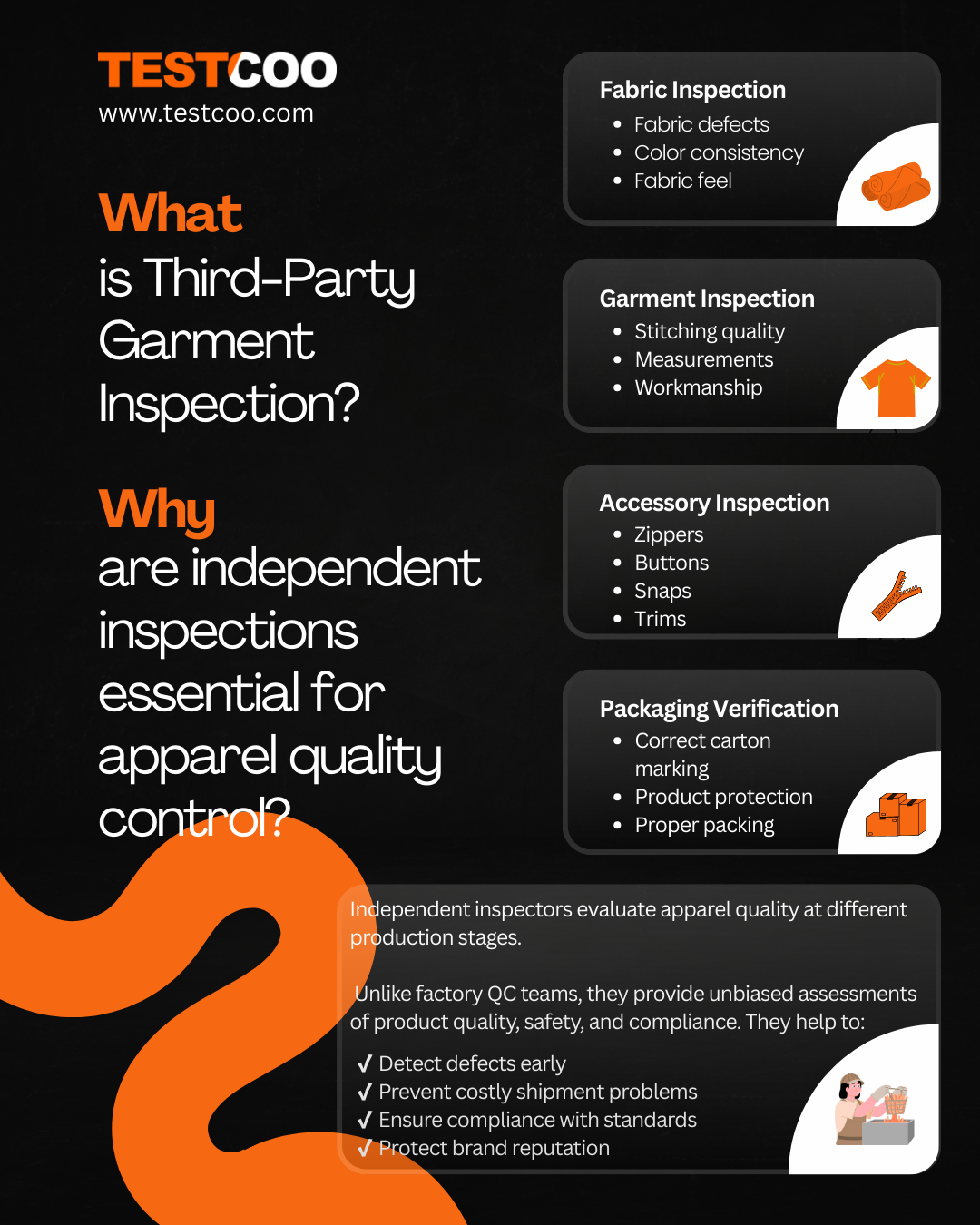
What Exactly is Third-Party Garment Inspection and Why Is It Necessary?
Third-party garment inspection involves hiring an independent, external organization to examine apparel at various stages of production. Unlike in-house teams employed by the brand or the factory’s internal quality controllers, third-party inspectors provide an unbiased assessment of product quality, safety and compliance.
These inspections cover a wide range of parameters, including:
- Fabric Inspection: Checking for defects, color consistency, and feel.
- Clothing Inspection: Evaluating stitching, dimensions, and workmanship.
- Accessory Inspection: Testing zippers, buttons, and snaps for durability.
- Packaging Verification: Ensuring cartons are correctly marked and products are protected for transit.
The necessity arises from the geographical and cultural distance between retailers (often in the US or Europe) and manufacturers (primarily in Asia). Brands cannot physically be present in every factory every day. Third-party inspectors act as their eyes and ears on the ground, providing objective data to make informed decisions before shipments leave the country.
How Do Third-Party Inspections Reduce Financial Risk and Returns?
One of the most compelling reasons to use third-party inspection is the direct impact on the bottom line. Product failures lead to returns, chargebacks, and lost customers. Third-party testing helps ensure that your product performs as expected—and that you have the documentation to prove it.
Here is how independent verification mitigates financial risk:
- Early Detection of Failure Modes: Testing can uncover issues such as premature wear, poor dimensional stability, color fading, and moisture sensitivity before full-scale production. Catching these issues early reduces costly rework and prevents bad products from being shipped.
- Reducing Return Rates: Services like OETI Slovakia’s ‘Fit & Proof’ label specifically help online retailers benefit from reduced return rates due to improved fit and durability testing. Fit is the number one reason for apparel returns; independent verification ensures the garment matches the size chart.
- Protecting Against Liability: In a dispute, documentation is everything. A third-party lab report provides objective evidence of compliance and proof that due diligence was performed, significantly reducing liability exposure.
Read more: Launching Your First Fashion Line? Your Essential Initial Production Check Checklist
What Unbiased Value Do Independent Inspectors Provide Over Internal Teams?
While internal teams are essential for daily process control, they can sometimes face conflicts of interest. The debate between third-party and in-house inspection is a classic one in the industry.
Third-party inspection agencies like Testcoo provide neutral and unbiased quality checks. Their advantages include:
- Objectivity: They are factory production pressures or internal brand politics. They follow the facts and the data.
- Global Standards: They are inherently trusted by global buyers and strictly follow international Acceptable Quality Level (AQL) standards like AQL 2.5/4.0.
- Professional Reports: They deliver standardized, professional reports with photographic evidence that are recognized worldwide.
In contrast, in-house inspectors, while more familiar with the brand's specific nuances, can sometimes be biased under pressure from production deadlines.
As noted by industry experts, the best approach often combines both: "Internal can do initial, mid and pre final but for the final inspection third party is best". For the final sign-off, the neutrality of a third party is invaluable.
Read more to find the difference between Third-Party QC and In-House QC
How Do Third-Party Companies Ensure Compliance with International Standards?
Compliance is a legal necessity. Markets in the EU and United States have strict regulations regarding garment labeling, chemical safety, and flammability. Incorrect or missing labels can see your product rejected at customs, or land you with a fine.
Third-party inspectors ensure compliance by:
- Label Verification: Checking that labels contain required information: fiber content, country of origin, care instructions, and manufacturer details.
- Chemical Safety Testing: Verifying compliance with standards like OEKO-TEX or REACH to ensure garments are free from harmful substances.
- Performance Standards: Conducting tests based on recognized methods such as ASTM International, AATCC textile tests, and ISO performance specifications.
Using an ISO/IEC 17025-accredited laboratory is critical here. This accreditation means test procedures are validated, equipment is calibrated, and technicians are qualified—ensuring results are accurate and defensible in court.
Read more: ASTM vs. ISO: Key Differences in Global Standards for Quality & Compliance
What Are the Core Quality Control Procedures Performed During an Inspection?
A standard garment inspection is a rigorous process. Whether you use in-house quality control inspectors or a third-party QC service, these fundamental steps must be included:
- Measuring Garment Dimensions: Inspectors measure critical points (sleeve length, chest width, neck opening) against your specifications. Tolerances are strictly enforced—for example, a ¼ inch discrepancy on a chest measurement might be acceptable, but the same error on a sleeve length could be a fail.
- Accessories Testing: This includes pull tests for zippers (pulling with a set force for 10 seconds), fatigue tests for snaps (repeatedly buttoning and unbuttoning 50 times), and stretch tests for elastic bands.
- Workmanship and Appearance: Visual checks against an approved sample ensure style, color (using Pantone charts), and logos are correct. For striped fabrics, inspectors ensure the stripes match up at the seams.
- Safety Checks: A needle detection check ensures no broken needle fragments are left in the garment, which is a critical safety step.
- Packaging and Barcode Verification: Inspectors verify that cartons are the correct size, polybags have proper warnings, and barcodes are scannable and linked to the correct product information.
Read more: Common Fabric Defects in Garment Manufacturing and How to Identify Them During Inspection
Frequently Asked Questions (FAQs)
1. What is the difference between 2nd-party and 3rd-party inspection?
2nd-party inspection refers to an inspection conducted by the buyer themselves or their directly employed representatives visiting the factory. 3rd-party inspection is conducted by an independent external company (like Testcoo, SGS, Intertek etc. ) that has no stake in the manufacturing or purchasing contract, ensuring complete neutrality.
2. What does "AQL" stand for in garment inspection?
AQL stands for Acceptable Quality Level. It is a statistical sampling method used to determine whether a batch of products meets the quality standards. The most common standard in apparel is AQL 2.5 for major defects, meaning the inspection allows for a limited, statistically insignificant number of defects in the sample size.
3. Can third-party inspectors conduct tests for fabric quality like colorfastness?
Yes. Third-party textile labs conduct a wide range of fabric tests, including colorfastness (to washing, rubbing, and light), fabric strength, seam slippage, and dimensional stability (shrinkage). These tests go beyond visual checks and require specialized lab equipment.
4. Are third-party inspections only for large retail brands, or can small businesses use them?
Small businesses can and should use them. Many inspection companies offer flexible pricing. For smaller batches, some manufacturers bundle QC into the unit price, while standalone inspectors may offer mini-inspections or charge a fixed fee per man-day, which can be cost-effective for ensuring a critical first shipment meets standards.
5. What happens if a third-party inspection finds defects?
If an inspection reveals defects exceeding the agreed AQL limit, the buyer is alerted immediately. The buyer can then negotiate remediation procedures with the factory, which may include rework (fixing the defects), a discount on the shipment, or rejection of the entire batch. The detailed third-party report serves as the official documentation for these negotiations.
Why Global Buyers Choose TESTCOO to Conduct Apparel Quality Inspection
The dependence of retail brands on third-party inspection companies is not a sign of weakness, but a strategy for resilience. In an era where a single viral complaint about quality can damage a brand built over decades, independent verification is the most effective insurance policy available.
Testcoo is a 3rd party quality control inspection service agency, which is fully accredited by ISO9001, ISO 27001, CNAS17020 and AQSIQ. We offer product inspection services (IPC, DUPRO and FRI), Loading Supervision, Sample Picking, Supplier Audit and QIP (Quality Improvement Project Service).
Brands choose us for the following reasons:
- • A dedicated staff is assigned to follow up your inspection request from start to end to ensure a smooth communication.
- • Unique online platform with individual access empowers to book inspection and review report at anytime and anywhere.
- • Highly competitive and all-inclusive rate providing a better service than other companies in the market is our key differentiator.
- • World-class interactive dashboards and reports helps the brands to make business decisions.
If you’re looking for a reliable third party inspection company to conduct your Apparel Quality Inspections, then look no further. Visit our website www.testcoo.com for more information.

Free Sample Report Performance Quality Control
Download a sample report to keep control of your supply chain!

Featured Articles
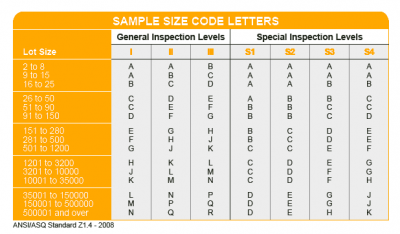 AQL Table | How to Read It
 TOP 10 Common Defects in Garments Quality Inspection
 Product Packaging and Shipment Label requirements for Amazon FBA
 What Is ASTM-F2413-18? Protective Footwear Standard
 How to Conduct Third-Party Quality Control Inspections for Electric Scooters
 SMETA Audit-What is SMETA Audit?
 TESTCOO Supplier Verification/Certification Service SLCP, Higg FEM, GRS, GOTS
 Quality Control Inspection Company in China
 What is Quality Inspection? A Complete Guide
 Guidelines for Product Inspection in India
Category
- Production Inspection Service
- Factory Audit
- Softline Inspection
- Hardline Inspection
- Electrics Inspection
- Certification
- Checklist
- Manufacturers
- Quality Assurance Basics
- Products Recall
- AQL
- Guidence and Standard
- News
- Supplier Management
- Amazon
- Protective Equipment
- e-commerce quality control
- Indian Manufacturing
- Soft Goods Quality Control
- Supply Chain Management
- Supply Chain Resilience
- E-Commerce Quality Control
- ISO 2859
- Supply Chain Optimization
- Garment Industry
- Higg Index