


Indonesia Apparel Quality Control Guide: Inspection Standards and During Production Practices for Exporters
↵
Indonesia is one of Southeast Asia’s key manufacturing bases for apparel and footwear, supplying global brands with high-volume production capacity.
However, quality consistency remains a challenge due to variations in factory capability, subcontracting structures and production control systems.
For exporters and brands, understanding local inspection practices, apparel quality benchmarks and during production inspection (DUPRO) methodologies is essential to maintaining product standards and avoiding shipment risks.
What Quality Standards Apply to Apparel Manufacturing in Indonesia?
Indonesia’s apparel manufacturing sector operates under a hybrid quality framework, combining national regulations, international standards and buyer-specific requirements. Unlike highly regulated markets, compliance in Indonesia is largely driven by export requirements and third-party verification, rather than a single mandatory national system.
1. National Standards and Regulatory Framework
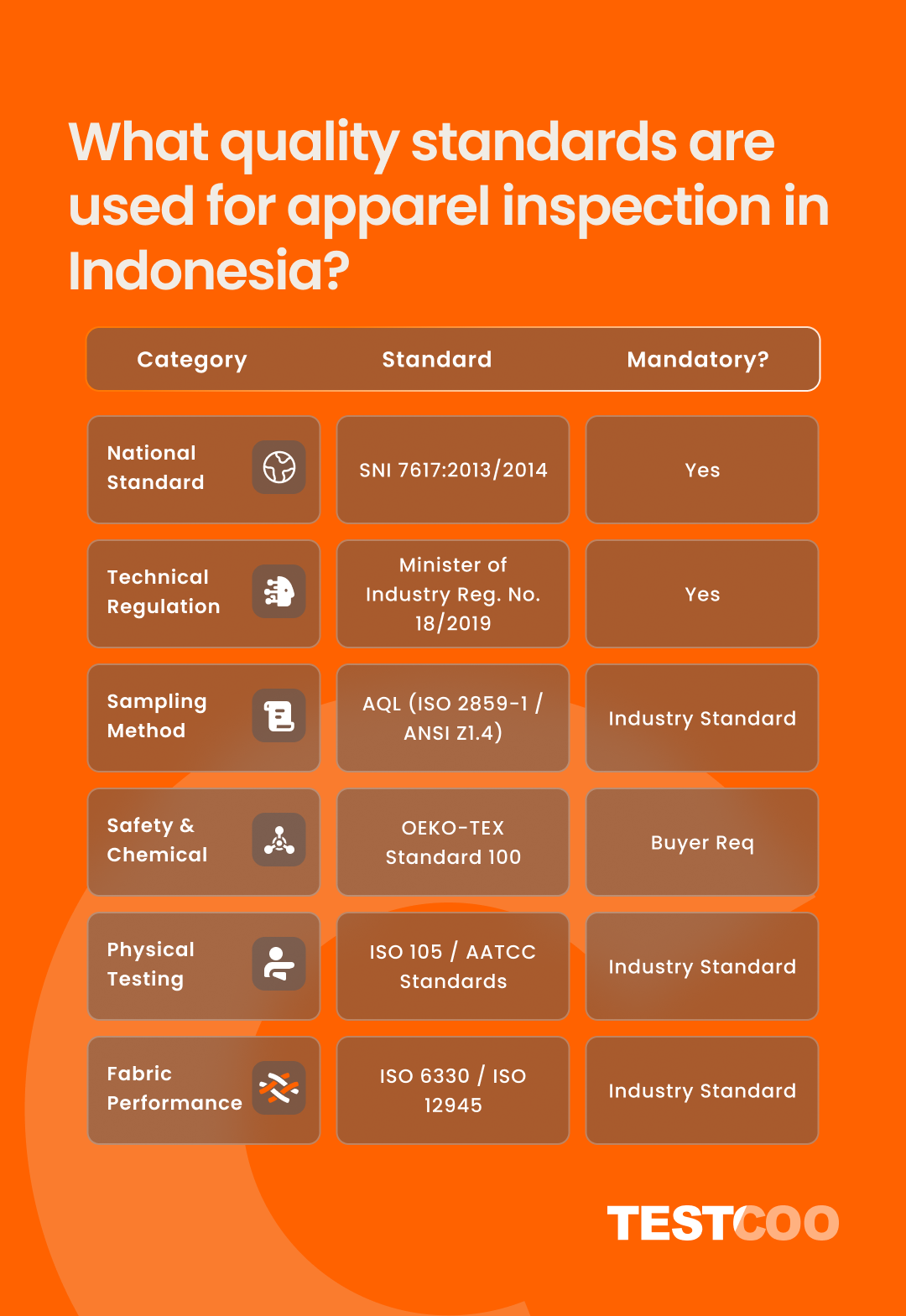
At the national level, SNI 7617:2013/2014 serves as a key reference for textile and garment-related product requirements. While not always strictly enforced for all export categories, it provides a baseline for product safety, labeling and performance.
Additionally, Minister of Industry Regulation No. 18/2019 defines broader industrial compliance requirements, including:
- Product conformity expectations
- Manufacturing process controls
- Market access requirements for regulated goods
For exporters, these regulations mainly become relevant when:
- Supplying to the Indonesian domestic market
- Working with government-linked buyers
- Producing regulated product categories
2. Sampling and Inspection Standards
Quality inspection in Indonesia is predominantly based on the AQL (Acceptable Quality Limit) system, aligned with:
- ISO 2859-1
- ANSI Z1.4
This system defines:
- Sampling size
- Acceptance/rejection criteria
- Defect classification (Critical / Major / Minor)
In practice:
- Most international buyers define their own AQL levels (e.g., 2.5 / 4.0)
- Factories rarely implement strict statistical QC internally without third-party involvement
This makes external inspection essential to ensure consistent application of AQL protocols.
3. Safety and Chemical Compliance
Chemical safety requirements are typically aligned with OEKO-TEX Standard 100, especially for:
- Children’s wear
- Skin-contact garments
Key control points include:
- Restricted substances (azo dyes, formaldehyde, heavy metals)
- Fabric chemical residues
- Dyeing and finishing processes
In Indonesia, risks often arise due to:
- Inconsistent chemical management across dyeing mills
- Subcontracted processing without full traceability
4. Physical and Performance Testing Standards
Fabric and garment performance is usually tested against internationally recognized standards such as:
- ISO 105 (color fastness testing)
- AATCC standards (washing, rubbing, perspiration tests)
These tests evaluate:
- Color fastness to washing, rubbing and light
- Dimensional stability (shrinkage)
- Fabric durability
5. Fabric Performance and Material Standards
Discover key fabric performance and material standards vital for textile quality. This guide covers crucial assessments like ISO 6330 for domestic washing and drying and ISO 12945 for pilling resistance, ensuring durable and reliable textiles.
Material-level performance is commonly assessed using:
These standards are critical for:
- Ensuring consistency between sample and bulk production
- Preventing post-sale quality claims
6. Social Compliance and Quality Management Systems
Beyond product quality, global buyers require compliance with:
These frameworks evaluate:
- Working conditions
- Ethical sourcing practices
- Supply chain transparency
At the factory level, many manufacturers are certified under:
- ISO 9001:2015 (quality management systems)
However, certification does not always guarantee execution quality, making process-level inspection still necessary.
In Indonesia, apparel quality is not governed by a single enforceable system but by a multi-layered structure combining international standards, buyer requirements and third-party inspection protocols.
As a result, quality consistency depends less on certification and more on how effectively these standards are implemented and verified during production.
What Are the Critical Apparel Quality Control Points in Indonesian Factories?
Apparel quality control in Indonesia is highly dependent on process-level execution, as many factories operate with varying levels of quality management maturity. Effective control requires monitoring each production stage rather than relying solely on final inspection.
1. Incoming Material Control (Fabric and Trims)
This is the first and most critical checkpoint, as defects introduced here will propagate throughout production.
Key controls include:
- Fabric GSM verification (weight consistency)
- Color matching against approved lab dips
- Fabric defect inspection (holes, stains, weaving defects)
- Trim verification (labels, zippers, buttons)
Common issues in Indonesia:
- Bulk fabric not matching approved samples
- Inconsistent dye lots across batches
2. Cutting Stage Control
Errors at the cutting stage directly affect garment sizing and alignment.
Inspection focus:
- Marker accuracy and fabric utilization
- Pattern alignment (especially for striped or printed fabrics)
- Ply alignment during bulk cutting
Typical risks:
- Misalignment leading to visual defects
- Size deviations due to inaccurate cutting
3. Sewing and Assembly Control
This stage represents the highest defect concentration point.
Critical checkpoints:
- Stitch density (SPI – stitches per inch)
- Seam strength and durability
- Thread tension consistency
- Workmanship (no loose threads, skipped stitches)
Indonesia-specific challenges:
- High reliance on manual labor
- Operator skill variability
- Production line speed pressure
4. Inline Quality Control (During Production Inspection Integration)
Inline checks are often weak or inconsistently applied in local factories.
Best practice includes:
- Random sampling during sewing
- Real-time defect identification
- Immediate corrective action
Without proper inline QC:
- Defects are repeated across large quantities
- Problems are only discovered at final inspection
5. Finishing and Final Appearance Control
At this stage, the focus shifts to product presentation and compliance.
Inspection points:
- Ironing quality
- Garment cleanliness (stains, oil marks)
- Thread trimming
- Shape retention
Common issues:
- Poor finishing due to rushed timelines
- Inconsistent visual appearance across batches
6. Measurement and Size Control
Measurement accuracy is a major source of buyer complaints.
Key requirements:
- Compliance with size tolerance charts
- Consistency across sampled units
Typical defects:
- Garments outside tolerance range
- Size variation within the same batch
7. Packing and Labeling Compliance
Final checks ensure products meet buyer and regulatory requirements.
Includes:
- Correct labeling (size, care instructions, country of origin)
- Barcode and packaging accuracy
- Carton marking compliance
Risks:
- Mislabeling leading to customs or retail issues
- Incorrect assortment ratios
In Indonesian apparel factories, quality risks are rarely isolated—they are usually systematic and process-driven.
Without structured control across material, cutting, sewing and finishing stages, defects can scale quickly during mass production. This is why integrating during production inspection into these control points is critical for maintaining consistent apparel quality.
How Does During Production Inspection Improve Apparel Quality Control?
During Production Inspection (DUPRO), conducted at 20%-50% production completion, is vital for apparel quality. Its core function is to detect systematic defects early, preventing their spread. This process significantly reduces rework costs, avoids shipment delays and stabilizes bulk production quality.
- DUPRO timing: typically at 20%–50% production completion
- Core function:
- Detect systematic defects early
- Prevent defect replication across batches
Key inspection activities:
- Inline product checks
- Measurement verification
- Workmanship evaluation
- Practical impact:
- Reduces rework cost
- Prevents shipment delays
- Stabilizes bulk production quality
What Are the Key Footwear Inspection Checkpoints in Indonesia?
- Footwear inspection in Indonesia focuses on critical checkpoints: upper material quality, assembly control, workmanship and functional testing. Addressing local risks like manual process inconsistencies and glue variability is key to quality.
- Upper material inspection:
- Color variation
- Material defects
- Assembly control:
- Sole bonding strength
- Alignment of upper and outsole
- Workmanship checks:
- Glue marks
- Stitching consistency
- Functional testing:
- Flexing resistance
- Adhesion testing
- Common Indonesia-specific risks:
- Manual processes leading to inconsistency
- Glue application variability
What Defects Are Most Common in Apparel and Footwear Production in Indonesia?
In Indonesian apparel production, common defects include measurement inconsistencies, uneven stitching, and undetected fabric flaws. For footwear, delamination, color mismatches between pairs and poor finishing are frequently observed. These issues often stem from a lack of inline quality control, intense production speed pressure and insufficient operator training.
Apparel Defects
- Measurement out of tolerance
- Uneven stitching
- Fabric defects not detected early
- Delamination
- Color mismatch between pairs
- Poor finishing
Root Causes
- Lack of inline QC
- Production speed pressure
- Insufficient operator training
Related Article: Common Fabric Defects & How to Spot Them in Inspection
How Should Exporters Structure an Inspection Plan in Indonesia?
To ensure consistent apparel quality in Indonesia, exporters should implement a multi-stage inspection plan aligned with production milestones, rather than relying solely on final inspection. A structured approach helps detect defects early, control process deviations and reduce shipment risks.
1. Define Quality Standards and Technical Requirements
Before production begins, exporters must clearly establish:
Product specifications (materials, measurements, workmanship standards)
Reference samples (golden sample / pre-production sample)
Applicable standards:
- AQL levels (e.g., 2.5 / 4.0)
- Fabric and performance testing standards (ISO, AATCC)
- Chemical compliance (e.g., OEKO-TEX Standard 100)
This step ensures alignment between buyer expectations and factory execution.
2. Conduct Initial Production Check (IPC)
The Initial Production Check is conducted at the early stage of production to verify:
- Raw materials (fabric, trims) match approved specifications
- Production setup and machinery readiness
- Factory understanding of technical requirements
In Indonesia, this step is critical due to:
- Frequent subcontracting
- Variability in material sourcing
3. Implement During Production Inspection (DUPRO)
The During Production Inspection (DUPRO) is the most important control stage.
Recommended timing:
- When 20%–50% of goods are completed
Inspection focus:
- Workmanship quality (stitching, assembly)
- Measurement consistency
- Inline defect detection
- Production process stability
DUPRO helps:
- Identify systematic issues early
- Prevent large-scale defect repetition
- Enable corrective actions before production completion
4. Perform Pre-Shipment Inspection (PSI)
The Final Random Inspection is conducted when production is at least 80%–100% complete and goods are packed.
Key checks include:
- AQL-based sampling inspection
- Final workmanship evaluation
- Measurement verification
- Packaging and labeling compliance
However, in Indonesia:
- PSI alone is insufficient if earlier stages are not controlled
- It should serve as a final verification step, not the primary quality control method
5. Apply AQL Sampling Method Consistently
AQL (ISO 2859-1 / ANSI Z1.4) should be applied across inspections to ensure:
- Statistical consistency
- Clear acceptance/rejection criteria
- Standardized defect classification
Exporters should define:
- Acceptable defect limits
- Critical vs major vs minor defect thresholds
6. Integrate Footwear and Apparel-Specific Inspection Criteria
For mixed production (common in Indonesia), inspection plans should include:
Apparel focus:
- Stitching quality
- Measurement tolerances
- Fabric defects
Footwear focus:
- Bonding strength
- Material alignment
- Functional durability
This ensures product-specific risks are properly controlled.
7. Use Third-Party Inspection for Independent Verification
Due to varying factory QC capabilities, third-party inspection provides:
- Objective quality assessment
- Standardized inspection procedures
- Local expertise and faster response
It also improves:
- Transparency
- Communication between buyers and factories
- Consistency across multiple suppliers
An effective inspection plan in Indonesia is process-driven rather than checkpoint-driven. Exporters who integrate IPC, DUPRO and FRI with clear standards and AQL methodology can significantly reduce defects, improve consistency and ensure that apparel and footwear products meet buyer expectations before shipment.
Frequently Asked Questions (FAQs)
1. What quality standards are used for apparel inspection in Indonesia?
Apparel inspection in Indonesia is based on a combination of national standards such as SNI, international frameworks including ISO and AATCC testing methods, AQL sampling systems and buyer-specific requirements, with compliance typically verified through third-party inspections.
2. What is during production inspection in garment manufacturing?
It is an inspection conducted during production to identify defects early and prevent large-scale quality issues.
3. What are the most common apparel quality issues in Indonesia?
Common issues include stitching defects, measurement deviations and fabric inconsistencies.
4. How does footwear inspection differ from apparel inspection?
Footwear inspection focuses more on material bonding, structural integrity and functional performance, while apparel inspection emphasizes stitching, measurement and fabric quality.
5. When should exporters schedule inspections in Indonesia?
Exporters should conduct inspections at multiple stages, especially during production, to ensure early defect detection and quality control.
How Can Third-Party Inspection Improve Apparel Quality in Indonesia?
In Indonesia’s apparel and footwear supply chains, quality issues are rarely caused by a single defect but by repeated process deviations during production. Relying only on final inspection is often too late to correct these issues effectively.
By integrating during production inspection with structured quality checkpoints, exporters can identify risks earlier, improve consistency and maintain control over large-scale production.
As a third-party inspection provider, Testcoo supports brands and manufacturers in Indonesia through on-site inspection, footwear-specific quality checks and standardized reporting systems. This approach helps reduce defects, improve shipment reliability and ensure that products meet buyer expectations before leaving the factory.

Free Sample Report Performance Quality Control
Download a sample report to keep control of your supply chain!

Featured Articles
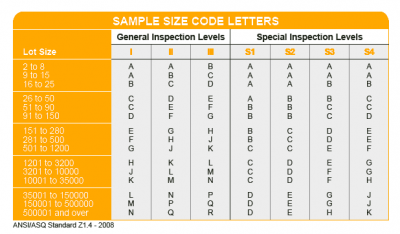 AQL Table | How to Read It
 TOP 10 Common Defects in Garments Quality Inspection
 Product Packaging and Shipment Label requirements for Amazon FBA
 What Is ASTM-F2413-18? Protective Footwear Standard
 How to Conduct Third-Party Quality Control Inspections for Electric Scooters
 SMETA Audit-What is SMETA Audit?
 TESTCOO Supplier Verification/Certification Service SLCP, Higg FEM, GRS, GOTS
 Quality Control Inspection Company in China
 What is Quality Inspection? A Complete Guide
 Guidelines for Product Inspection in India
Category
- Production Inspection Service
- Factory Audit
- Softline Inspection
- Hardline Inspection
- Electrics Inspection
- Certification
- Checklist
- Manufacturers
- Quality Assurance Basics
- Products Recall
- AQL
- Guidence and Standard
- News
- Supplier Management
- Amazon
- Protective Equipment
- e-commerce quality control
- Indian Manufacturing
- Soft Goods Quality Control
- Supply Chain Management
- Supply Chain Resilience
- E-Commerce Quality Control
- ISO 2859
- Supply Chain Optimization
- Garment Industry
- Higg Index