


RDS Certification Process: Requirements, Audits and Supply Chain Verification
Down and feather products are widely used in apparel, outdoor clothing, bedding and home textile applications, but increasing sustainability expectations have changed how companies evaluate these materials. Global brands and retailers are paying closer attention to responsible sourcing, animal welfare and supply chain transparency, making certifications such as the Responsible Down Standard (RDS) increasingly important for manufacturers and suppliers. However, RDS certification is not only about obtaining a sustainability label. Companies must establish reliable supplier management processes, maintain traceable documentation and ensure that certified down materials can be verified throughout the supply chain. Understanding the RDS certification process, audit requirements and supply chain verification methods helps textile companies reduce compliance risks and build more transparent responsible sourcing systems.
What Is the RDS Certification Process and Why Is It Important?
The RDS certification process verifies that down and feather materials are responsibly sourced, traceable and managed according to recognized animal welfare and supply chain requirements. By establishing clear standards for sourcing, documentation and chain of custody control, RDS helps companies demonstrate responsible down management to global buyers while improving supply chain transparency.
What Does Responsible Down Standard Certification Verify?
The Responsible Down Standard (RDS) is a voluntary certification developed by Textile Exchangee to ensure that down and feather materials come from sources that follow responsible animal welfare practices. Unlike conventional sourcing approaches that mainly focus on product performance and material availability, RDS evaluates the conditions under which down is obtained and managed throughout the supply chain.
RDS certification verifies that certified down does not come from animals subjected to practices such as live plucking or force feeding. It also requires companies involved in the supply chain to maintain proper control over certified materials, ensuring that responsible down can be distinguished and traced from the original source to the final product.
For textile manufacturers and brands, RDS provides a structured framework to demonstrate responsible sourcing practices. The certification helps companies respond to increasing buyer expectations around ESG commitments, ethical sourcing policies and transparent supply chain management.
The key areas covered by RDS certification include:
- Responsible animal welfare practices throughout the down supply chain
- Traceability of certified down and feather materials
- Documentation and transaction record management
- Control of certified and non-certified materials
- Verification through independent third-party audits
Although RDS focuses specifically on down and feather materials, its role extends beyond raw material verification. It provides companies with a systematic approach to managing supplier relationships, documentation control and responsible sourcing risks.
Why Is Supply Chain Traceability Essential for Down Products?
Down supply chains are often more complex than buyers and consumers realize. A finished jacket or bedding product may involve multiple stages, including farms, down collection facilities, processing plants, traders, textile manufacturers and final product producers. Each stage introduces potential risks if material information is incomplete or supply chain records are not properly maintained.
Without effective traceability systems, companies may face challenges in verifying the origin of down materials, controlling supplier information and demonstrating compliance during customer reviews or certification audits. Common supply chain risks include unclear material sources, incomplete transaction records, inconsistent supplier documentation and difficulties separating certified materials from conventional materials.
RDS addresses these challenges through chain of custody requirements. Certified organizations must maintain records showing how certified materials move through different stages of the supply chain. This creates a documented connection between suppliers and finished products, allowing brands and manufacturers to verify responsible sourcing claims more effectively.
For international textile businesses, traceability has become an important part of supplier evaluation. Buyers increasingly expect manufacturers to provide evidence of responsible material sourcing, not only product quality inspection results. A transparent down supply chain helps companies strengthen buyer confidence, support ESG reporting and reduce risks related to sustainability claims.
What Are the Key Requirements for RDS Certification?
RDS certification requires companies to establish responsible sourcing controls, maintain supply chain traceability and provide documented evidence that certified down materials meet animal welfare and chain of custody requirements. These requirements ensure that responsible practices are not limited to individual suppliers but are consistently managed across the entire down and feather supply chain.
How Does RDS Control Animal Welfare Requirements?
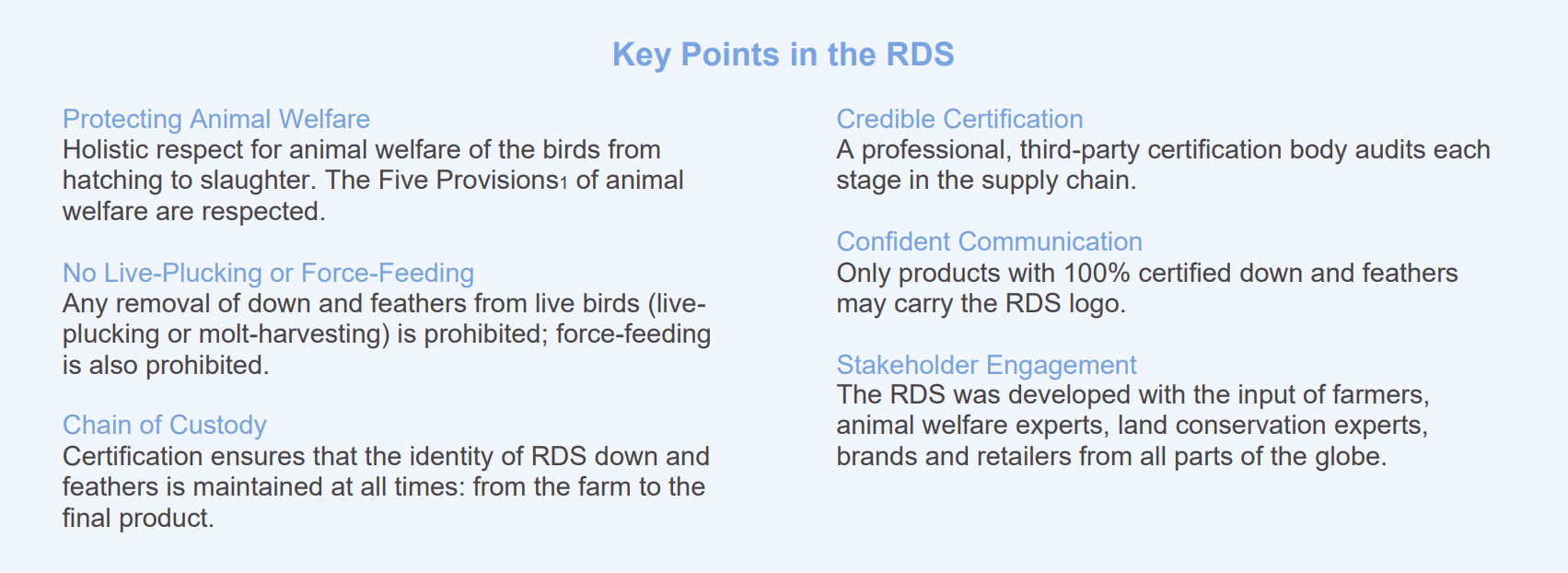
Animal welfare is the foundation of the Responsible Down Standard. RDS aims to ensure that down and feathers are sourced from animals that have not been subjected to prohibited practices and that suppliers follow responsible treatment principles throughout the sourcing process.
The standard requires organizations involved in the down supply chain to demonstrate control over sourcing activities and maintain records that support verification. Key expectations include preventing practices such as live plucking and force feeding, while ensuring that responsible sourcing principles are applied by relevant suppliers.
For textile companies, this requirement changes the way down materials are evaluated. Instead of focusing only on material performance and product quality, companies must also consider the ethical conditions behind raw material sourcing. This is particularly important for brands and retailers that have established ESG policies or responsible sourcing commitments.
What Documentation Is Required for RDS Certification?
Documentation control is one of the most important parts of RDS certification because traceability depends on accurate and consistent records throughout the supply chain.
Companies must be able to demonstrate where certified down materials come from, how they are processed and how they move between certified organizations. During certification assessments, organizations are expected to maintain relevant records that support material verification and supply chain transparency.
Typical documentation requirements include:
- Supplier certification information and scope details
- Purchase and transaction records for certified materials
- Production records showing certified material usage
- Chain of custody documentation
- Internal procedures for handling certified and non-certified materials
- Records related to corrective actions and compliance management
Without proper documentation systems, companies may face difficulties during audits, especially when multiple suppliers and production locations are involved. Effective document management helps organizations maintain certification readiness and quickly respond to buyer or auditor requests.
How Does Chain of Custody Support RDS Compliance?
Chain of custody management ensures that certified down materials remain identifiable and controlled as they move through different stages of the supply chain. For products containing down or feathers, this process is essential because raw materials often pass through multiple suppliers before becoming part of a finished textile product.
A typical down supply chain may involve:
Down source → Collection and processing → Material supplier → Manufacturer → Finished product
At each stage, companies need appropriate controls to ensure certified materials are not mixed with non-certified materials and that relevant records are maintained.
Strong chain of custody management helps companies:
- Verify the origin of certified materials
- Prevent incorrect sustainability claims
- Improve supplier accountability
- Support customer and audit requirements
- Maintain transparency across complex supply chains
For global textile manufacturers, chain of custody is not only a certification requirement but also an important supply chain risk management tool. As buyers increasingly request evidence of responsible sourcing practices, companies with structured traceability systems are better prepared to meet evolving compliance expectations.
Read More: Textile Exchange Supply Chain Supervision Certification | Testcoo
How Does the RDS Audit Process Work?
The RDS audit process evaluates whether companies have effective systems to manage responsible down sourcing, material traceability and chain of custody controls. Through independent third-party verification, RDS audits confirm that organizations can demonstrate compliance with animal welfare requirements, documentation procedures and certified material management practices across the supply chain.
What Happens Before an RDS Certification Audit?
Before an RDS audit takes place, companies need to establish the necessary management processes and prepare supporting documentation to demonstrate how certified down materials are controlled. The preparation stage is critical because auditors evaluate not only the final product but also the systems used to manage sourcing, production and traceability.
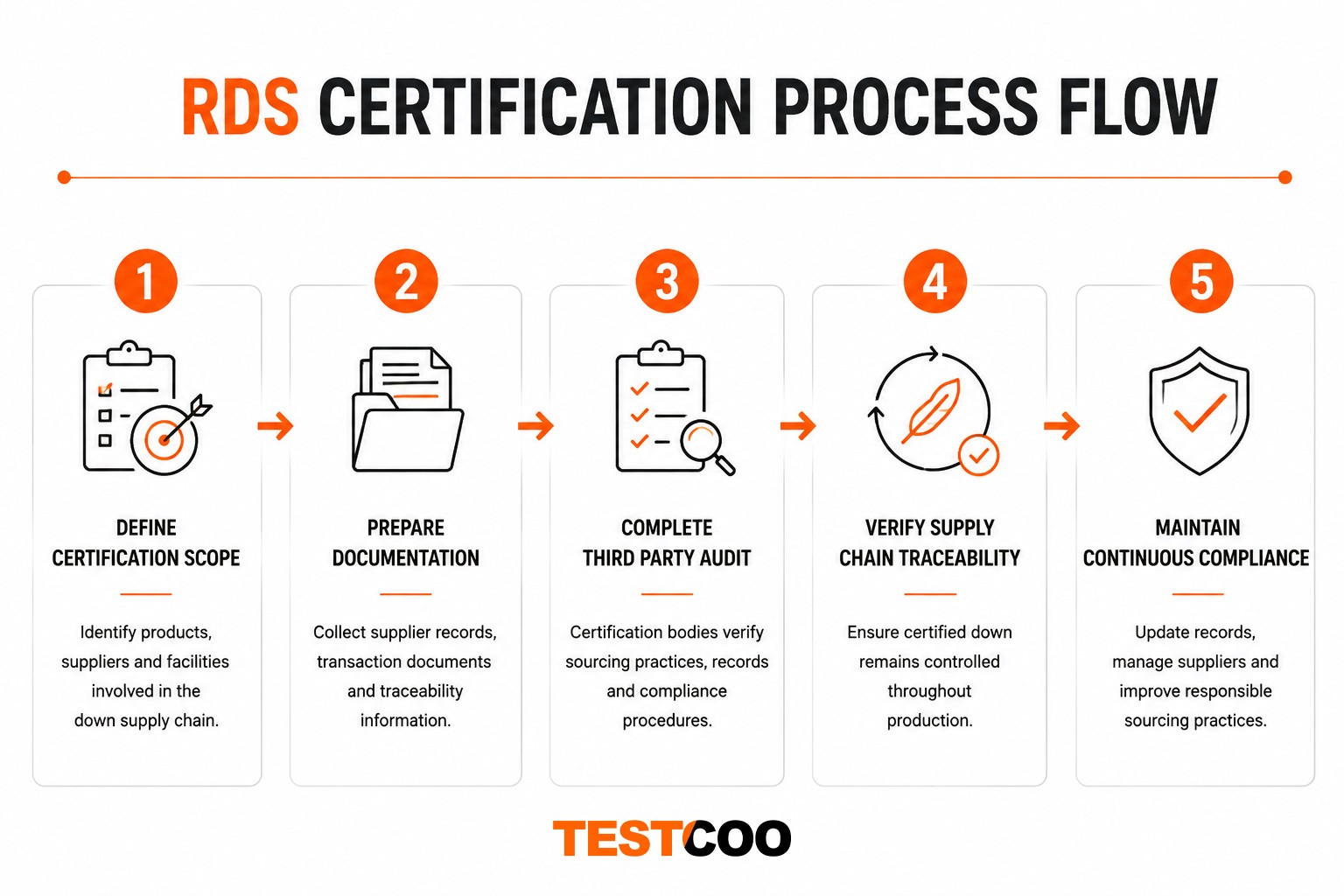
Companies typically begin by defining the certification scope, including the facilities, products and supply chain activities that will be included in the assessment. This helps determine which suppliers, production sites and material flows require verification.
During the preparation phase, companies should review their internal processes and ensure that relevant information is available, including:
- Supplier certification records
- Material purchasing and transaction documents
- Production and inventory records
- Chain of custody procedures
- Internal control processes for certified materials
A well-prepared audit process reduces the risk of documentation gaps and allows companies to respond more efficiently to auditor requests. For manufacturers working with multiple suppliers or production locations, early preparation is especially important because incomplete information from upstream partners can affect overall certification progress.
How Do Certification Bodies Verify RDS Compliance?
RDS certification audits are conducted by independent certification bodies approved within the Textile Exchange certification system. These organizations assess whether companies meet applicable RDS requirements through document reviews, facility evaluations and supply chain verification activities.
During the audit, certification bodies typically review how companies manage certified materials throughout their operations. The assessment focuses on whether the organization has effective controls to maintain traceability and prevent incorrect claims regarding responsible down sourcing.
Key audit activities may include:
- Reviewing documentation related to certified down materials
- Verifying supplier and transaction records
- Evaluating procedures for handling certified materials
- Checking chain of custody controls
- Assessing whether operational practices match documented procedures
For textile manufacturers, the audit is not only a review of documents but also an evaluation of whether responsible sourcing practices are integrated into daily operations. Companies must demonstrate that their processes are consistently implemented rather than relying only on individual records prepared for the audit.
What Happens After the RDS Audit?
After completing the audit, the certification body evaluates the findings and determines whether the company meets RDS requirements. If non-conformities are identified, the company may need to implement corrective actions before certification approval.
Corrective actions may involve:
- Updating incomplete documentation
- Improving supplier information management
- Strengthening material tracking procedures
- Revising internal control processes
- Providing additional evidence of compliance
Maintaining RDS certification also requires ongoing management after approval. Companies need to continue monitoring supplier information, updating records and ensuring that certified materials remain traceable throughout production.
This means RDS certification should not be treated as a one-time compliance activity. A sustainable responsible sourcing system requires continuous supplier coordination, documentation management and internal process improvement.
Why Is Continuous Compliance Management Important After Certification?
Obtaining RDS certification is only the beginning of responsible down supply chain management. As suppliers change, production volumes increase and sourcing networks become more complex, companies must maintain visibility over material flows and compliance documentation.
Continuous compliance management helps companies:
- Maintain accurate traceability records
- Identify supplier documentation risks earlier
- Respond efficiently to buyer inquiries
- Prepare for future audits
- Strengthen responsible sourcing practices
For global textile companies, a structured approach to supplier management and documentation control is essential for maintaining certification credibility. By integrating RDS requirements into daily quality and supply chain operations, companies can improve transparency while reducing risks related to responsible sourcing claims.
Frequently Asked Questions (FAQs)
1. What does RDS certification mean?
RDS certification verifies that down and feather materials are responsibly sourced and traceable through the supply chain.
2. Is RDS certification mandatory for down products?
RDS is generally not a legal requirement, but many global brands and retailers require it as part of responsible sourcing policies.
3.Who issues RDS certification?
RDS certificates are issued by approved certification bodies authorized under the Textile Exchange certification system.
4. How long does RDS certification take?
The timeline depends on supply chain complexity, documentation readiness and audit preparation.
5. What is the difference between RDS and GRS?
RDS focuses on responsible down sourcing and animal welfare, while GRS focuses on recycled materials and broader sustainability requirements.
How Can Companies Build More Transparent Down Supply Chains?
Building a transparent down supply chain requires more than achieving RDS certification. Companies need to combine responsible sourcing practices, supplier management, traceability systems and continuous compliance processes to ensure that certified materials remain controlled throughout the product lifecycle.
RDS certification provides textile manufacturers and brands with a structured approach to managing responsible down sourcing by verifying animal welfare practices, strengthening chain of custody control and improving supply chain transparency. However, maintaining certification readiness requires companies to continuously manage supplier information, documentation accuracy and material traceability across complex global production networks. As buyers and consumers place greater emphasis on ESG commitments and responsible sourcing, companies that integrate certification requirements into daily supply chain management will be better positioned to reduce compliance risks and build long term trust.
Testcoo supports textile companies by centralizing supplier management, inspection workflows, documentation and quality records within a digital quality management platform. By improving supplier visibility, strengthening document control and supporting structured compliance processes, Testcoo helps businesses enhance supply chain transparency and operational efficiency while preparing for evolving responsible sourcing expectations. Through better data visibility and standardized management practices, companies can build more resilient textile supply chains that support both quality objectives and sustainability goals.

Free Sample Report Performance Quality Control
Download a sample report to keep control of your supply chain!

Featured Articles
 AQL Table | How to Read It
 TOP 10 Common Defects in Garments Quality Inspection
 Product Packaging and Shipment Label requirements for Amazon FBA
 What Is ASTM-F2413-18? Protective Footwear Standard
 How to Conduct Third-Party Quality Control Inspections for Electric Scooters
 SMETA Audit-What is SMETA Audit?
 TESTCOO Supplier Verification/Certification Service SLCP, Higg FEM, GRS, GOTS
 Quality Control Inspection Company in China
 What is Quality Inspection? A Complete Guide
 Guidelines for Product Inspection in India
Category
- Production Inspection Service
- Factory Audit
- Softline Inspection
- Hardline Inspection
- Electrics Inspection
- Certification
- Checklist
- Manufacturers
- Quality Assurance Basics
- Products Recall
- AQL
- Guidence and Standard
- News
- Supplier Management
- Amazon
- Protective Equipment
- e-commerce quality control
- Indian Manufacturing
- Soft Goods Quality Control
- Supply Chain Management
- Supply Chain Resilience
- E-Commerce Quality Control
- ISO 2859
- Supply Chain Optimization
- Garment Industry
- Higg Index