


Unmasking Factory Conditions: How 360° VR Audits Support ESG Due Diligence in India
For overseas buyers sourcing apparel, textiles, consumer goods, or industrial components from India, supplier evaluation involves more than product quality and delivery capacity. Factory working conditions, fire safety, ventilation, protective equipment and labor practices can all affect sourcing decisions and responsible business commitments. Yet conventional factory photos often show only selected areas, making it difficult for buyers to understand the wider production environment from a distance. A 360° virtual reality (VR) factory audit provides a more comprehensive visual record of the site, supported by an auditor's observations and structured reporting. This article explains how VR audits can improve visibility into Indian factory conditions, support ESG and social compliance due diligence and complement formal labor audits without replacing the evidence those audits require.
Why Do Factory Working Conditions Matter for ESG Due Diligence in India?
Factory working conditions matter because buyers need to understand how suppliers manage worker health and safety, labor practices and daily production operations, not just whether finished goods meet specifications. In India's diverse manufacturing supply chains, conditions can vary considerably between suppliers, facilities and production processes, making site-specific verification important.
Which Working Conditions Should Buyers Examine?
For apparel and textile factories, visible working conditions can provide useful evidence of how a facility is managed. Buyers should pay attention to production-floor ventilation, access routes, electrical installations, machine guards, personal protective equipment (PPE), housekeeping and the availability and condition of fire safety equipment.
Other areas may also deserve attention, including raw material storage, packing lines, worker washrooms, canteens and dormitories where accommodation is provided. Poor housekeeping, obstructed walkways, or unsafe storage arrangements may indicate wider weaknesses in day-to-day safety management.
The same principles apply to consumer goods and industrial suppliers, although the specific risks depend on the manufacturing process. A textile dyeing facility, for example, may require closer attention to chemical storage and handling, while an industrial component factory may present additional machinery and electrical hazards.
Why Are Conventional Factory Photos Not Always Enough?
Traditional photographs can document specific conditions, but the person taking the photographs determines what appears in the frame. A series of close-up images may show clean equipment and orderly workstations without revealing the surrounding storage areas, blocked walkways, or the relationship between different production zones.
This does not mean conventional photographs are inherently unreliable. The limitation is that selected images offer only a partial view unless the reviewer knows what was photographed, what was omitted and under what conditions the images were captured.
A 360° panoramic record gives buyers more surrounding context. It allows them to look around the captured scene rather than relying entirely on the supplier or photographer to select each angle. Combined with an independent auditor's observations, this can make remote supplier assessment more informative.
The International Labour Organization's work on responsible business conduct and decent work in India also reflects the importance of improving labor conditions through cooperation among businesses, employers, workers and other stakeholders.
How Can 360° VR Audits Improve Visibility Into Factory Conditions?
A 360° VR factory audit uses panoramic imaging to document a supplier's physical environment and lets buyers explore captured areas remotely. When the images are collected by an on-site auditor and linked to professional comments, the resulting report can provide a clearer view of factory conditions than a collection of unconnected photographs.
How Can 360° Images Reveal Potential Safety Risks?
A panoramic view can help buyers understand the layout of a production floor and identify visible conditions that may deserve further investigation.
Fire safety is another important inspection focus. Panoramic images may reveal blocked access to fire extinguishers, obstructed exit routes, or materials stored near emergency equipment. These observations can help the buyer and auditor identify areas requiring closer examination.
However, an image cannot establish every safety condition. Seeing an extinguisher does not confirm that it is serviced and functional. Seeing a ventilation fan does not measure air quality or prove that ventilation is adequate. Those questions require relevant physical checks, measurements, records, or specialist assessment.
How Does a VR Report Help Reduce Selective Photo Reporting?
The main advantage of 360° imaging is its broader visual coverage. Instead of reviewing only the angles chosen for a conventional photo report, buyers can explore more of the captured environment and compare the auditor's comments with the surrounding scene.
A structured VR audit report can also connect panoramic images with specific observations, conventional photographs, factory information and documented findings. This makes it easier to understand where an issue was found and why it matters.
Consider a hypothetical apparel supplier that provides conventional photos showing organized sewing stations and clean packing tables. During a VR factory audit, the auditor captures wider views of the production floor and storage areas. The buyer notices materials stacked near a walkway and asks for clarification about the access route and emergency arrangements. The finding can then be investigated, recorded and followed up rather than being overlooked because it did not appear in the original photos.
Can 360° VR Audits Replace SMETA or SA8000 Audits?
No. A VR factory audit can support social compliance assessment by providing visual evidence of factory conditions, but it cannot independently verify every labor practice or replace formal auditing requirements. SMETA and SA8000 have distinct assessment frameworks and buyers should understand how panoramic evidence fits into each process.
What Can VR Audits Contribute to a SMETA Assessment?
SMETA, or Sedex Members Ethical Trade Audit, is a social audit methodology covering labor standards and health and safety, with environmental management and business ethics added in a four-pillar audit. It examines workplace practices, workers, records and operating conditions.
According to Sedex's official SMETA guidance, SMETA audits are carried out by independent third-party auditors affiliated with Sedex-approved Affiliate Audit Companies (AACs). A SMETA audit involves an on-site assessment. A standalone VR factory audit should therefore not be presented as a completed SMETA audit or as authorization to claim SMETA compliance.
Panoramic imaging can nevertheless provide useful supporting information for supplier screening and ongoing monitoring. It may help buyers review visible aspects of workplace safety, facilities, housekeeping and environmental management before or between formal assessments. The evidence can also help identify questions that warrant further investigation.
For a formal SMETA audit, buyers should engage an approved audit company and confirm that the assessment follows the applicable methodology and scope.
What Does SA8000 Require Beyond Visual Evidence?
SA8000 is a social accountability standard that addresses decent work, worker rights, health and safety and management systems. The current SA8000:2026 Standard published by Social Accountability International covers areas including child and young workers, freedom of association, fair recruitment and employment, working hours and wages, discrimination, health and safety and privacy.
Some relevant physical conditions can be observed during a VR factory audit. For example, images may show the condition of a work area, the arrangement of machinery, or visible access to safety facilities. But many important requirements cannot be established from images alone.
Buyers need appropriate evidence for matters such as wage payments, working hours, recruitment practices, worker grievances and discrimination. Depending on the audit scope, this may involve records, interviews, management-system review and direct verification.
SA8000 certification assessments must be handled through the appropriate accredited conformity assessment bodies. Buyers can consult SAAS's directory of SA8000-accredited bodies to identify authorized certification providers.
Which Social Compliance Risks Cannot Be Verified Through Panoramic Images Alone?
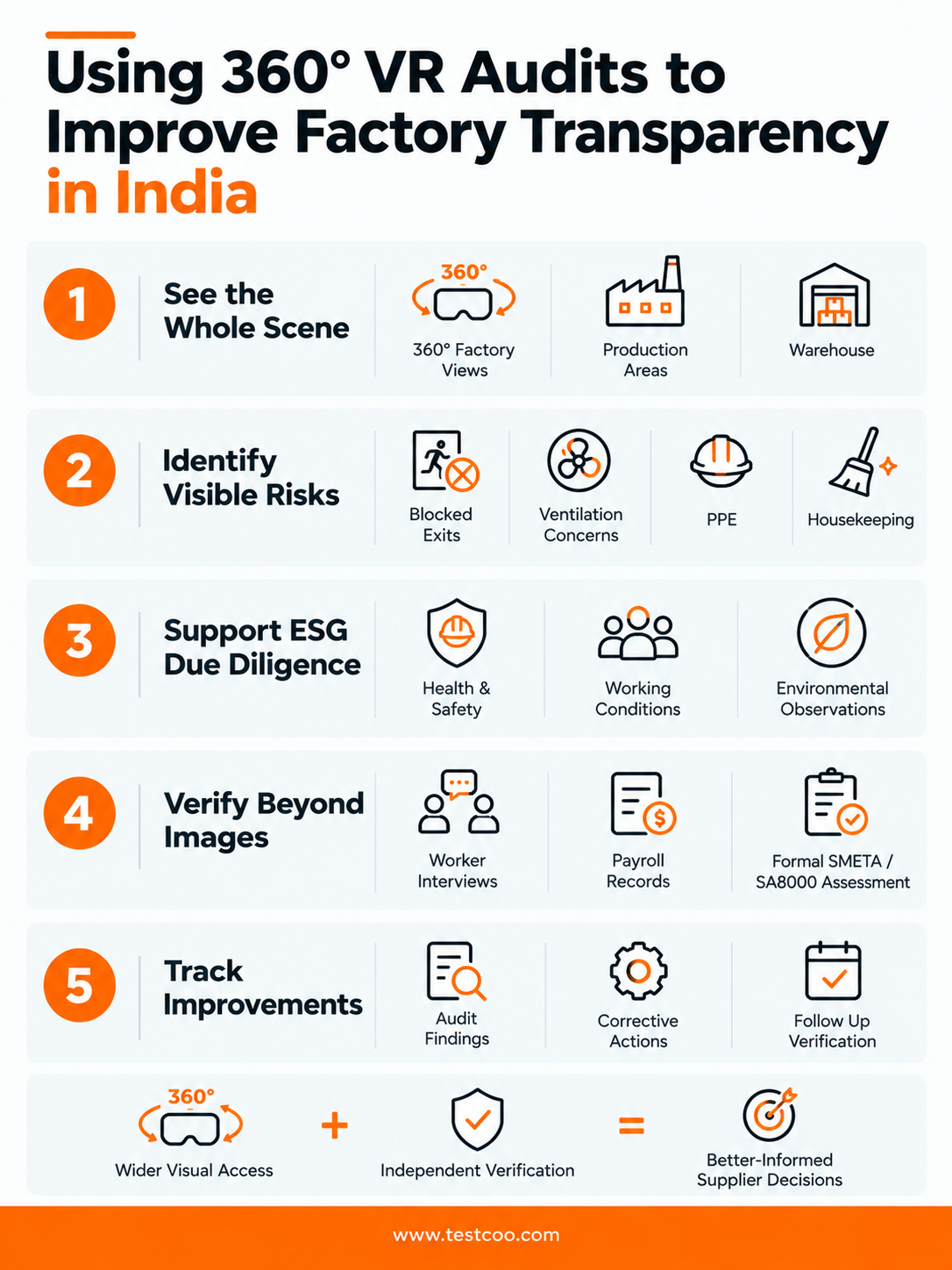
Several important labor risks require evidence beyond visual observation.
- Working hours and wages: Payroll records, time records, employment documents and other relevant evidence are needed to evaluate whether workers receive appropriate pay and work within applicable limits.
- Child labor and forced labor: Worker age and employment records, recruitment practices, interviews and other verification may be necessary. A visual scene cannot reliably establish whether either risk is present or absent.
- Freedom of association and discrimination: Policies, confidential worker interviews, grievance mechanisms and evidence of workplace practices are more informative than images alone.
- Fire and occupational safety performance: Panoramic images can reveal visible hazards, but confirming equipment functionality, training, emergency procedures and compliance with applicable requirements may require additional checks.
For this reason, the strongest approach combines visual transparency with independent auditing, document review, appropriate worker engagement and corrective action. VR is an evidence-gathering and review tool, not a substitute for the entire social compliance process.
Read More: What Companies Offer VR Audit Services? | TESTCOO
How Should Buyers Use VR Factory Audits in an ESG Due Diligence Program?
Buyers should use VR factory audits as one layer of supplier due diligence, with the scope and follow-up determined by the factory's risk profile and the buyer's requirements. This makes the technology useful without overstating what it can prove.
When Should Buyers Arrange a VR Factory Audit?
A VR factory audit can be useful when screening a new supplier, reviewing an existing factory remotely, or checking whether previously identified physical issues appear to have been addressed. It is particularly relevant when travel is impractical and the buyer needs a structured visual assessment rather than supplier-submitted photographs alone.
Before arranging the audit, buyers should define which areas need to be captured. For an apparel supplier, these may include cutting, sewing, finishing, packing, material storage, worker facilities and visible safety arrangements. A factory handling chemicals or operating heavy machinery may require additional checkpoints.
Buyers should also confirm who will collect the evidence, whether the auditor will provide professional comments and how findings will be documented.
How Should Buyers Combine VR Evidence With Traditional Audit Methods?
A practical verification process combines complementary evidence sources rather than relying on one method.
First, buyers review the supplier's profile and relevant documents. An on-site auditor then examines the facility and captures agreed areas using panoramic imaging, recording observations and issues in a structured report.
Next, the buyer reviews the evidence and determines which findings need further verification. Visible obstructions may require a closer physical check, while concerns involving wages or working hours require document review and potentially confidential worker interviews. Where formal SMETA or SA8000 requirements apply, the buyer should arrange the relevant assessment through the appropriate authorized organization.
Finally, findings should be assigned to responsible parties, corrective actions should be tracked and closure should be verified through evidence suited to the original issue. A corrected photo may be enough for some visible housekeeping issues, but it will not necessarily resolve a deeper management-system or labor concern.
Read More: What’s New in SMETA 7.0 and Why You Should Care
How Can Buyers Protect Worker Privacy During Virtual Audits?
Transparency should not come at the expense of worker privacy or safety. Buyers and auditors should determine how images and records will be captured, stored, shared and retained before the visit.
Where workers may be identifiable, the audit team should follow appropriate consent, privacy and data-protection procedures. Sensitive areas and confidential information should not be recorded or shared without a legitimate purpose and suitable safeguards. Worker interviews should also remain confidential and free from management influence where the assessment requires them.
These controls matter because a social compliance program should protect workers, not merely improve the buyer's access to factory information.
Frequently Asked Questions
1.What Is a 360° VR Factory Audit?
A 360° VR factory audit uses panoramic imaging to record factory environments so buyers can explore captured areas remotely. When combined with an on-site auditor's observations and a structured report, it provides broader visual context for supplier assessment than selected photographs alone.
2.Can a VR Factory Audit Verify Social Compliance in India?
A VR factory audit can help buyers identify visible workplace risks, such as blocked access routes, poor housekeeping and unsafe-looking production arrangements. It cannot independently verify wages, working hours, worker rights, or all regulatory requirements. Those matters require suitable records, interviews and formal assessments.
3.Can a VR Audit Replace a SMETA Audit?
No. SMETA is a defined social audit methodology conducted by auditors from Sedex-approved Affiliate Audit Companies. VR imagery can support supplier screening and provide additional visual evidence, but it does not replace the on-site assessment and other verification required by the SMETA methodology.
4.What Can 360° VR Imaging Reveal About Factory Safety?
Panoramic imaging can show the layout of production areas, visible obstructions, the placement of safety equipment, housekeeping and some aspects of ventilation arrangements. However, it cannot by itself confirm equipment functionality, air quality, fire system performance, or compliance with every applicable safety requirement.
5.When Should Buyers Arrange a VR Factory Audit in India?
Buyers may arrange a VR factory audit when evaluating a new supplier, reviewing factory conditions remotely, or monitoring visible corrective actions. It is most useful when the audit scope is clearly defined and visual evidence is combined with professional assessment and additional verification where necessary.
How Can Testcoo Support VR Factory Audits in India?
Testcoo's VR Factory Audit service combines on-site auditing, 360° panoramic imaging and structured reporting to help buyers review supplier environments remotely. Testcoo lists India among its service coverage countries and the audit process can document production areas, warehouses, packing lines and other relevant factory locations alongside the auditor's observations. For overseas buyers assessing apparel, textiles, consumer goods, or industrial suppliers, this approach can make physical conditions easier to review and help identify issues that require further investigation. When labor, safety, or ESG concerns extend beyond what images can verify, the findings should be supported by appropriate document checks, worker interviews, formal social compliance assessments, or other relevant verification. By combining broader visual access with professional assessment and corrective-action follow-up, Testcoo helps buyers make supplier decisions based on clearer evidence of factory conditions.

Free Sample Report Performance Quality Control
Download a sample report to keep control of your supply chain!

Featured Articles
 AQL Table | How to Read It
 TOP 10 Common Defects in Garments Quality Inspection
 Product Packaging and Shipment Label requirements for Amazon FBA
 What Is ASTM-F2413-18? Protective Footwear Standard
 How to Conduct Third-Party Quality Control Inspections for Electric Scooters
 SMETA Audit-What is SMETA Audit?
 TESTCOO Supplier Verification/Certification Service SLCP, Higg FEM, GRS, GOTS
 Quality Control Inspection Company in China
 What is Quality Inspection? A Complete Guide
 Guidelines for Product Inspection in India
Category
- Production Inspection Service
- Factory Audit
- Softline Inspection
- Hardline Inspection
- Electrics Inspection
- Certification
- Checklist
- Manufacturers
- Quality Assurance Basics
- Products Recall
- AQL
- Guidence and Standard
- News
- Supplier Management
- Amazon
- Protective Equipment
- e-commerce quality control
- Indian Manufacturing
- Soft Goods Quality Control
- Supply Chain Management
- Supply Chain Resilience
- E-Commerce Quality Control
- ISO 2859
- Supply Chain Optimization
- Garment Industry
- Higg Index