


Your Essential Garment Inspection Checklist for Uncompromised Apparel Quality
Whether you're a seasoned importer or a budding fashion entrepreneur, understanding the nuances of a garment inspection is crucial. It’s the systematic process of verifying that your products meet pre-defined quality standards, specifications and regulatory requirements before they leave the factory. As one industry guide aptly puts it, product quality is "the result of continuous quality control efforts and strict quality inspection procedures".
A comprehensive quality control checklist is the essential tool that brings these procedures to life. It serves as a tangible agreement on expectations between you, the buyer and your supplier, helping to prevent defects, ensure consistency and protect your brand from costly errors.
This blog will serve as your deep-dive guide, exploring the essential checkpoints in a garment inspection. We'll break down the process using a question-style format, providing you with the knowledge to build a bulletproof QC strategy.
Pre-Production and In-Process Checks
When Does Quality Control Really Begin?
Many believe quality control starts at the final inspection. This is a critical misconception. Effective quality control is a proactive journey, not a reactive one. It begins long before the first stitch is sewn. As WorldFirst highlights, "the quality control process starts with pre-production, where every component of the garment is tested before it is assembled".
Pre-Production Inspection:
This stage focuses on verifying raw materials. Is the fabric the right GSM (grams per square meter) and colour? Are the trims, buttons and zippers as specified? Inspecting these components early prevents a flawed product from being manufactured. A key part of this is an "in-line quality control" check, where garments are examined at different stages of production from cutting, sewing and finishing to identify and fix defects early, saving time and money.
Are Your Raw Materials and Initial Samples Up to Standard?
Before bulk production, you must have an approved sample. This is your "golden sample" against which all production will be judged. A quality checklist should verify that the bulk production matches this sample in terms of:
- Fabric Quality: Confirm the material composition, weight (GSM), colour and texture.
- Trims and Accessories: Ensure the correct buttons, zippers, snaps and labels are being used.
- Specifications: Check a detailed tech pack which includes a measurement chart (point of measure) and acceptable tolerances for each garment size. This prevents inconsistencies in fit.
Read more: Caught in the Middle: How During Production Inspection Safeguards Your Supply Chain

The Final Pre-Shipment Inspection: The Ultimate Checklist
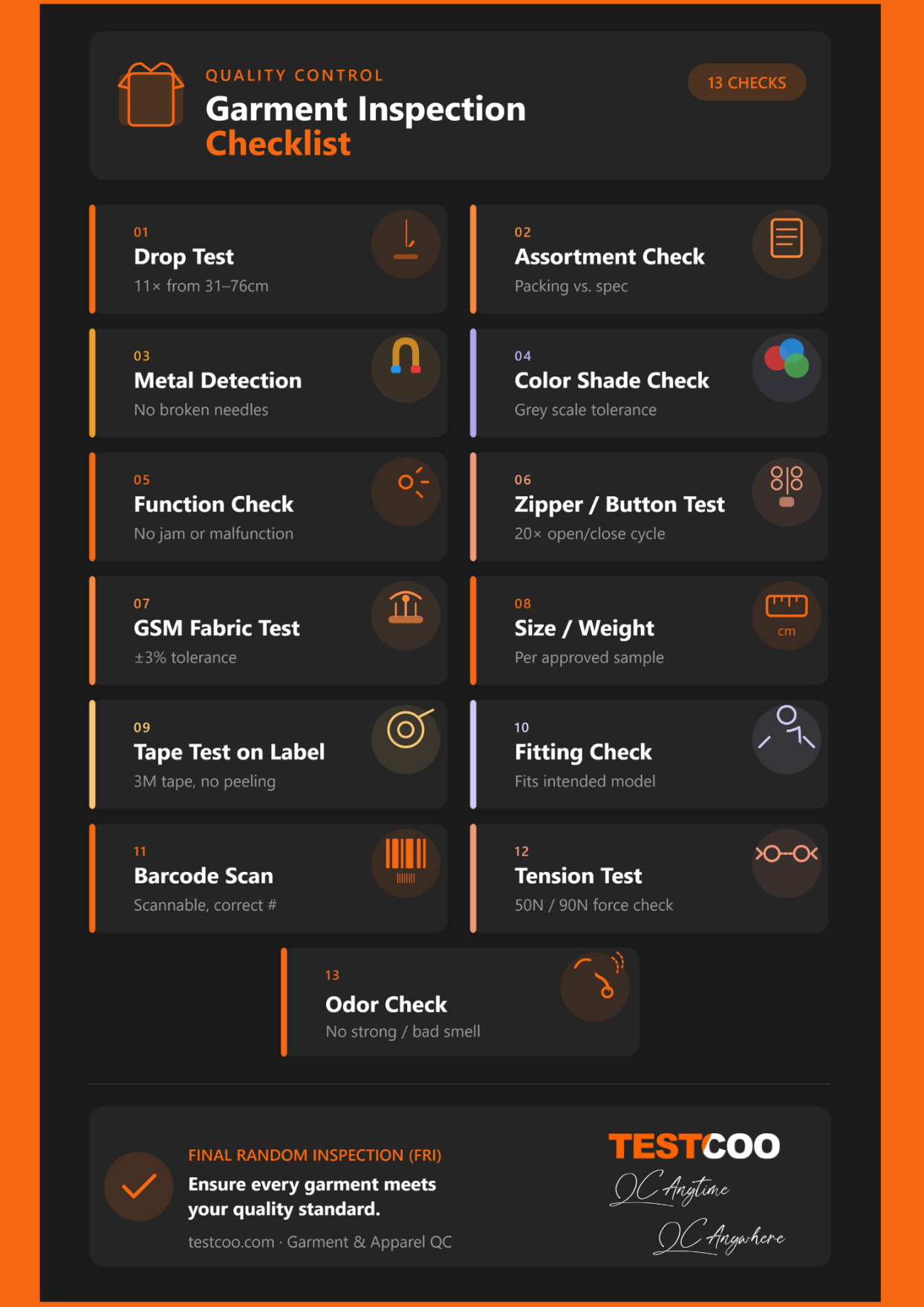
The final pre-shipment inspection is your last line of defence. Here, a statistically significant sample of the finished goods is inspected, usually based on the AQL (Acceptable Quality Limit) standard. Let's break down the critical 13 essential checks from Testcoo's framework and expand upon them.
How Do You Ensure the Package and Product Can Survive the Journey?
Drop Test: This is a crucial test for packaging integrity. According to Testcoo, this is performed with reference to the ISTA 1A standard, where the package is dropped multiple times from varying heights onto a hard surface. The goal is to ensure the packaging can protect the garment from damage during shipping and handling.
Assortment Check: It's not just about the garments themselves; the packing assortment must be perfectly correct. This check verifies that the correct styles, colors and sizes are packed into the correct cartons according to the client's packing list. As a guide from InTouch Quality notes, this involves checking if the "correct number and assortment [is] packed per carton".
What Are the Hidden Dangers and How Do You Detect Them?
Metal Detection: This is a non-negotiable safety check in the apparel industry. Broken needles from the sewing process are a serious hazard. A metal detector ensures no needle fragments or other metallic contaminants are hidden in the finished garments.
Odor Check: A seemingly simple but very telling check. Your inspector should check for any "strong/bad smell of colorants, adjuvants or mold". A musty smell can indicate mold from improper storage, while a chemical smell might point to poor-quality dyes or finishing agents. This protects the consumer from potential allergic reactions or health issues.
Does the Garment Fit, Look and Function as Intended?
Color Shade Check: Color inconsistency is a major defect. Inspectors should compare garments against the approved sample and within the same batch. As per Testcoo's strict guidelines, "No color shade within same pieces is allowed," and specific grey scales are used to determine acceptable levels of variance within a shipment.
Fitting Check: A garment that measures correctly on paper might still look awkward on a body. This check involves putting the garment on a mannequin (or a live fit model) to assess its overall drape, look and fit. It verifies that the pattern and construction work in three dimensions.
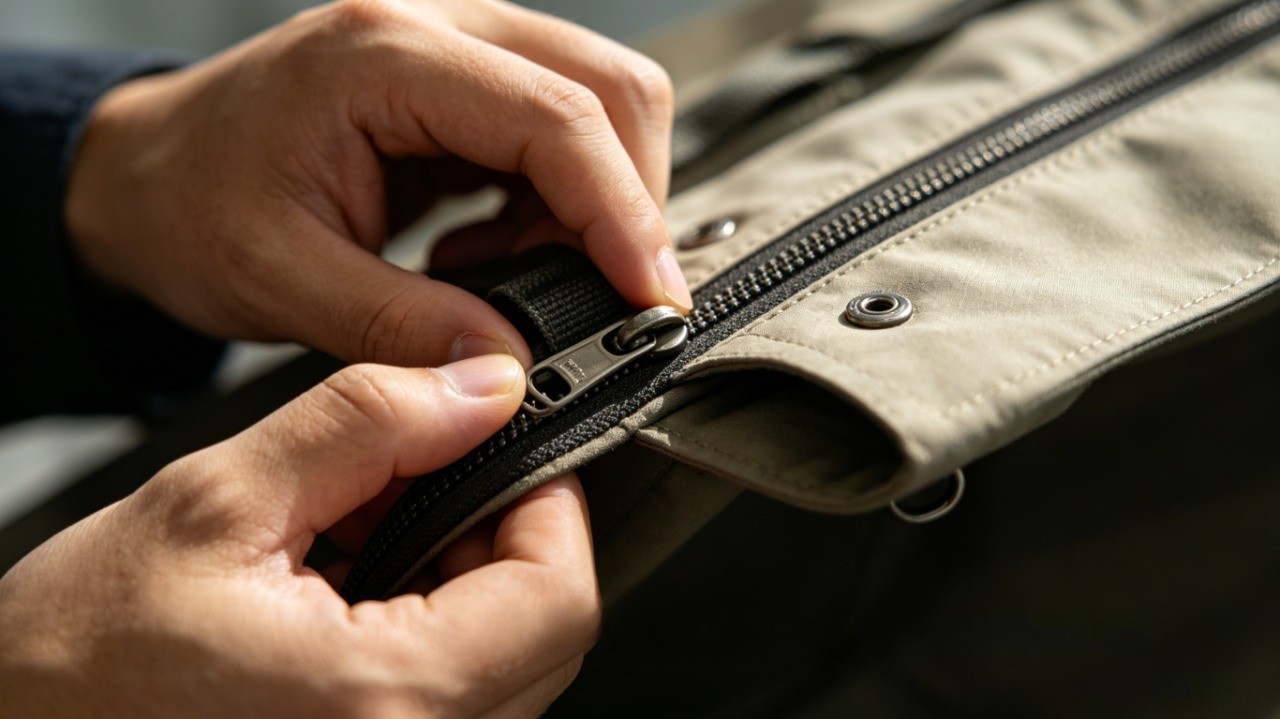
Function Check: This is a practical test of all the moving parts. Does the zipper glide smoothly without jamming? Do the snaps fasten and unfasten correctly? Every functional component is tested to ensure it runs smoothly.
Reliability Test for Zipper/Button/Snap: This goes beyond a simple function check. It's a durability test. Testcoo's method involves opening and closing a zipper or fastening a button 20 times to see if it remains intact after this stress test. Other sources, like QIMA, recommend performing a fatigue test "50 times" for snaps and buttons.
Read more about Textile Appearance Inspection: Standards and Defect Control Guide
What Do Physical and Mechanical Tests Tell You About Quality?
Tension Test: This is vital for safety, especially for children's clothing. This test applies a specific pulling force to small accessories like buttons, bows or zipper pullers for a set period (e.g., 50N for 5 seconds, hold for 10 seconds). The aim is to ensure these small parts do not detach and become a choking hazard or create a sharp edge.
Tape Test on Printed Label: This check ensures the durability of your branding and care labels. A piece of 3M tape is pressed firmly onto the printed label and then pulled off quickly at a 45-degree angle. The inspector then checks to see if any print has peeled off, which would render the label illegible.
Are Your Measurements and Weight Accurate?
Product Size / Weight Measurement: This is non-negotiable. Garments must be measured against a size chart with clear tolerances. Critical points like chest, body length and sleeve length are measured. A standard tolerance of +/- 3% is common unless a tighter specification is given. Correct dimensions ensure that the customer receives the size they ordered, reducing returns.
GSM Test: This measures fabric weight, which can indicate the quality and density of the material. It's a key test for fabrics like cotton, but as Testcoo notes, it's "not applicable for sweater/cardigan or any other woolen product". The measured GSM is compared to the client's specification.
Is Your Packaging and Labeling Correct and Legally Compliant?
Barcode Scan Check: You'd be surprised how often barcodes are wrong. It's a frequent issue found during inspections. Inspectors will use a barcode scanner to verify that the barcode is scannable and contains the correct information, ensuring it can be processed at distribution centers and retail points of sale.
Tape Test on Printed Label: As discussed, this ensures the durability of your labels. It's a crucial step for ensuring legal compliance and brand longevity.
Packaging Inspection: This is a critical final step. The inspector checks that the right polybags, cartons and markings are used. This includes verifying that the shipping carton has the correct dimensions and weight, is sealed properly and that all shipping marks (like the buyer's name, PO number and country of origin) are correct and legible. Correct packaging is vital for logistics and to ensure the product arrives in perfect condition.
Read more: E-commerce Package Spot-Checks: What's Behind the Increase in the Philippines and Malaysia?
Beyond the Checklist: Best Practices and Proactive Strategies
How Can You Prevent Defects and Build a Stronger Supply Chain?
Beyond the checklist itself, a proactive approach to quality control can save you immense headaches.
- Clear Communication is Key: "Communication gaps" are a major red flag. Ensure your inspection requirements and checklist are detailed, unambiguous and even translated into the supplier's language. If something isn't clear, a defect is likely to occur.
- Use a Reputable Third-Party Inspector: A professional QC company provides unbiased and expert inspections. They are familiar with the AQL standards, have the necessary equipment and can provide a detailed report.
- Set Realistic and Clear Tolerances: What constitutes a "pass" or a "fail"? Be specific. For instance, don't just say "no loose threads." Specify the maximum allowable length for a loose thread (e.g., no loose threads longer than 1 inch).
- Don't Forget In-Line Inspections: Final random inspection is vital, but catching issues early with pre-production and during production inspections can prevent 100% of a batch from being wrong. Work with your supplier to schedule inspections at key points in the production process.
- Document Everything: The final inspection report is a crucial document. It provides objective data on the quality of a shipment, serves as a record for future orders and can be used to hold your supplier accountable if quality fails to improve.
FAQ: Frequently Asked Questions About Garment Inspection
1. What is a garment quality control checklist?
A garment quality control checklist, also known as an Inspection Criteria Sheet (ICS), is a detailed document used by quality control inspectors to systematically verify that finished garments meet a brand's specifications, packaging requirements and safety standards. It provides a structured list of checks to ensure consistency.
2. What is an AQL inspection in the garment industry?
AQL stands for Acceptable Quality Limit. It is a statistically-based international standard used to determine the maximum number of defects allowed in a random sample of products. During a garment inspection, a specific number of pieces are sampled from the shipment and the number of defects found determines whether the entire batch passes or fails.
3. What is a critical defect in garment inspection?
A critical defect is the most severe type of defect. It is defined as a flaw that could potentially harm the user or make the product illegal to sell. Examples include the presence of sharp needles from broken needles, use of prohibited chemicals, or, in the case of children's clothing, a button that detaches easily, posing a choking hazard.
4. What are the key points of a garment inspection?
The key points of a garment inspection can be broadly categorized into:
- Product Specifications: Workmanship, color, fabric quality (GSM) and measurements.
- Safety and Function: Metal detection, tension tests (for buttons/zippers) and function checks.
- Packaging and Labeling: Checking the correct packaging assortment, carton markings, barcode readability and compliance of care and fiber content labels.
5. What are the 3 types of garment defects?
Defects are typically classified into three categories during a quality inspection:
- Critical Defects: Pose a safety hazard or violate regulations (e.g., a loose button on a child's garment).
- Major Defects: Affect the garment's performance, fit or durability, leading to customer dissatisfaction and returns (e.g., incorrect size, a broken zipper or significant color shade issues).
- Minor Defects: Aesthetic imperfections that do not affect the garment's function or safety but may reduce its perceived quality (e.g., a slightly loose thread or a minor, barely visible print defect).
Weaving Quality into Your Brand's Fabric with Testcoo
Quality control is the thread that holds your brand's reputation together and at Testcoo, we understand that every stitch matters. As a leading third-party inspection company accredited by ISO9001, CNAS, AQSIQ and ISO27001, we bring over a decade of expertise to garment and apparel quality assurance.
Our Comprehensive Garment Inspection Services
Full Production Cycle Coverage
We offer inspections at every critical stage of your manufacturing process:
- Initial Production Check (IPC): Performed before production begins or when 10-20% is complete, this early-warning system verifies machinery and materials, safeguarding against costly import risks from the start.
- During Production Check (DUPRO): Conducted when 50-60% of production is complete, this check ensures your factory continues following specifications and remains on schedule.
- Final Random Inspection (FRI): Our systematic inspection of randomly selected units, conducted when production is 100% complete and at least 80% packed, is your final opportunity for corrective action before shipment.
- Loading Supervision (LS): The crucial final step where we verify counts, confirm loads and seal containers to minimize transit damage risks.
The Essential 13-Point Garment Inspection Checklist
Our inspectors execute a thorough 13-point checklist during every garment inspection:
- Drop Test – Packaging integrity verification
- Assortment Check – Correct style, color and size packing
- Metal Detection – Needle and metal contaminant screening
- Color Shade Check – Consistency against approved samples
- Function Check – Zipper, snap and component operation
- Reliability Test – 20-cycle durability testing of fasteners
- GSM Test – Fabric weight verification
- Product Size/Weight Measurement – Dimensional accuracy
- Tape Test – Printed label durability assessment
- Fitting Check – Garment appearance and drape evaluation
- Barcode Scan Check – Scannability and data accuracy
- Tension Test – Pull force testing on small accessories
- Odor Check – Detection of chemical or mold smells
↵ ↵
Global Reach, Local Expertise
With over 500 full-time qualified inspectors and auditors performing more than 100,000 inspections annually, Testcoo serves over 5,000 global retailers, brands and suppliers worldwide. Our coverage spans 30 countries across Asia, Africa, Europe and the Americas, including all major apparel sourcing hubs including China, India, Bangladesh, Vietnam, Turkey, Cambodia and more.
Digital Innovation for Faster Decisions
We empower our clients with a technology-driven platform offering real-time tracking of inspections, visual defect reports and centralized QC data across factories. With same-day inspection reports and a self-service booking platform allowing cancellations up to 12 hours before inspection without extra charges, we help reduce lead times and accelerate decision-making.
Customized Solutions for Every Brand
Whether you're a multinational corporation or a growing D2C brand, our tailored inspection checklists are developed based on your specific buyer specifications, AQL standards and product type from kidswear to lingerie to outerwear. Our all-inclusive rates with no additional travel costs provide transparent and competitive pricing.
Trusted by Industry Leaders
Our rigorous inspector management includes online video monitoring, GPS tracking systems and signed Code of Conduct agreements with factories, ensuring accountability and consistency. We don't just inspect your products, we protect your brand's integrity and help you build a resilient, quality-centric supply chain that delivers on every promise to your customers.
Ready to safeguard your garment quality? Get in touch with our garments and apparel quality assurance experts to customize your inspection requirements and bring trust to your supply chain.

Free Sample Report Performance Quality Control
Download a sample report to keep control of your supply chain!

Featured Articles
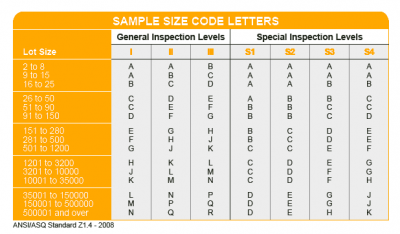 AQL Table | How to Read It
 TOP 10 Common Defects in Garments Quality Inspection
 Product Packaging and Shipment Label requirements for Amazon FBA
 What Is ASTM-F2413-18? Protective Footwear Standard
 How to Conduct Third-Party Quality Control Inspections for Electric Scooters
 SMETA Audit-What is SMETA Audit?
 TESTCOO Supplier Verification/Certification Service SLCP, Higg FEM, GRS, GOTS
 Quality Control Inspection Company in China
 What is Quality Inspection? A Complete Guide
 Guidelines for Product Inspection in India
Category
- Production Inspection Service
- Factory Audit
- Softline Inspection
- Hardline Inspection
- Electrics Inspection
- Certification
- Checklist
- Manufacturers
- Quality Assurance Basics
- Products Recall
- AQL
- Guidence and Standard
- News
- Supplier Management
- Amazon
- Protective Equipment
- e-commerce quality control
- Indian Manufacturing
- Soft Goods Quality Control
- Supply Chain Management
- Supply Chain Resilience
- E-Commerce Quality Control
- ISO 2859
- Supply Chain Optimization
- Garment Industry
- Higg Index