


Factory Acceptance Test Checklist Versus Final Random Inspection: What Each Covers and When to Use Them
What Is a Factory Acceptance Test and How Is It Different From Final Random Inspection?
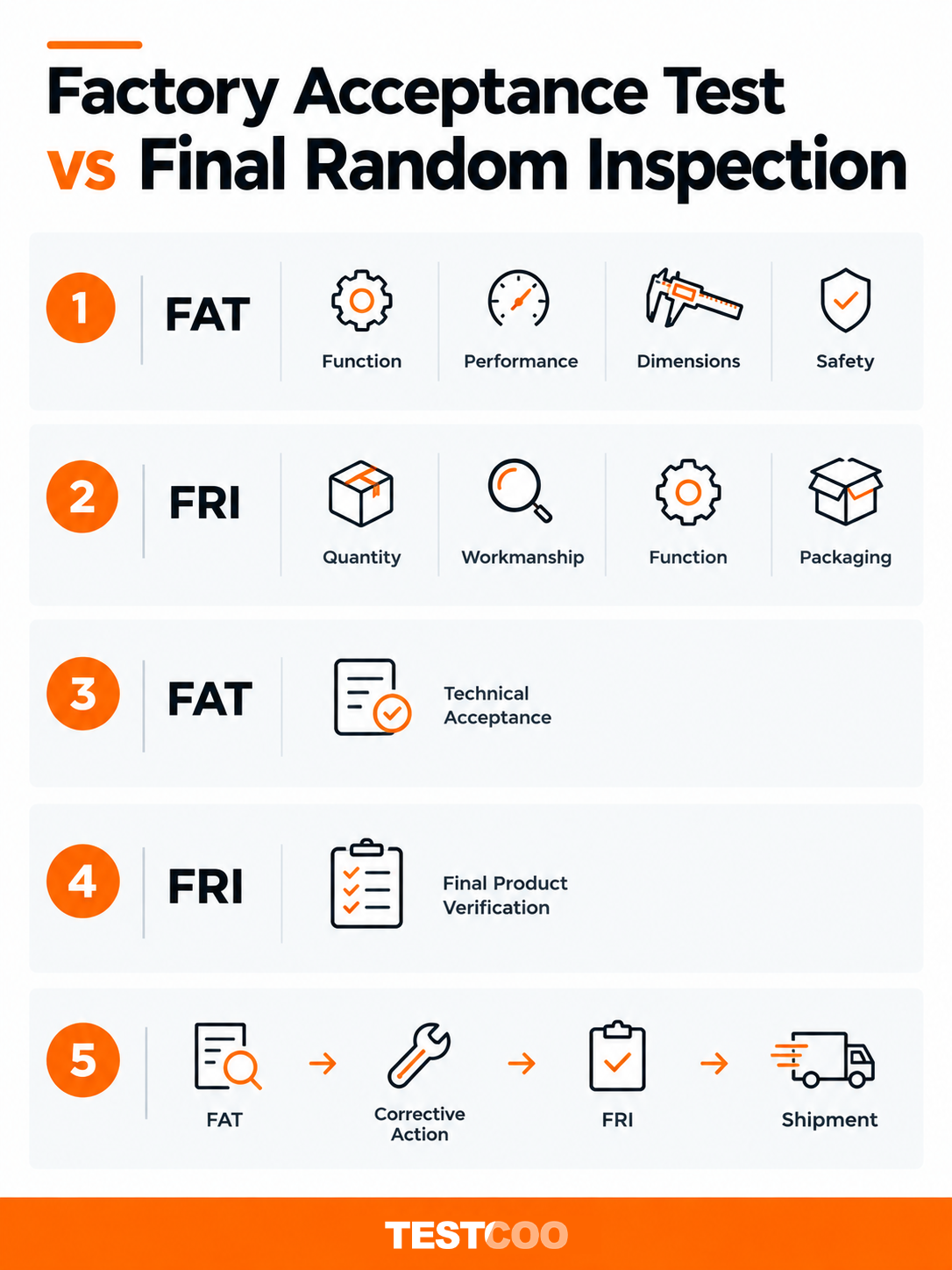
A factory acceptance test verifies whether a product or system performs according to predefined technical and functional requirements, while a Final Random Inspection checks finished goods before shipment to identify defects and confirm conformity with the buyer's specifications.
What Does a Factory Acceptance Test Verify?
A factory acceptance test is usually based on technical specifications agreed between the buyer and manufacturer. The inspection focuses on whether the product or system can perform its intended functions under defined test conditions.
Depending on the product, a FAT may cover functional performance, operating controls, dimensions, electrical characteristics, safety functions, materials, components and required documentation. The test criteria should be established before testing begins so that the supplier and buyer have a clear basis for acceptance.
For complex equipment, FAT may also involve operating cycles, performance measurements, alarms, interfaces, control systems, or other technical functions. The purpose is not simply to identify visible defects, but to demonstrate that the product performs as required.
What Does a Final Random Inspection Check?
A Final Random Inspection is conducted when production is substantially complete and finished goods are available for inspection. Inspectors randomly select samples from the completed production according to the agreed inspection plan and evaluate them against defined quality requirements.
Typical FRI checks include product appearance, workmanship, dimensions, quantity, functionality, labeling, packaging, accessories and other buyer-specific requirements. Depending on the product, inspectors may also conduct simple performance or safety-related checks within the scope of the inspection.
FRI provides a final quality checkpoint before shipment. It can identify defects that remain after production and give buyers an opportunity to request corrective action before goods leave the factory.
Read More: Final Random Inspection: Your Last Line of Defense Before Shipping
When Should Importers Use FAT Instead of Final Random Inspection?
FAT is particularly useful when acceptance depends on technical performance or functionality that should be demonstrated at the factory. This is common for machinery, electrical equipment, industrial systems and other technically complex products.
FRI is more appropriate when the main concern is whether finished goods conform to approved specifications before shipment. For many consumer products, both approaches can be useful at different stages. FAT verifies technical acceptance earlier, while FRI provides a final check on finished production and shipment readiness.
The two processes therefore address different quality risks rather than serving as direct substitutes.
What Should Be Included in a Factory Acceptance Test Checklist?
A practical factory acceptance test checklist should connect the buyer's specifications with measurable inspection points, test methods, acceptance criteria and documented results.
What Functional Tests Should Be Included?
Functional testing should verify that the product performs its intended functions under the conditions specified by the buyer or agreed test protocol.
Depending on the product, checks may include start-up and shutdown functions, operating cycles, controls, switches, displays, alarms, interfaces, response times, output performance and other functional requirements. For equipment, inspectors may also verify whether the machine operates consistently through defined operating sequences.
Each functional test should have a clear pass or fail criterion. Instead of recording only that a function was "checked," the checklist should identify what was tested, how it was tested, what result was obtained and whether the result meets the requirement.
Which Dimensional and Physical Checks Are Required?
Dimensional and physical checks verify whether critical product characteristics match approved drawings, specifications, samples, or tolerances.
Depending on the product, inspectors may measure length, width, height, thickness, diameter, weight, component position, assembly dimensions, or other critical characteristics. Appropriate tools can include calipers, micrometers, thickness gauges, scales, gauges and other measurement equipment.
The checklist should identify the required specification and tolerance rather than simply asking the inspector to record a measurement. This makes it easier to determine whether the measured result is acceptable.
Read More: The Essential Garment Inspection Checklist for Quality Control

What Electrical and Safety Checks Should Be Performed?
Electrical and safety checks should focus on requirements that can be verified through the agreed FAT procedure and available test equipment.
Depending on the product, these checks may include voltage, current, grounding, insulation, electrical connections, switches, protective functions, emergency controls, or other specified safety features. The exact tests should be determined by the product requirements and applicable standards rather than applying the same electrical checklist to every product.
Where compliance characteristics require specialized laboratory equipment or formal certification testing, those requirements should be handled through the appropriate testing process rather than treated as a simple visual inspection.
How Should Labeling, Packaging and Documentation Be Verified?
A FAT checklist should also cover the information and materials required for product acceptance. Inspectors can verify product labels, model numbers, serial numbers, warning marks, rating plates, manuals, drawings, operating instructions, accessories, packaging specifications and other agreed documentation.
Documentation review is particularly important for technical products because missing or incorrect documents can affect installation, operation, maintenance, or regulatory compliance even when the physical product appears acceptable.
How Should Test Equipment and Calibration Be Controlled?
Measurement and testing equipment should be suitable for the required inspection accuracy. Where calibrated equipment is required, the checklist should record the equipment identification and confirm that its calibration status is valid.
For critical measurements, the inspector should be able to trace the recorded result back to the equipment used during the test. This improves the reliability of the FAT record and provides stronger evidence if the test result is later reviewed by the buyer or supplier.
How Should a Factory Acceptance Test Checklist Define Sampling and Acceptance Criteria?
A FAT checklist should define how many units or samples are tested, which requirements must be met and what happens when a test result fails.
How Should the Sample Size Be Determined?
There is no single sample size that applies to every factory acceptance test. The appropriate approach depends on the product, production quantity, technical complexity, failure risk, contractual requirements and purpose of the test.
For equipment or machinery, FAT may focus on one completed unit or a defined number of systems because the product itself is being accepted. For mass-produced goods, the buyer may define a sampling plan based on production quantity and quality risk.
The checklist should therefore state the sample or unit identification clearly and link the tested item to the relevant production order, model, or batch.
What Acceptance Criteria Should Be Set Before Testing?
Acceptance criteria should be established before the FAT begins. They may include dimensional tolerances, functional performance requirements, electrical parameters, safety requirements, material specifications, visual standards, documentation requirements and other contractual conditions.
For each test, the checklist should make the acceptance requirement measurable wherever possible. For example, instead of writing "check performance," the checklist can specify a required operating range, output value, cycle time, dimensional tolerance, or other defined criterion.
This prevents disagreements after testing because the supplier and buyer are working from the same acceptance basis.
What Should Happen When a FAT Test Fails?
A failed FAT result should be recorded against the specific requirement that was not met. The record should identify the affected product or component, test result, observed nonconformity and required corrective action.
Depending on the severity of the failure, the buyer may require repair, replacement, adjustment, additional testing, or a complete retest. Critical failures should remain open until corrective action has been verified.
The final FAT record should clearly distinguish accepted requirements from open issues so that the buyer can determine whether the product is ready for acceptance or requires further work.
How Does FAT Compare With Final Random Inspection?
FAT and Final Random Inspection address different quality risks, so importers may use them at different stages rather than treating one as a replacement for the other.
Checkpoint | Factory Acceptance Test | Final Random Inspection |
Main purpose | Verify technical and functional acceptance | Verify finished goods before shipment |
Timing | Before final acceptance or shipment | When production is substantially complete |
Main focus | Function, performance, technical requirements | Quantity, workmanship, dimensions, function, packaging |
Test environment | Usually at the factory | Usually at the factory before shipment |
Sampling approach | Based on product and test requirements | Based on the agreed inspection sampling plan |
Witness testing | Common for technical or complex products | Not usually the central purpose |
Calibration records | Important when calibrated equipment is used | Relevant when measurement equipment is required |
Corrective action | Often linked directly to technical acceptance | Used to address defects before shipment |
Shipment readiness | May not be the main objective | One of the main objectives |
For consumer products such as toys, electronics, or textiles, FRI may be the more relevant final checkpoint because the focus is often on finished-product conformity. However, specific functional, electrical, chemical, or safety requirements may require additional testing or a product-specific FAT approach.
The appropriate inspection strategy depends on the product, purchase requirements, supplier risk and consequences of a quality failure. In some supply chains, FAT and FRI can work together as separate checkpoints within the same quality control process.
Frequently Asked Questions
1.What Is a Factory Acceptance Test Checklist?
A factory acceptance test checklist is a structured document used to verify whether a product, machine, or system meets agreed technical, functional, dimensional, safety and documentation requirements before acceptance. It defines test points, methods, acceptance criteria, results and corrective actions.
2.What Should Be Included in a FAT Checklist?
A FAT checklist can include functional tests, dimensional measurements, electrical and safety checks, labeling, packaging, documentation, calibration records and other product-specific requirements. Each checkpoint should have a defined test method and acceptance criterion.
3.What Is the Difference Between FAT and Final Random Inspection?
FAT focuses mainly on technical and functional acceptance, while Final Random Inspection evaluates finished goods before shipment. FAT is often used for complex products or equipment, whereas FRI commonly checks finished-product quality, workmanship, quantity, packaging and shipment readiness.
4.Who Should Conduct a Factory Acceptance Test?
A FAT may involve the manufacturer, buyer, buyer's technical representatives, or an appointed third party inspection company. For independent verification, a qualified third party inspector can perform or witness agreed tests and document the results against the buyer's requirements.
5.Can a Factory Acceptance Test Replace Laboratory Testing?
No. FAT can verify many physical and functional requirements, but it cannot replace specialized laboratory testing where compliance depends on chemical, material, safety, or performance characteristics that require laboratory equipment or standardized test methods.
How Can Testcoo Support Factory Acceptance Testing and Final Random Inspection?
Testcoo supports importers and OEMs with factory-based quality control services covering technical verification, product inspection and shipment readiness. Depending on the product and inspection requirements, trained inspectors can perform dimensional checks, visual inspections, functional tests, labeling and packaging verification, documentation reviews and other agreed inspection activities based on buyer specifications and acceptance criteria. Where product requirements involve characteristics that cannot be reliably verified through physical inspection, Testcoo can also coordinate relevant third party laboratory testing. Inspection findings can be documented through measurements, photographs, defect records and structured inspection reports, while buyers can manage inspection requirements, orders, scheduling, status and reports through Testcoo's online platform.. By combining appropriate inspection methods with trained inspectors and documented quality data, Testcoo helps buyers identify quality risks before shipment and maintain better control over supplier quality.




Free Sample Report Performance Quality Control
Download a sample report to keep control of your supply chain!

Featured Articles
 AQL Table | How to Read It
 TOP 10 Common Defects in Garments Quality Inspection
 Product Packaging and Shipment Label requirements for Amazon FBA
 What Is ASTM-F2413-18? Protective Footwear Standard
 How to Conduct Third-Party Quality Control Inspections for Electric Scooters
 SMETA Audit-What is SMETA Audit?
 TESTCOO Supplier Verification/Certification Service SLCP, Higg FEM, GRS, GOTS
 Quality Control Inspection Company in China
 What is Quality Inspection? A Complete Guide
 Guidelines for Product Inspection in India
Category
- Production Inspection Service
- Factory Audit
- Softline Inspection
- Hardline Inspection
- Electrics Inspection
- Certification
- Checklist
- Manufacturers
- Quality Assurance Basics
- Products Recall
- AQL
- Guidence and Standard
- News
- Supplier Management
- Amazon
- Protective Equipment
- e-commerce quality control
- Indian Manufacturing
- Soft Goods Quality Control
- Supply Chain Management
- Supply Chain Resilience
- E-Commerce Quality Control
- ISO 2859
- Supply Chain Optimization
- Garment Industry
- Higg Index